Grandma Rose raised me, protected me, and loved me fiercely for thirty years while carrying a secret heavy enough to reshape my entire identity. I discovered the truth hidden inside the lining of her wedding dress, sewn there carefully by hands that already knew one day I would need answers more than comfort. The strange…
Fiction. This story is a dramatized work created for entertainment. Names, characters, events, and circumstances are fictional.
Grandma Rose raised me, protected me, and loved me fiercely for thirty years while carrying a secret heavy enough to reshape my entire identity. I discovered the truth hidden inside the lining of her wedding dress, sewn there carefully by hands that already knew one day I would need answers more than comfort.
The strange thing is, I think part of her always wanted me to find it.
Grandma used to say some truths only become survivable once you grow strong enough to carry them without breaking apart beneath the weight.
I didn’t understand what she meant when I was younger.
I thought she was simply being poetic the way older people sometimes are when memory and pain have spent decades living together quietly inside them.
She said those words to me the night I turned eighteen.
We were sitting on her porch after dinner while summer cicadas screamed through the dark Tennessee heat and the old porch swing creaked softly beneath us. Grandma disappeared inside for a moment before returning with a long white garment bag she carried like something sacred.
Even before she unzipped it, I knew exactly what was inside.
Her wedding dress.
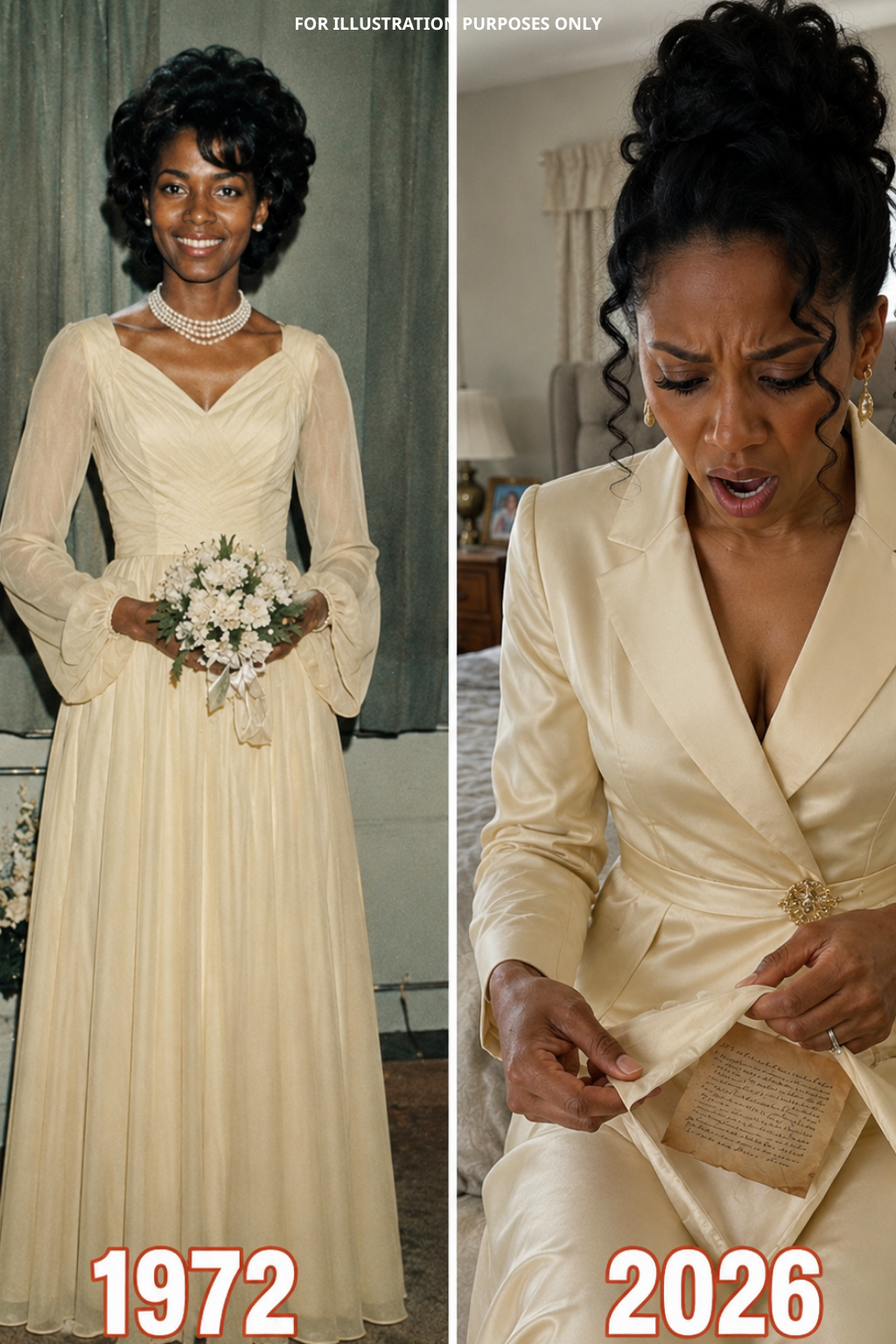
I had seen photographs of it my entire life. Delicate lace sleeves. Pearl buttons running down the back. Soft ivory satin aged slightly golden with time.
When she held it beneath the yellow porch light, her expression changed completely.
Not sad.
Not nostalgic.
Almost protective.
“You’ll wear this someday, darling,” she whispered.
I laughed automatically.
“Grandma, this thing is ancient.”
“It’s timeless,” she corrected firmly, smoothing one hand carefully over the lace. “Promise me something, Catherine.”
“What?”
“When the time comes, you’ll alter it yourself. With your own hands. And you’ll wear it.”
I smiled softly.
“Of course I will.”
But she kept staring at me with unusual seriousness.
“Not for me,” she added quietly. “For you. So you’ll know I was there.”
At the time, I didn’t understand why those words made my chest tighten slightly.
Now I do.
Because Grandma Rose never said things accidentally.
I grew up inside her little white house after my mother died when I was only five years old. My memories of my mother are fragmented and blurry now — perfume, soft hands, laughter echoing through a kitchen I can barely picture anymore.
As for my biological father…
According to Grandma, he disappeared before I was born and never looked back.
That explanation remained unchanged my entire childhood.
Whenever I asked questions, Grandma’s hands would suddenly become still. Her eyes drifted somewhere far away, somewhere painful enough that even as a child I learned not to push further.
And because she loved me so completely, I eventually stopped needing answers.
Grandma became everything.
She packed school lunches with handwritten notes folded inside napkins. Sat through every piano recital. Worked extra shifts at the diner when braces or textbooks became expensive. She kissed scraped knees, stayed awake through fevers, and somehow managed to make our little house feel safe even during years when money barely stretched far enough to survive.
She gave me a childhood so full of love that I almost forgot pieces of it had been built from loss.
As I grew older and moved to Nashville to build my own life, I still drove back every single weekend without fail. Sometimes we cooked together. Sometimes we watched old movies while she knitted quietly beside me. Sometimes we simply sat on the porch drinking tea while she told stories about neighbors I had known my entire life.
Home was wherever Grandma was.
Then Tyler proposed.
And suddenly life felt brighter than it ever had before.
I still remember Grandma crying when he slipped the ring onto my finger during dinner at her house. Real tears. The kind she laughed through instead of wiping away.
She grabbed both my hands tightly and whispered:
“I’ve been waiting for this since the day I first held you.”
For the next few months, wedding planning completely took over our lives. Grandma had opinions about everything — flowers, music, invitations, cake flavors. She called constantly with new ideas she pretended were casual suggestions even though we both knew she expected me to listen.
I loved every second of it.
Sometimes she would pause mid-conversation and say softly:
“You really are happy, aren’t you?”
And every single time, I answered honestly.
“Yes.”
Looking back now, I think she needed reassurance before leaving me behind.
Because four months later…
Grandma Rose was gone.
Peacefully.
Quietly.
One moment she existed inside the world exactly as she always had, and the next there was only silence where her voice used to live.

The grief hit me harder than losing my mother ever did because this time I was old enough to fully understand what disappearing meant.
I walked through her empty house after the funeral feeling physically lost. Her reading glasses still rested beside her favorite chair. A half-finished grocery list remained pinned to the refrigerator. Her sweater still hung behind the kitchen door carrying faint traces of lavender and soap.
Everything looked painfully alive without her.
A week later, I finally gathered enough strength to start packing her belongings.
That was when I found the wedding dress again.
It rested exactly where she always kept it, tucked carefully inside the back corner of her closet beneath tissue paper yellowed softly with age.
The second I touched the fabric, I started crying.
Not dramatic sobbing.
The quiet kind of crying grief turns into after exhaustion has already drained the body hollow.
I remembered her voice instantly.
“You’ll alter it yourself.”
So I carried the dress home.
Two weeks later, I spread the gown carefully across my apartment floor and began adjusting the lining to fit my frame properly. My fingers moved slowly because part of me felt terrified of damaging something she loved so deeply.
That was when I felt it.
A small bump hidden beneath the inner seam near the waistline.
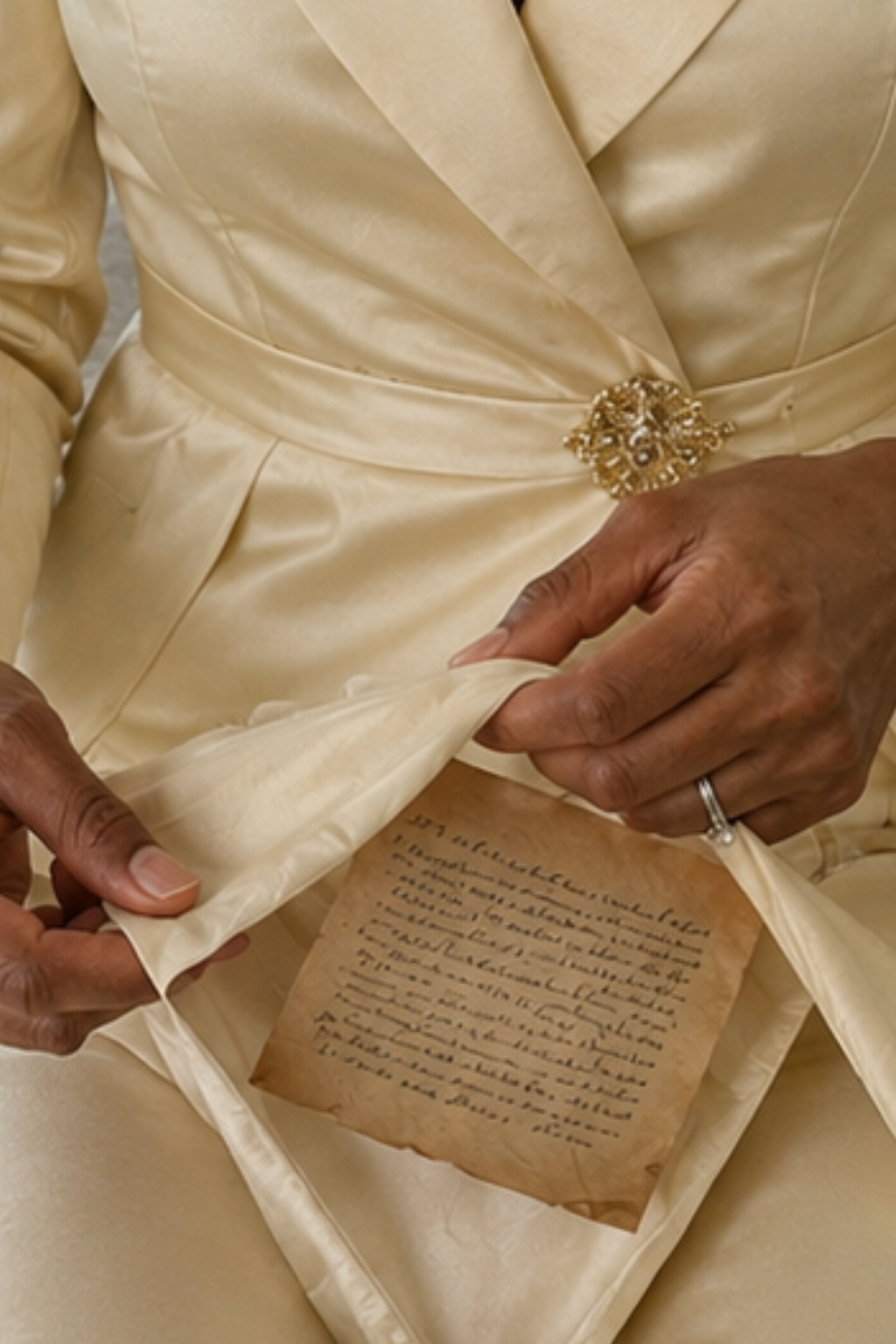
At first I thought it might be damaged stitching or old fabric padding. But when I pressed my fingers closer, I realized something solid had been sewn carefully into the dress itself.
My heartbeat started quickening immediately.
Confused, I reached for tiny sewing scissors and carefully opened the seam.
Inside the lining sat a hidden pocket so small it would have remained invisible unless someone intentionally searched for it.
And tucked inside…
was a folded letter.
My hands started shaking before I even opened it because the second I saw the handwriting, I recognized it instantly.
Grandma’s.
Careful.
Elegant.
Familiar enough that suddenly I could hear her voice inside my head again.
For several seconds, I simply stared at the envelope unable to breathe properly.
Why would she hide something there?
And why did she seem so certain I would eventually find it?
My chest tightened painfully while unfolding the paper.
Then I read the first sentence.
“There’s something I’ve hidden from you for many years, Catherine, but you deserve to know who your parents really were… and why I lied.”
Everything around me went silent.
Because suddenly the woman I trusted more than anyone in this world…
was telling me the story of my life had never been true at all.
I read the rest sitting on the floor with the dress across my knees.
“Your mother was not my daughter,” Grandma had written. “Her name was Marianne, and she walked into the diner on a February night when she was nineteen, six months pregnant, with a split lip and a bus ticket she could not afford to use. I was a widow with no children and a spare room. I gave her pie, and then I gave her the room, and she never left.”
“The man she ran from was your father. He did not disappear before you were born. She disappeared from him, and I helped her do it. He died in a prison in Kentucky when you were eleven. I checked every year until then.”
“When Marianne got sick and we knew she would not get better, she asked me to keep you. I had no right to you on paper. So when the county came, I told them I was your grandmother, and I said it so plainly that nobody asked twice. I have been afraid every day since that someone would.”
“That is why I lied, darling. Not because the truth was shameful. Because I could not have survived them taking you.”
I had to stop there for a while.
The last paragraph was written in a shakier hand, added later.
“I have no blood to leave you. I have this dress, which I wore to marry the only man I ever loved, and thirty years of mornings. You were never mine by birth. You were mine by every lunch I packed. I wanted you to find this with a needle in your hand, so you would know that families can be altered to fit, and that the stitching holds.”
I cried the way I had not let myself cry at the funeral. Then I read it again and found that nothing had moved. The porch was still the porch. The notes in my napkins were still in her handwriting. Every weekend I had driven home, I had driven home to her.
She had not taken the story of my life away. She had told me how hard she had worked to give me one.
I finished the alterations that month, with my own hands, the way I had promised. Before I closed the last seam I folded the letter back into its pocket and sewed it in.
On my wedding day I could feel it at my waist, a small flat weight, each time I breathed.
Tyler asked why I kept pressing my hand there.
“So I’ll know she was there,” I said.