
Fiction. This story is a dramatized work created for entertainment. Names, characters, events, and circumstances are fictional.
PART 1 — THE NIGHT THEY LOCKED US OUT
“The old man left you NOTHING, Claire! So take your son and get the hell out of my house!”
My mother-in-law screamed those words while she flung my twelve-year-old son’s belongings down the staircase, one armful after another.
A framed photograph of his late father hit the railing and burst apart, spraying jagged glass over the floor. My son, Wyatt, flinched backward. My husband did not move at all. Grant Kessler stood behind his mother and stared at the broken glass with the bored face of a man waiting on an elevator.
“Grant,” I whispered. “That’s Evan’s picture.”
He just shrugged.
“Then pick it up.”
Only three hours earlier, this same man had squeezed my hand in a probate lawyer’s office and promised we would get through my father’s death together. Now, in the entryway of the condominium we had shared for five years, he was ending our marriage because my father had left his entire fortune to my son. Not to me. Not to Grant. To a twelve-year-old boy. Apparently that meant neither Wyatt nor I was worth keeping.
I’m Claire Hensley, a forty-year-old paramedic from Norfolk, Virginia. Until that Thursday evening, I had believed that losing my first husband while he saved another man’s life was the worst thing that could ever happen to me.
I was wrong.
“Please,” I said, looking straight at Grant. “Can we at least go inside and talk?”
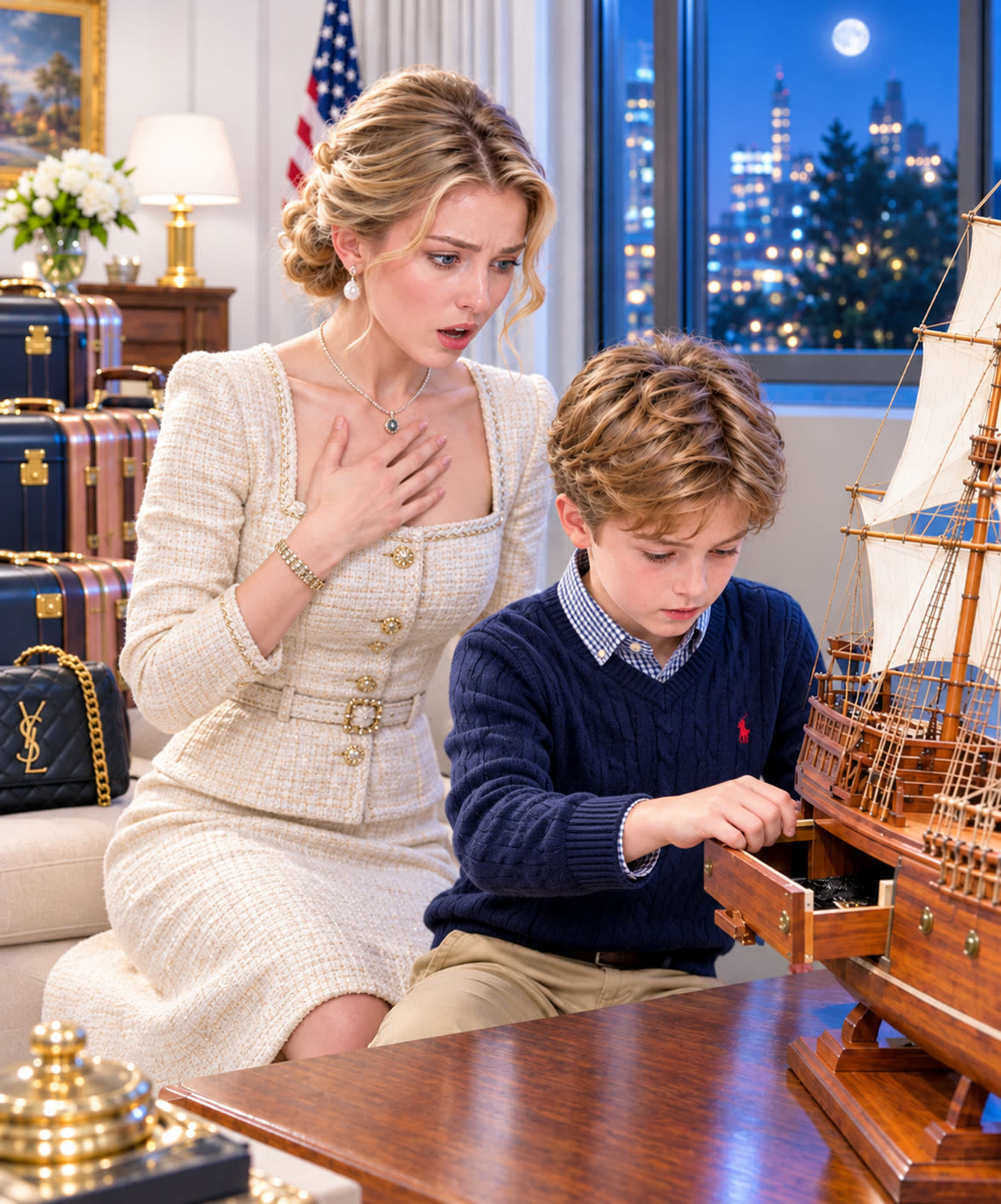
Marjorie stepped forward in her expensive silk pajamas. “Talk about what? Your father had millions, Claire. Millions! And he couldn’t leave his own daughter a penny? That should tell you something about what kind of woman you are.”
Wyatt bent down to pick up the cracked photograph.
“Don’t touch that garbage,” Marjorie snapped.
He froze. I moved between them.
“Don’t speak to him like that.”
“Oh, now you’re going to give me orders?” she laughed. “You’re standing on my property, sweetheart.”
I turned to my husband. “Tell her who paid for this condo.”
His jaw tightened. “Claire, don’t start.”
“My father gave your mother the money to buy it. Every dollar.”
“And the deed has my name on it,” Marjorie answered with a triumphant smirk. “Your father knew exactly what he was doing.”
Something unfamiliar flickered across her face. For a heartbeat she looked afraid. Then it was gone.
Grant folded his arms. “I’m not raising another man’s kid for the rest of my life. I’ve done my part.”
Wyatt lifted his head, and I saw the gray-blue eyes he had inherited from my father.
“Five years,” Grant went on. “Five years of paying bills, buying groceries, helping with school. I think I’ve earned the right to stop.”
I stared at him. “Earned? My son isn’t a business expense.”
He wouldn’t meet my eyes. “You’re making this harder than it needs to be.”
I had answered emergency calls for eighteen years. I had pulled children from crushed cars and held the hands of strangers while they died. None of it had prepared me to hear my husband describe my child like a bad investment.
Marjorie dragged another suitcase into the corridor. “Keys,” she demanded.
I didn’t move.
“Now, Claire.”
Grant reached for my handbag, and I jerked it away. “Don’t touch me.”
He raised both palms. “Fine. Keep the keys. The locks are getting changed.” A smile spread across his face, the same smile that once made me feel safe. “We can discuss divorce paperwork through my attorney.”
Then Wyatt spoke up, in a small voice. “Grandma Marjorie?”
She turned with obvious impatience. “What?”
“Can I have the little tugboat Grandpa made me?”
Her mouth twisted. “The stupid wooden thing?”
“Please.”
She disappeared into his bedroom and came back with a miniature harbor tugboat, navy-blue hull, white wheelhouse, yellow smokestack. Dad had built it to look like the first commercial boat he ever bought, back when he started his marine transportation business. I had always worried that its delicate brass mast would snap.
Marjorie threw it at Wyatt. He barely caught it, and the mast bent against his chest.
“There’s your inheritance,” she sneered. “A toy boat.”
Wyatt hugged it tight. “Thank you,” he whispered.
Grant let out a quiet laugh. “Unbelievable.”
He shut the door. Two deadbolts slid home.
Within seconds, my son and I were homeless. Neither of us moved for almost a minute. Rain hammered the windows at the far end of the hallway.
Then Grant’s voice drifted through the door, and the lazy calm was gone. He sounded desperate.
“Listen, Vince, the money’s locked up! The kid got everything. There’s a trustee involved. I can’t touch it!”
A pause.
“Don’t threaten me. I said I’ll figure it out!”
Another pause.
“Give me thirty days!”
My stomach knotted. Who was Vince? What had made Grant so desperate for Dad’s fortune? And why did he sound so frightened?
“Mom?” Wyatt tugged gently at my sleeve. “We should leave before Grandma comes back.”
Every instinct told me to scream and pound on that door until Grant opened it. Instead I wrapped Wyatt’s ruined photograph in my scarf, gathered our bags, and led my son into the storm.
We had nowhere to go. My bank account held less than three hundred dollars, and payday was a week away. Grant had always insisted on handling most of our savings, so I couldn’t pull a cent from the joint emergency account.
By eight o’clock we reached Norfolk’s EMS headquarters. My supervisor, Denise Carter, quietly let us into the crew rest room and brought sandwiches. She didn’t ask for explanations. Her eyes moved from Wyatt’s soaked shoes to our luggage and finally to my face.
“You and that boy are staying somewhere safe tonight,” she said. “We’ll deal with everything else tomorrow.”
Wyatt curled up on a spare cot, clutching his damaged boat. I thought he had fallen asleep.
At 2:13 a.m., he suddenly sat bolt upright.
“Mom?”
“Yes, sweetheart?”
“Grandpa told me this was going to happen.”
I stared at him. “What?”
He climbed off the cot. “He said Grant and Grandma would throw us out as soon as they found out about the inheritance.”
My mouth went dry. “When did he say that?”
“Before he went to the hospital.” Wyatt set the little boat between us. “He made me promise not to tell you until it happened.”
“Tell me what?”
He looked me in the eye. “Grandpa gave me something. He said it could save us.”
Wyatt grasped the yellow smokestack, twisted it counterclockwise, and exposed a hidden compartment beneath the deck.
Inside lay two brass keys, a sealed envelope, and a tiny black flash drive.
On the envelope, in Dad’s unmistakable handwriting, were seven words:
CLAIRE — IF THEY THREW YOU OUT, READ THIS.
Beneath them was something far more chilling. A date.
Dad had written that letter six months before he died. He hadn’t merely guessed that Grant would betray me. He had planned for it. And whatever was inside that envelope mattered so much that he had trusted a twelve-year-old child to guard it, in secret from everyone.
Even from me… 👇
PART 2 — WHAT MY FATHER HID INSIDE A WOODEN TUGBOAT
All my life I had seen Dad’s handwriting. On shipping manifests, birthday cards, medical forms, grocery lists scribbled on scrap paper. None of it had ever frightened me the way that envelope did.
I tore it open. Inside were three handwritten pages, a folded legal agreement, and a business card.
The letter began:
Claire,
If this letter has reached you, Grant has finally shown who he really is.
I wish I could have protected you without hurting you.
Your husband has been waiting for my death for the past five years, and his mother has helped him every step of the way.
I had to stop. Five years? Since the very start of our marriage? Wyatt watched me in silence, and I forced myself to keep going.
I left my estate to Wyatt because an honest, independent trustee would never allow Grant to spend a child’s inheritance on his car dealership. If I had given everything to you, he would have used your love for him against you. You would have tried to save your marriage, believed his promises, and lost everything.
You had to discover the truth yourself.
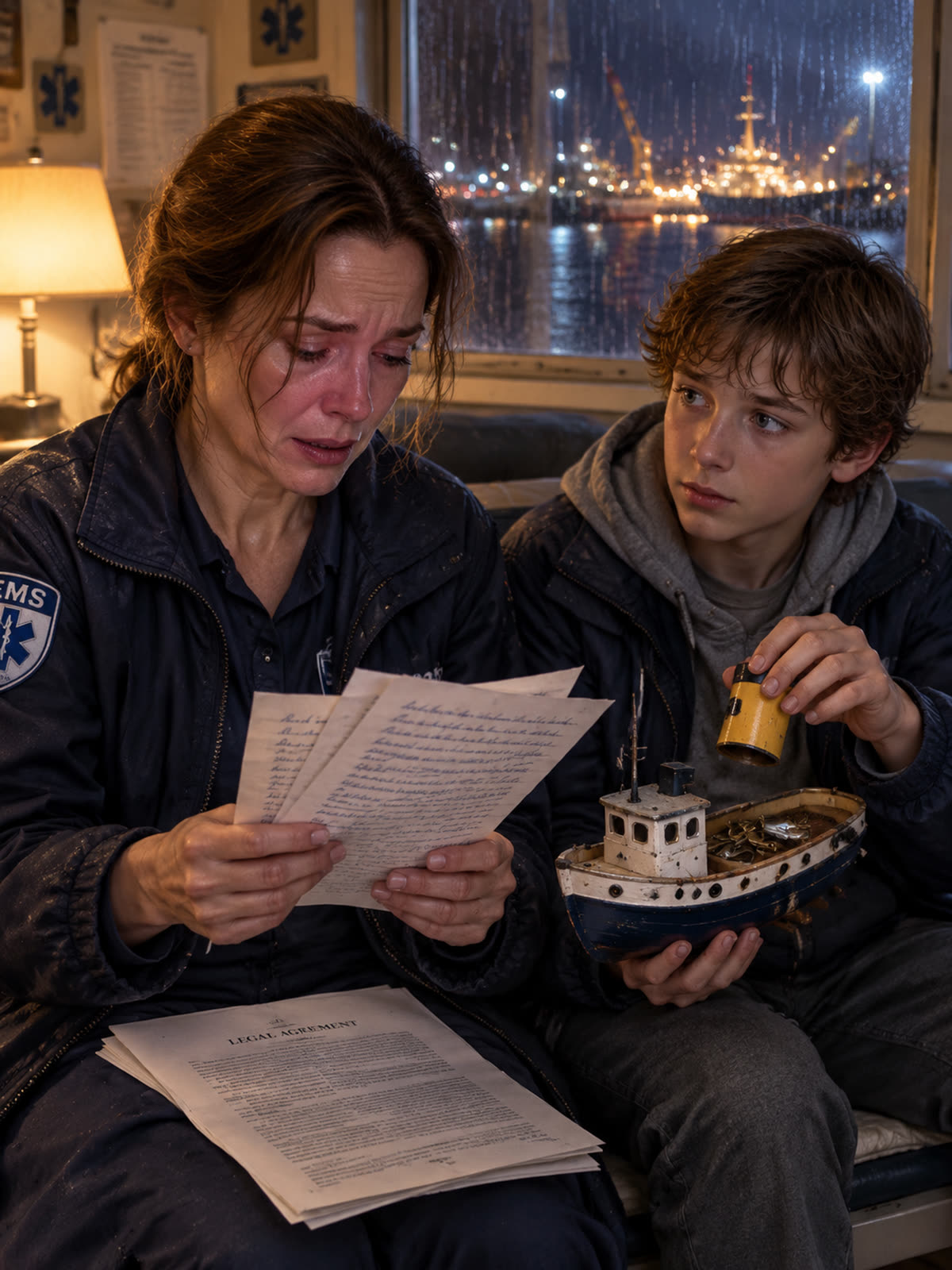
The words blurred through my tears. My father, Thomas Marlow, had never been a gentle man. He had started with a rusting tugboat and a few borrowed tools and built Marlow Harbor Services into a multimillion-dollar marine transportation company. He began work before sunrise, paid his debts before buying luxuries, and read every document twice before signing. He had also decided he was a failure as a father when I married Evan Hensley at nineteen.
Evan was a mechanic on one of Dad’s tugboats. My father suspected he was after our money. I thought Dad was an arrogant businessman who couldn’t imagine his daughter loving someone without a fortune. We didn’t speak for nearly four years.
Then Evan died saving a dockworker trapped between a barge and a pier. Wyatt was three. Dad came to the funeral uninvited. When the other mourners had gone, he walked toward me with open arms.
“Let me hold my grandson.”
He held Wyatt for almost ten minutes. Then he said something I never expected to hear from him. “I was wrong about his father.”
It was the first time I had ever seen my father cry. After that, Wyatt followed him everywhere. They repaired engines, fished along the Elizabeth River, and built tiny boats on rainy afternoons. To Dad, Wyatt was Captain. To Wyatt, Dad was the Old Admiral. I never realized their time together also held lessons in protecting our future.
I went back to the letter.
First, the condominium. Because Marjorie’s name is on the deed, she believes it is hers free and clear. It is not. I provided $460,000 for the purchase. She wanted it treated as a gift, but I made her sign a loan agreement. The original is enclosed. It requires repayment within thirty days of a written demand. I never made that demand. The debt now passes to my estate, and eventually to Wyatt’s trust.
I unfolded the legal document with shaking fingers. Everything was there: Marjorie’s signature, the loan amount, the date, her written promise to repay. For years she had bragged that Dad bought the condo because he admired her business sense. Clearly he had admired it enough to insist on a contract.
Second, Grant’s debts are far more serious than you know. He came to my hospital room and asked me to sign blank documents. I refused. If he produces papers claiming I owed him money, fight them. I’ve left a sworn statement and genuine samples of my signature. For two years I have added a tiny ink dot under the first letter of my name. My lawyer knows. Grant does not.
Third, take the flash drive to Simon Halbrook, a retired judge and my oldest friend. He will know what to do.
Fourth, these keys open my townhouse in Ghent. Under the trust, you and Wyatt may live there throughout his childhood. Our neighbor Florence Doyle is expecting you and has agreed to help.
Then came his closing words.
I couldn’t explain this to you while I was alive. You stood up for Evan when I judged him, and you were right. You also defended Grant when I voiced my doubts. I was afraid of another estrangement. My heart is failing, Claire. I couldn’t lose another four years with you.
So I built one last chance for you to see the truth. If Grant stayed loyal after you received nothing, I would have known I was mistaken. If he abandoned you, you would be free.
I love you, my daughter. I’m sorry I didn’t say it more often.
Dad.
I pressed the pages to my lips. For years I had believed his stubbornness was about controlling me. Only now did I understand how deeply he feared losing his daughter again.
Wyatt rested a hand on my shoulder. “Are you mad at Grandpa?”
“No.”
“Because he didn’t leave you the money?”
I pulled him into my arms. “Sweetheart, your grandfather gave me something more important.”
“What?”
“The truth.”
For the first time that night, I let myself cry. Not over Grant. Not over the lost home. I cried because even with his heart failing, my father had spent his last months protecting me.
The next morning Denise drove us to Ghent. Dad’s three-story brick house sat on a quiet street shaded by huge oaks. I unlocked the door with the first brass key and stopped dead.
The hallway drawers had been dumped out. Books lay scattered across the floor and cabinets hung open. In the study, the cushion beneath his antique desk had been slashed and framed photographs torn apart. Wyatt stepped carefully over the strewn papers.
“Mom?” His voice was barely there.
Dad’s old captain’s hat lay crushed beneath an overturned chair. Someone had ripped the whole house apart, sure that he had hidden something valuable inside.
Florence Doyle appeared in the doorway, a woman of seventy-eight and barely five feet tall. She gasped at the wreckage. “Oh, Claire. They came back?”
I spun around. “Who came back?”
She gripped the doorframe. “Your husband and his mother. They were here twice after the funeral.”
A chill ran through me. “Did they say what they wanted?”
“Documents. They said they were collecting documents for you.”
“Did they find anything?”
“No. But the second time, I heard your husband yelling.”
“What did he say?”
Florence swallowed. “He said, ‘That old bastard couldn’t have hidden it from us. Somebody has the evidence.’”
Wyatt’s hold on the tugboat slowly tightened. I looked down at him. Dad hadn’t locked his evidence in some bank vault. He had hidden it inside the one thing Grant and Marjorie considered worthless.
And they had practically thrown it into our hands.
I changed every lock in the house that day and phoned Reese Latham, the attorney handling Dad’s estate. Then I called Simon Halbrook. He lived near Williamsburg in a house crammed with books, maritime charts, and photographs of fishing boats. He opened the door in a faded Navy sweatshirt, and his face softened when he saw Wyatt.
“Well, I’ll be damned. Little Thomas.”
Wyatt blinked. “My name’s Wyatt.”
Simon smiled sadly. “You’ve got your grandfather’s eyes, son.”
In his study I spent two hours telling him everything: the inheritance, the eviction, the wrecked townhouse, the secret compartment, Dad’s letter. Simon studied the documents and tapped Marjorie’s loan agreement. “Your father was a careful man.”
“Can we get the condo back?”
“Not automatically. Marjorie owns it. But the estate has a strong claim against her, and we can pursue repayment through the courts.”
He examined the signature samples, then turned to the flash drive. “Have you listened to it?”
“Not yet.”
He plugged it in. Forty-one audio recordings appeared, most of them numbered. When he opened the first, Dad’s voice filled the room.
“First winter I worked the harbor, the ice froze right around the tug’s rudder…”
My hand flew to my mouth. It was as if he were alive. Dad described storms, engine failures, and sailors he had loved like brothers, until Simon paused the file.
“Your father knew how much this family meant to him,” he said. “He also knew you wouldn’t believe anyone who told you your husband was dangerous. Listen to every recording. Somewhere in there is the reason he hid it.”
He introduced me to his daughter, Audrey Halbrook, a litigator who specialized in estate disputes. She agreed to protect Wyatt’s interests alongside Reese. I left that night feeling we finally had a direction.
Nine days later, Reese called. “Claire, I need you to sit down.”
“What’s wrong?”
“Grant has filed a creditor’s claim against your father’s estate.”
I closed my eyes. “How much?”
“One million, two hundred and fifty thousand dollars. He says your father borrowed it privately and signed a promissory note.”
“That’s impossible.”
“He submitted a signed document. Audrey needs to see it immediately.”
An hour later the file landed in my inbox: a single typed page, an enormous sum, and a signature remarkably close to Dad’s. But not identical. There was no ink dot.
Then I saw the date and went still. October 3. The day I had driven Dad to the hospital after his final heart emergency. According to the document, he had taken the cash at his townhouse at eleven that morning. In truth he had been unconscious in intensive care, and he never left the hospital alive.
Without realizing it, Grant had picked the one date that could destroy his entire lie.
I called Audrey. “I can prove he lied.”
“Claire, don’t confront him,” she said. “Preserve the document and let us collect the medical and emergency records. Someone willing to forge a million-dollar debt may do far worse when the forgery fails.”
She was right. The next morning Child Protective Services called me. Someone had reported that I was homeless, emotionally unstable, and neglecting Wyatt by leaving him alone on night shifts. The complaint specifically mentioned our night at EMS headquarters.
I knew instantly it was Marjorie.
I cooperated fully and restricted Wyatt’s school pickup to myself and approved adults. Two hours later the school phoned again. An older woman had called pretending to be from CPS, asking whether Wyatt seemed hungry, frightened, or poorly dressed. The school had refused to say a word. When I contacted CPS, they confirmed she wasn’t one of theirs.
Then my husband called.
“Claire, sweetheart. We need to stop fighting.”
His sweet tone turned my stomach. “What do you want?”
“Come home. We can work things out.”
“You threw my son into the rain.”
“Mom got emotional.”
“You told Wyatt he wasn’t your responsibility.”
“I said things I regret.”
I stayed silent until his voice shifted. “There’s a legal solution to all this.”
“Which is?”
“You challenge the will. Say your dad wasn’t mentally competent when he signed it.”
I stared at the phone. “Why would I do that?”
“Because the estate should belong to you. You’re his daughter.”
“And then?”
“We negotiate the disputed debt. I withdraw my claim, we settle everything, and we stay married.”
His plan was crystal clear. He wanted me to wreck Wyatt’s inheritance so he could pry the fortune out of my hands.
“What about the CPS complaint?” I asked.
He hesitated. “Mom can straighten that out.”
In those few words was a confession. Through the kitchen doorway I could see Wyatt doing math homework at Dad’s desk.
“I’m not sacrificing my son to save your dealership.”
Grant’s voice turned to ice. “Then don’t expect me to save you when the court takes that house.”
He hung up.
That night I stayed up until nearly three, working through the recordings. At the start of file twenty-eight, I heard hospital machines. Then Grant’s voice.
“Thomas, it’s just paperwork. Sign at the bottom. We’ll fill everything else in later.”
Dad answered calmly. “I built a company from a sinking boat, Grant. I didn’t do that by signing blank paper.”
Grant chuckled. “Don’t make this difficult.”
A chair scraped the floor, and then Grant said something that froze my blood. “You won’t be around forever, Thomas. And when you’re gone, Claire will do whatever I tell her.”
Dad’s voice rose. “Get out.”
After a long silence, Grant spoke again. “Your signature is beautiful, Thomas. Good thing my mother kept that birthday card you signed.”
The recording ended. I couldn’t move. I had just learned where the forged signature came from, and who Grant’s partner was.
Marjorie.
I thought the worst was behind me. Then, three days later, I went to work and found Denise waiting outside the medical director’s office, her face grim.
“Claire, you need to come inside.”
An anonymous letter addressed to state health officials sat on the desk. It claimed I had been stealing controlled medications from ambulances and selling them to fund my supposedly unstable life. It mentioned Dad’s death, my eviction, and my money troubles, details very few people knew.
The medical director looked miserable. “Claire, until we investigate, we have to pull you from any field duty involving controlled substances.”
My knees nearly gave out. Grant had gone after my marriage, my home, my child, and my father’s legacy. Now he was coming for the career I had spent eighteen years building.
He no longer wanted only the money. He wanted to destroy every reason a court might have to trust me with Wyatt.
PART 3 — THE FRIDAY MORNING GRANT’S WORLD COLLAPSED
Pending the investigation, I was moved from the ambulance to dispatch. Colleagues who once trusted me with critically ill patients now lowered their eyes and whispered when I walked past. One even asked whether I had been arrested. I didn’t scream. I demanded a full audit of every controlled drug from my shifts: administration records, recorded doses, disposal witnesses, surveillance footage.
“If somebody thinks I stole something,” I told the medical director, “then check every single record. I don’t want a partial investigation.”
For almost two weeks I helped investigators reconstruct my records. Every vial was accounted for. No missing drugs, no discrepancies, no theft. Still, the shame lingered, until Denise showed up with a copy of the complaint and pointed to one line. She regularly carries stolen medication in a blue insulated lunch bag.
“I don’t own a blue lunch bag,” I said.
“You did last summer,” Denise said, and the memory came back: the old insulated bag I had used for a week to pack Wyatt’s day-camp lunches. “And do you remember who covered administrative work at our station that week? Marla Bell. She used to work in medical billing. Before that, she worked at a bridal boutique.”
“Marjorie’s boutique?”
“They’ve been friends for thirty years.”
We handed the information to investigators. Marla denied it at first, then confessed that Marjorie had dictated the accusations and talked her into sending the letter. My employer cleared me of theft, misconduct, and missing medication, and the medical director apologized publicly. I accepted it, but I couldn’t forget how easily one lie had shaken eighteen years of trust.
Around the same time, CPS closed its case. Caseworker Patricia Langford toured the townhouse and found Wyatt’s room tidy, his homework organized, the refrigerator full, and reliable childcare arranged for every night shift. “Ms. Hensley, I don’t see neglect. I see a mother who has gone to extraordinary lengths to keep her child safe.”
Not long after, Grant’s creditor claim reached court. Audrey walked into the Norfolk courthouse carrying two thick binders. Grant appeared in a rumpled suit with hollow eyes. He smiled at me, but his fingers trembled as he straightened his tie. His lawyer presented the original promissory note and insisted Grant had handed Dad the cash personally at eleven that morning.
Audrey rose. “Your Honor, the estate disputes the authenticity of this instrument, and we have evidence that the alleged transaction could not have happened as described.”
She presented certified emergency records. An ambulance had been dispatched to Dad’s townhouse at 6:52 a.m. He reached the hospital before eight in critical condition and never went home. At eleven, when Grant claimed to deliver the money, Dad lay unconscious in intensive care. She showed genuine samples of Dad’s signature, each with his secret ink dot. The disputed note had none. Then she played the hospital recording. The whole courtroom heard Grant pushing Dad to sign blank pages, mentioning the birthday card, and boasting that he would control me after my father was gone.
The judge ordered the note preserved for forensic testing and rejected Grant’s demand for immediate payment. Outside the courtroom, Grant cornered me.
“You think you’ve won?”
I met his eyes. “I think you’ve been lying for a very long time.”
His face twisted. “You have no idea what I’m dealing with.”
“Then stop making it my son’s problem.”
He grabbed my wrist. Audrey stepped in. “Remove your hand from my client.” Grant let go, and in his eyes I saw something that wasn’t fury. It was terror.
That evening Denise called. “Claire, you’re going to want to hear this.” Marla, now cooperating with investigators, had revealed that Marjorie was furious about the estate’s repayment demand. With the thirty-day deadline closing in, she had arranged to transfer the condominium to her younger sister, Pamela, before any collection could begin.
“She thinks if she gives it away, there won’t be anything left for your son’s trust to recover.”
The transfer was set for Friday morning, less than forty-eight hours away. I told Audrey at once, and she answered firmly. “Claire, we’re filing for emergency relief.” I looked at Dad’s picture above the fireplace and smiled for the first time since his death. Marjorie had forgotten something. Dad had spent forty years dealing with people who dodged their debts, and he taught me never to threaten consequences unless I was ready to enforce them.
Friday began under a heavy, concrete-gray sky. At 8:30, Audrey filed the estate’s collection lawsuit and an emergency motion to block the transfer. Before noon, the court temporarily forbade it. At 10:57, I walked into the county administration building with a certified copy of the order.
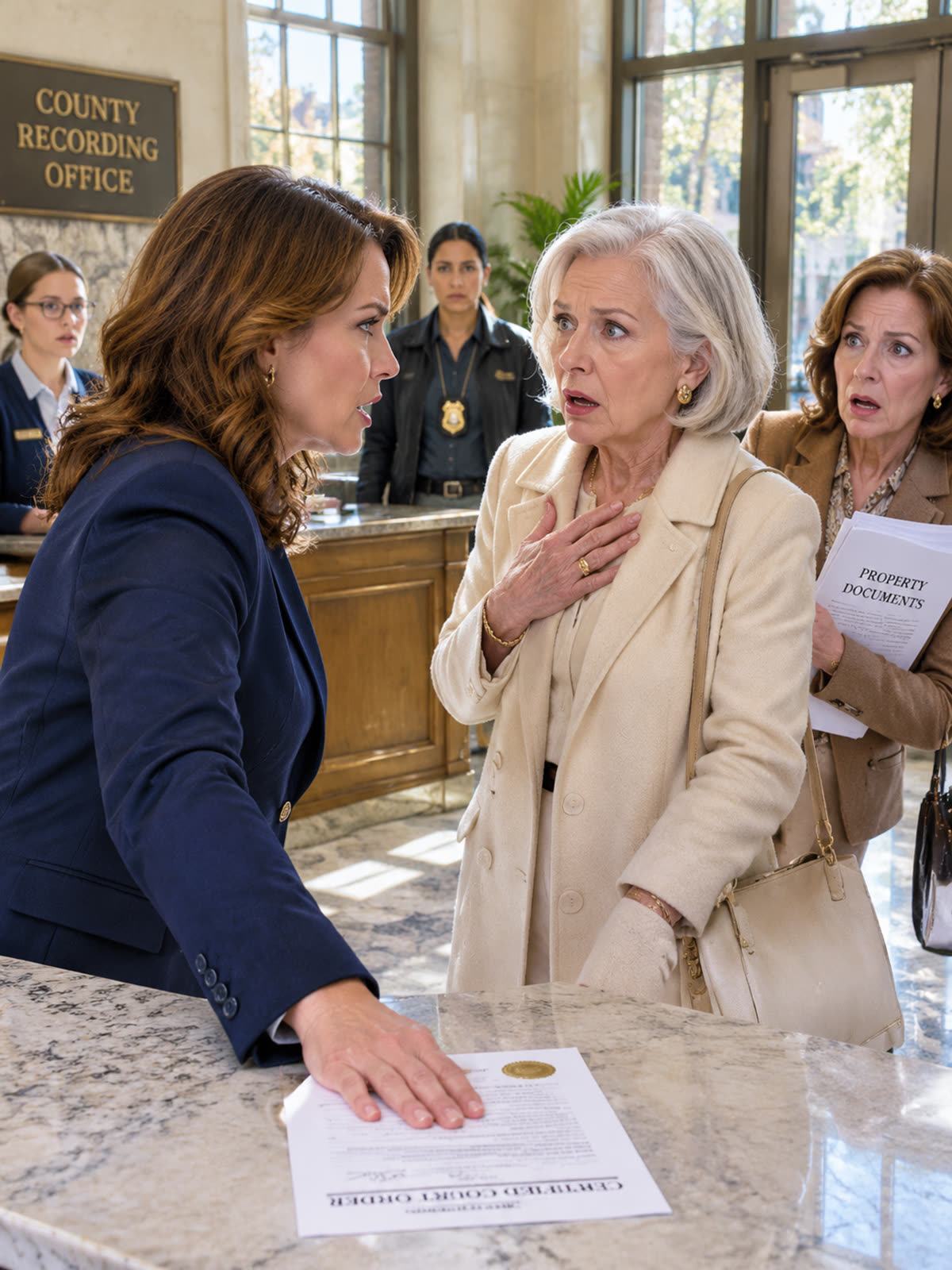
Marjorie stood at the recording counter beside Pamela, wearing a luxurious cream coat and a delighted smile. It vanished when she saw me.
“What are YOU doing here?”
I laid the order in front of them. “Stopping you from transferring property to escape a debt.” Pamela looked bewildered. “What debt?” Marjorie seized her arm. “Don’t listen to her. She’s been harassing me for months.”
I spoke directly to Pamela. “My father paid for that condominium. Marjorie signed an agreement to repay him. The estate has demanded payment, and she’s trying to put the property in your name to keep it out of reach.”
Pamela read the order, then looked at her sister. “You told me it was a gift.”
“It is!”
“You told me we’d put it in my name temporarily and change it back later.”
Marjorie went pale. “Pamela, lower your voice.”
Pamela stepped away. “Are you using me to hide property from a court?”
“Don’t be ridiculous.”
But Pamela had already turned to the clerk. “I’m withdrawing from this transaction.”
“Pamela!”
“I said I’m not signing anything!”
Everyone in the room was watching. Marjorie looked ready to explode. “You did this!” she screamed at me.
“No, Marjorie. You did.”
A familiar voice sounded behind us. “Mrs. Kessler?” Detective Celia Ortega approached with another investigator. “I’d like to speak with you about an ongoing forgery investigation.”
Marjorie fell silent. For once, she had nothing to say.
Two hours later, with a police civil standby arranged, Wyatt and I went to the condominium to collect the belongings withheld since our eviction. He wanted his winter boots, his school awards, and Evan’s acoustic guitar. Grant was sitting in the living room, unwashed, red-eyed, empty bottles scattered across the coffee table.
“Well,” he muttered. “The little prince comes home.”
Wyatt ignored him, went into his old bedroom, and pulled his father’s guitar from behind a stack of boxes. Marjorie glared from the kitchen. “You’ve ruined this family.”
I looked around the luxurious room. “No. We were never family to you. We were a business opportunity.”
Grant lurched to his feet. “Don’t talk to my mother like that!”
Three hard knocks cut him off. Detective Ortega entered with two officers and held up a search warrant. “Grant Kessler, we need you to stay where you are.”
He froze. “What is this?”
“Toby Merrick has given investigators a detailed statement. We also recovered materials used to copy Thomas Marlow’s signature, including traced samples and document templates, and records connecting Mr. Merrick to earlier transactions involving Rachel Wynn’s family.”
I had met Rachel weeks earlier, Grant’s first wife, in a Fredericksburg kitchen. She had told me how he married her soon after her father died, then convinced her that her father owed a debt to one of his associates, with a signature to prove it. She sold her father’s house to pay it. She had spent ten years believing she was stupid, and she told me she once saw a designer named Toby tracing her father’s signature from an old birthday card. She had been willing to tell a detective everything.
Marjorie clutched the counter. “No…”
“We also have authority to search for the birthday card bearing Mr. Marlow’s signature,” Ortega said.
Marjorie closed her eyes. Grant suddenly shouted. “Mom, tell them! Tell them it was your idea!”
Her eyes snapped open. “My idea?”
“You told me to marry Claire! You told me her father was worth millions!”
“Because you said you’d take care of me!”
“You gave Toby that birthday card!”
“YOU asked for it!”
They screamed over each other until five years of calculated dishonesty poured out. Marjorie had pushed Grant to pursue me because I was expected to inherit Dad’s wealth. His dealership was failing and his creditors wanted payment, and he planned to talk me into funding it. When Dad fell ill, Grant looked for ways to seize the estate without my consent. After Dad died, he ordered Toby to forge a promissory note using the birthday-card signature. The will naming Wyatt had ruined everything.
Marjorie dissolved into tears. “I only wanted my son to have a better life.”
“You already had a home,” I said. “You had food. You had people who cared about you. You wanted my father’s money more than you wanted your own grandson to have somewhere safe to sleep.”
“He’s not my grandson,” she whispered.
Silence fell. Wyatt stood beside me holding Evan’s guitar, and I rested my hand on his shoulder. “You’re right,” I said quietly. “He isn’t.”
Grant turned to me. “Claire, please. You know I loved you.”
I looked at the man who had comforted me at Dad’s funeral, watched our belongings fly down a staircase, and frightened my child for guarding his grandfather’s last gift. “No,” I said. “You loved what you thought I was worth.”
Ortega arrested him on charges tied to the fraudulent paperwork. As officers led him out, he paused. “Claire? We had five years.”
“We did.”
His voice cracked. “Wasn’t any of it real?”
I thought of the flowers, the holidays, the promises. Then I thought of Dad spending his final months keeping us safe. “Whatever you felt,” I answered, “it wasn’t enough to make you treat my son like a human being.”
Grant bowed his head, and the officers took him away.
Months later, forensic analysis confirmed that the signature on the million-dollar note had been traced, not written by Dad. The estate defeated Grant’s claim. He pleaded guilty to forgery and fraud-related charges and went to prison. Toby assisted prosecutors. Marjorie faced criminal proceedings for supplying the signature and organizing the false allegations, ending in probation and a ban on further harassment, and the estate won its civil case against her. Under court supervision the condominium was sold, with the recoverable proceeds going to Wyatt’s trust. My divorce became final. Rachel came to Grant’s sentencing and hugged me outside the courthouse. “I spent ten years believing he was smarter than I was,” she whispered.
“He was just better at lying,” I said, and she smiled through tears, finally at peace.
I stayed a paramedic, and we stayed in Dad’s townhouse. Florence brought cookies whenever Wyatt had a rough day at school. Simon taught him to fish. Every Sunday, my son and I built model boats at Dad’s workbench. On a warm Saturday in May, we finished the passenger ferry Dad had never painted. Wyatt carefully lettered his late father’s name along the hull: EVAN HENSLEY.
We carried it to a quiet stretch of waterfront near where Evan gave his life for a stranger. Sunlight danced on the Elizabeth River, and somewhere far off a real tugboat sounded its horn. Wyatt lowered the ferry into the water on a thin line. We were silent for a while. Then he looked up.
“Mom? Do you think Grandpa knew everything was going to happen?”
I thought of the letter, the keys, the recordings, the signature samples, the little wooden boat full of his last safeguards. “No,” I said. “I think he knew what kind of people we were dealing with. But he couldn’t know every choice they would make.”
“Then why did he trust me with the boat?”
I knelt beside him. “Because he knew you would protect something important.”
“The money?”
I smiled gently. “No, honey. He knew you would protect the truth.”
Wyatt leaned against my shoulder and said something I will remember forever. “Grandpa told me a real captain doesn’t abandon his crew. And you’re my crew, Mom.”
Tears filled my eyes, and for once I let them fall. I had lost Dad, my marriage, and the illusion of a family that would always stand by me. But I had found something worth more than any inheritance. Love isn’t measured by the promises people make when you’re comfortable. It shows in the ones who refuse to leave when you have nothing.
Dad understood that. Wyatt understood it too. And at last, so did I.
Disclaimer: This story is a work of fiction inspired by real-life themes. Names, characters, places and events are fictionalized, and any resemblance to real persons is purely coincidental. Images are for illustration purposes only.