Fiction. This story is a dramatized work created for entertainment. Names, characters, events, and circumstances are fictional.
Part 1: The Children at the Window Table
Adrian Bell had his fingers laced through another woman’s when his eyes landed on our children for the very first time.
It happened while I was laughing, which felt almost cruel looking back. My daughter, Willa, had just declared that crème brûlée was “fancy pudding for people who own too many napkins,” and her twin brother, Ben, was earnestly arguing that pudding cups deserved to count as a whole food group. The three of us were squeezed into a corner booth at an elegant Philadelphia restaurant, marking two victories: Willa’s outstanding report card, and Ben’s willingness to taste an unfamiliar vegetable without first demanding to know whether it had ever been anywhere near a mushroom.
“If you two keep debating dessert like this, they’ll ask us to leave,” I told them, doing my best to sound stern.
Willa’s eyes drifted over the crystal glassware and the linen tablecloths. “They won’t. We look expensive.”
I laughed, and for a moment it came so easily that I forgot how carefully I had once rationed that sound.
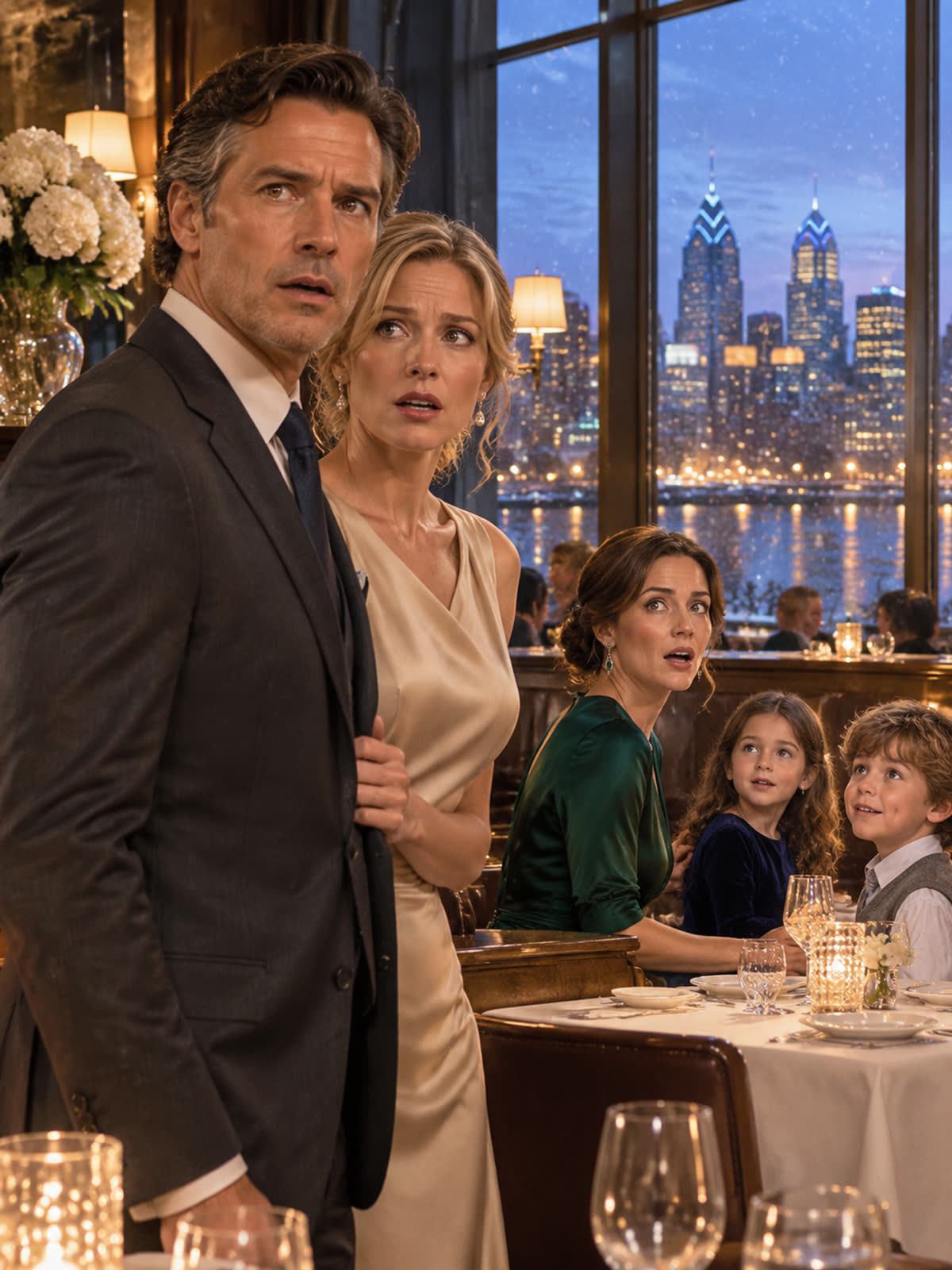
Then I noticed Adrian standing at the entrance.
Seven years had gone by since we had last shared a room. He had aged in the particular ways that success and worry leave behind: a touch of silver at his temples, faint lines at the corners of his eyes, and the settled assurance of a man whose name now hung on office towers and filled the business pages. His charcoal suit fit him perfectly. The woman at his side wore cream-colored silk and a small, exact smile. I knew her from photographs in the business section. Her name was Celeste Ward, and she had once worked alongside Adrian at his family’s investment firm.
The hostess was still talking to them, but Adrian had stopped hearing her. He had spotted me.
I felt his gaze travel from my face to the children and then back again, as though he had found something in their features he couldn’t explain away. Willa had his dark brown eyes, ringed with amber, and the same crease between her brows that showed up whenever she concentrated. Ben had my dimples and my lopsided smile, but his chin and the way he tilted his head belonged entirely to Adrian.
Celeste traced the direction of his stare. Her fingers tightened on his arm.
“Adrian?”
He gave no answer.
Ben was the first to notice him. “Mom, who’s that man?”
I nudged my napkin aside and got to my feet. My heart was pounding hard enough to make the whole room seem to shrink around me.
“Hello, Adrian.”
He spoke my name as though it had been resting on his tongue for years.
“Mara.”
Willa’s gaze bounced from one of us to the other. “You know him?”
“Yes.”
“What kind of know?”
Adrian never took his eyes off the children.
“How old are they?”
“This isn’t the place.”
“How old?”
His voice still had that old steadiness, the tone that used to make people at business dinners turn toward him before they understood why. I had loved that certainty once. I had also learned what it could turn into when trust was gone.
“You don’t get to question me like this.”
He dropped his voice. “I’m asking how old they are.”
Willa slipped her hand into mine. Her small fingers were warm and certain.
“Seven,” I said.
I watched Adrian’s face shift as he counted backward. Our divorce had been final for a little more than seven years. The twins had arrived months after that.
“When’s their birthday?”
“Adrian, stop.”
“Mara.”
“February twelfth.”
His eyes closed briefly. I could tell he was remembering the last month of our marriage, that rare evening when we had managed to sit together without talking about doctors, unanswered questions, or a future neither of us could picture.
When he opened his eyes again, there was no anger in his face.
“Are they mine?”
The question fell into the space between us. Willa squeezed my hand harder. Ben looked up at me, then over at Adrian.
“What does he mean?”
I turned to face Adrian and kept my voice low.
“If you have any respect left for me, you won’t do this in front of them.”
“You let me go seven years without knowing I had children.”
“You don’t know what happened.”
“Then tell me.”
“Not here.”
Ben had gotten to his feet. He was small for his age, but he planted himself firmly, as though he meant to fill the gap between us all on his own.
“Don’t yell at my mom.”
Adrian’s expression gentled. “I’m not yelling at her.”
“You kind of are,” Willa said.
Celeste stepped closer to Adrian, but she made no attempt to steer him away. Instead, she turned her eyes to me.
“Mara, I’m sorry.”
It felt strange to receive an apology from the one person in the room who had done the least to wound me.
I gathered up the children’s coats. When I reached for them, Adrian moved back, and the restraint in that tiny gesture unsettled me more than an argument would have.
Outside, a light snow had begun to collect along the sidewalk. I kept one child in each hand as we walked, and neither of them spoke until we had crossed the avenue.
“Mom,” Willa said, “is that man our dad?”
I had promised myself I would tell them the truth when the moment felt right. Instead, the truth had arrived in a restaurant, beneath soft lights, with two children searching my face.
I knelt down to their eye level.
“Yes. Adrian is your biological father.”
Ben looked back toward the restaurant. “You told us our dad wasn’t part of our lives.”
“He wasn’t.”
“Did he leave us?”
“No, sweetheart. He didn’t know you existed.”
Willa’s eyes filled with tears. “Why not?”
I brushed her cheek. “That’s a story I should have told you sooner. I’m going to tell you all of it.”
That night, once the twins were asleep, my phone showed fourteen missed calls. Adrian had left a voicemail, and I listened to it twice, even though I didn’t want to.
“Mara, I know I have no right to demand anything. I know I have to earn the chance to speak with them. But if they are my children, I need to know them. And I need to understand why you believed I shouldn’t.”
From a drawer buried under school calendars and grocery lists, I pulled out a yellowed envelope. It had traveled with me from one apartment to the next, and finally to the small row house where I had raised the twins. My name was written across the front. Inside was a letter I had written seven years earlier and never mailed.
It was dated June third, three days after our divorce became final.
I sat at the kitchen table, wrapped in the quiet of the house, and remembered how a single frightened decision had stretched into seven years of silence.
Adrian and I hadn’t started out with penthouses or magazine profiles. We met at a fundraiser for a neighborhood reading program. He showed up late in an expensive suit, and I was stationed beside a table piled with donated children’s books.
He had come on behalf of his father’s investment company. I was running the program and had spent most of the night trying to convince donors that the children mattered more than the names printed in the brochure.
“The sponsors paid for the program,” Adrian said when I told him the children’s names should be printed larger than the donors’.
“The children are the reason there’s a program.”
“Money keeps the doors open.”
“Then give quietly.”
He shot me a look that might have been irritation, though it softened around the edges.
“Do you speak to every donor like this?”
“Only the ones who annoy me.”
He smiled, and I had fallen before I even realized what was happening.
We married two years later. His family’s company grew from a regional property business into a national firm, acquiring hotels, office buildings, and warehouses from Pennsylvania to the Midwest. Adrian could pull a problem apart until every piece had a label and a price tag. He was brilliant at making plans. He was far less sure of himself when a problem refused to become manageable.
For years, we tried for a baby. I kept track of the appointments, the tests, and the medication schedules; Adrian came to the important consultations and brought me coffee when I forgot to eat. Nothing pointed to one clear explanation. My doctors mentioned a few possible complications, but nobody could say why a pregnancy hadn’t happened.
His mother, Meredith, treated that uncertainty like a hole in a business plan. She was not a loud woman. She seldom needed to be. Her questions could leave a bruise without her ever raising her voice.
One evening, I overheard her talking to Adrian in his study.
“She isn’t telling you everything.”
“Mother, the doctors haven’t found a serious problem.”
“That’s what she says.”
“It’s what her doctor says.”
I stood frozen in the hallway, listening to the calm assurance with which Meredith had started making decisions about my body.
“You’re nearly forty. You want children. I don’t understand why she refuses to see Dr. Nolan.”
Dr. Nolan was Meredith’s own physician. I had already explained that I wanted my medical care to stay between me and my doctors. Rather than confront them, I went upstairs and shut the bedroom door.
After that, Adrian began asking for more information: every test result, every new appointment, every possible next step. He said he wanted to help, and I believed he meant it. But the more he asked, the more it felt as though my private life had become a file he needed to review.
He began working later. I started reading his silences as judgment. He read my hesitation as secrecy. Neither of us knew how to say I’m frightened without making the other feel accused.
Then, on a snowy evening in our kitchen, he told me he no longer loved me the way he once had.
He hadn’t even taken off his coat. I had made tea and was holding the mug in both hands, though I had stopped drinking it.
“Is this what you really want?”
“Yes.”
I put the mug down without letting it rattle. It was a small thing to be proud of, but I was grateful for it.
“I’ll have my attorney contact yours.”
He reached for me, then stopped himself.
“I don’t want this to become ugly.”
“You’re standing in our kitchen telling me you don’t love me. It already is.”
The divorce was quiet and fast. Adrian offered me far more money than I was willing to take. I kept our old condominium and enough to start over, turning down the rest because I couldn’t stand the feeling that the end of our marriage had been converted into a settlement.
Three days after it was final, I woke up nauseated, with a late period. I had been under stress before, and my cycle had always been irregular, so I took a test without expecting anything at all.
Two lines appeared.
I sat on the bathroom floor for several minutes, staring at them as though they belonged to someone else. At the clinic that afternoon, the doctor confirmed it: I was pregnant. I went home with an ultrasound picture and an urge to call Adrian that was stronger than every reason I had not to.
Instead, I wrote him a letter.
In it, I asked whether he would want the baby, or whether he would see the child only as proof that our marriage had ended for reasons he had misunderstood. It was an unfair question, but back then I couldn’t think of a fairer one.
The next morning, I called his private number.
A woman picked up.
“Hello?”
“Is Adrian there?”
“He’s in the shower. Who’s calling?”
I recognized the voice. Celeste had been a fixture at company dinners and acquisitions. I had noticed the way she listened whenever Adrian spoke.
“Never mind,” I said, and hung up.
Later that day, I came across a photograph online of Adrian leaving Celeste’s apartment building, holding her hand. I never found out exactly when their relationship began. I did know that the picture appeared the day after my call, while the ultrasound photo was still tucked in my purse. At the time, the order of events felt like an answer.
I put the letter in a drawer.
Two weeks later, an ultrasound technician told me she could hear two heartbeats. I had gone to the appointment alone expecting one child, and I walked out with a future that felt both miraculous and impossible. I called my mother, Ruth, from the parking lot. She listened while I cried, then showed up with groceries and a steadiness I couldn’t find in myself.
She was the first person to tell me I should reach out to Adrian.
“He deserves to know,” she said.
“What if he comes back because I’m pregnant?”
“What if he doesn’t?”
I had no answer. What scared me most wasn’t simply that he might reject me. I was afraid he would want the babies without wanting me, that his family would lay claim to them while I stood outside their world, that his money and certainty would turn my children into something I had to bargain for.
I called that fear protection.
By the time the twins arrived early, I was too exhausted and too frightened to reconsider. Ben weighed just over four pounds. Willa was even smaller. They spent seventeen days in the hospital while I watched the monitors and learned to decode every beep. When I finally brought them home, I promised them a life in which they would never doubt they were wanted.
I built that life as well as I could. I left nonprofit work and became a grant writer for schools and community programs. I bought a modest row house, learned how to stretch a paycheck, and made sure the children knew their biological father existed but wasn’t part of our everyday lives. I never told them he had chosen to leave. I never told them why he didn’t know about them, either.
The older they got, the harder it became to find an easy way into the truth.
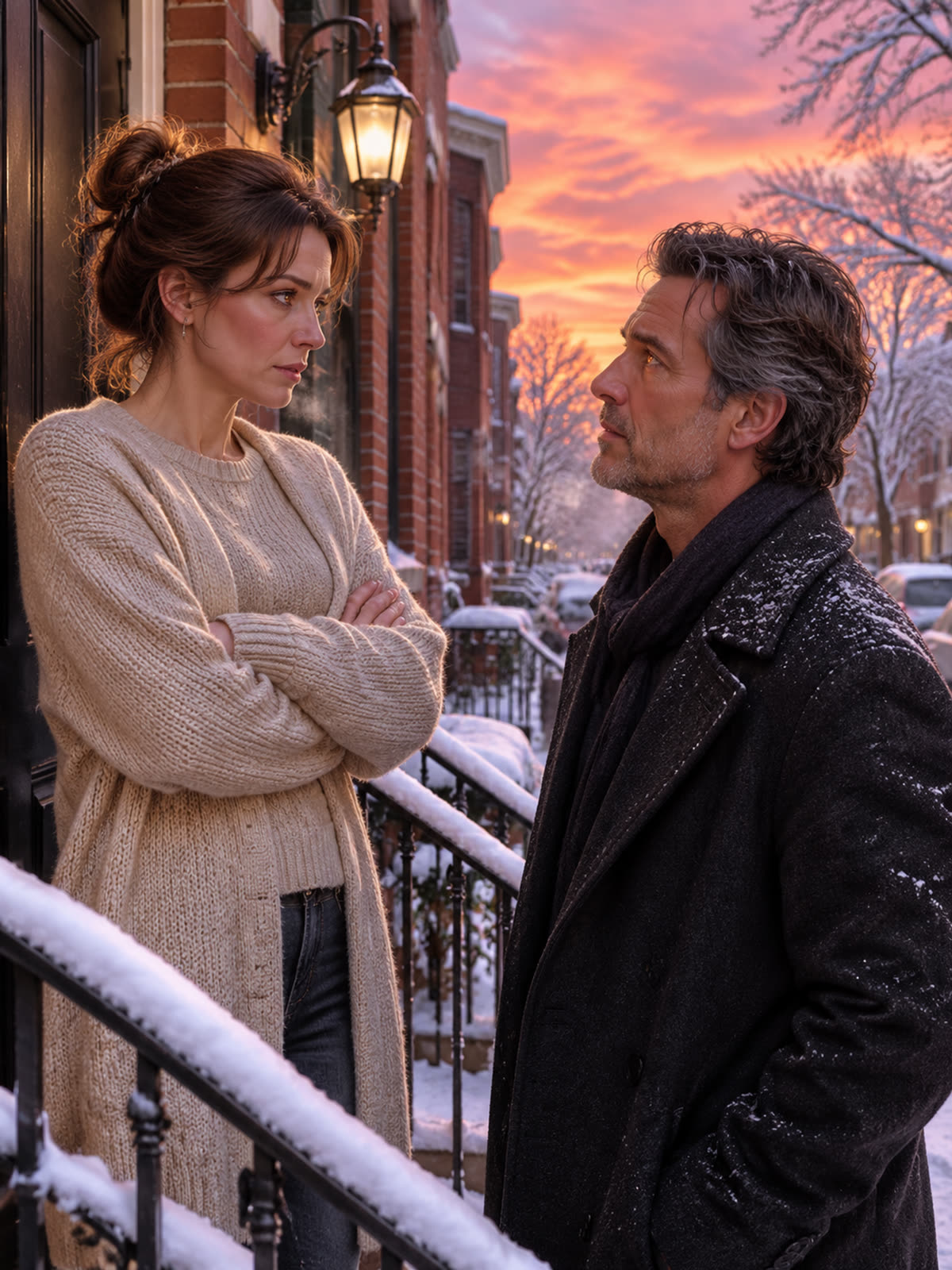
At six the next morning, Adrian knocked on my door. I opened it but stayed planted in the doorway.
Part 2: The Truth We Could No Longer Avoid
“You can’t come by without calling.”
“I know.”
“Then why are you here?”
“Because I wasn’t sure you’d answer the phone.”
“I wouldn’t have.”
He looked worn out, snow still clinging to his overcoat. For one brief, uncharitable moment, I was glad to see the night had been hard on him. Then I felt ashamed of myself.
“I’m not asking to see the children,” he said. “I’m asking to speak with you.”
I stepped out onto the stoop and pulled the door closed behind me.
He studied me carefully. “You still do that.”
“Do what?”
“Turn fear into anger.”
“You don’t get to analyze me.”
“No. I don’t.”
For several seconds, we stood there listening to the hush of the street.
“Why didn’t you tell me?” he asked.
“I tried. I called you the day after I found out I was pregnant.”
He stared at me. “You never called.”
“Celeste answered your phone.”
His expression changed as the memory of that call came back to him.
“She was at my apartment.”
“I know.”
“Nothing happened between us before the divorce.”
“I didn’t ask.”
“I need you to know that.”
“Why? What you believed about me didn’t matter when you were ending our marriage.”
“Mara, I’m sorry.”
“I was carrying your child while learning that you had already moved on.”
He looked as if he wanted to respond, but I raised my hand.
“I know we were divorced. My body didn’t know that. My heart didn’t know it either.”
“I should have listened to you.”
“Yes.”
“And you should have told me.”
I looked at him, caught off guard by how plainly he said it.
“Yes,” I said. “I should have.”
Adrian’s first visit with the children was set for the following week. Before it happened, Celeste asked to meet with me alone. I went to a quiet café in the city expecting her to defend Adrian, and I got something else entirely.
She had brought a folder.
Two years earlier, she explained, she had come across copies of my reproductive health records in Meredith’s home office while helping sort insurance paperwork. The files contained clinic forms, medication notes, and test results. I had never given Meredith permission to see any of them.
“Why didn’t you tell me?” I asked.
“I didn’t know where to find you, and I should have tried harder.”
She said she had brought it up with Adrian at the time. Meredith had claimed I authorized her to receive the records. Celeste had doubted that, but she couldn’t prove otherwise. Adrian had taken his mother’s word without ever asking me.
The clinic’s specialist had also gone back over the records after Adrian sought new medical advice. Nothing in them had ever established that either of us was unable to have children. There had been uncertainty, not the clear diagnosis Meredith had hinted at.
“So there was no proof I was the problem,” I said.
“No.”
“Only suspicion.”
“Yes.”
Celeste folded her hands on the table. She told me she was leaving Adrian, and that the decision had begun taking shape months before the restaurant. She had spent years beside a man who met fear with work and treated hard feelings as problems he could solve later.
“I loved him,” she said. “But I can’t spend the rest of my life waiting for him to understand that silence is a choice, too.”
For the first time, I could see her without the story I had wrapped around her. She hadn’t stolen a happy life from me. She had found Adrian after he had already started pulling away, and she had discovered that money and competence didn’t make him any easier to reach.
Before she left, she told me there had been no affair while Adrian and I were married. I believed her, though believing it didn’t erase the hurt.
That evening, Adrian came to our house for the first time. He showed up with pancake mix and chocolate chips, which was about the only gift I hadn’t expressly forbidden.
Willa peered into the grocery bags.
“You remembered the chocolate chips.”
“I did.”
Ben examined Adrian’s coat. “Mom says you own hotels.”
“Some.”
“How many?”
Adrian glanced at me, then back at Ben. “The company owns part of twenty-seven.”
“Do you have to pay if you sleep there?”
“Usually not.”
Ben looked impressed. Willa cared more about whether Adrian knew how to make pancakes. He did not. His first one came out shaped like a shoe; the second looked like Florida.
“I followed the instructions,” he said.
“Mom doesn’t use instructions,” Ben replied.
“That is not true,” I called from the counter.
“It’s a little true,” Willa said.
For a while, the afternoon settled into the shape of an ordinary family visit. Adrian learned that Ben couldn’t stand strawberries and that Willa always went for the crispy edges of the pancakes. He listened when she explained that her favorite dinosaur was not a triceratops, no matter what he had guessed. He asked about school without trying to turn their answers into a lesson.
After they finished eating, Ben looked at him across the table.
“Why didn’t you know about us?”
Adrian put down his fork. He didn’t glance at me for help.
“Your mom and I were hurt and scared, and we both made choices that made things worse.”
“Would you have wanted us?”
“Yes,” Adrian said. “I would have wanted to know you.”
Ben turned to me. I moved to sit beside him.
“I should have told your dad,” I said. “I was afraid, and I thought keeping quiet would protect you. I was wrong about that.”
“Were you afraid of him?”
“I was afraid of what might happen. Your dad hurt me, and I didn’t know how to trust him. But keeping the truth from him was my choice, and I’m sorry I made it.”
“Are you sorry we lived with you?”
“Never.”
Willa crawled into my lap, and Ben leaned into my shoulder. Adrian lowered his eyes, letting us have the moment without trying to step into it.
Once the children were in bed, I showed him the folder Celeste had given me. He paged through the records and went completely still.
“I’m going to find out how my mother got these.”
“No.”
“Mara, someone accessed your private medical information.”
“I know.”
“If my mother—”
“This isn’t about punishing Meredith.”
“She may have paid someone at the clinic.”
“Then that was wrong. But the problem standing here is still you.”
He looked up.
“You believed suspicion over me. You let someone else’s fear become more important than your wife’s voice. If Meredith took the records, she was wrong. If someone at the clinic shared them, they were wrong. But you were the person who was supposed to know me.”
Adrian set the folder down.
“I don’t know how to fix that.”
“Good. Maybe start by admitting there are things you can’t fix with a phone call and a lawyer.”
He did look into it, though he never sent anyone to my door or made the story public. The records showed that a clinic employee had passed copies to Meredith in exchange for money. Meredith had told the employee I had given my consent. When Adrian confronted his mother, she said she had only been trying to shield him from a problem she believed I was hiding.
“She thought I was afraid you would leave,” I said when Adrian told me.
“That’s what she said.”
“So she violated my privacy because she thought I was afraid of losing you.”
He nodded.
“And then you left.”
“Yes.”
Meredith had crossed a serious line, but she hadn’t made Adrian distrust me, and she hadn’t made me hide my pregnancy. Those choices were ours.
He removed his mother from the board of the family foundation. I told him the decision sounded like corporate punishment, which almost made him smile, but I also told him that cutting her out didn’t clear him of his own part in it.
“I wake up thinking about what I missed,” he said one evening, his voice rough with feelings he had spent years keeping in neat order. “I wasn’t there for their first day of school, their birthdays, or the nights when they were sick. I was twelve miles away, congratulating myself for building something important while my children were growing up without me.”
I didn’t reach for him. There was a time when I rushed to comfort Adrian whenever he was hurting, even when the pain had started with something he had done to me. I had learned that compassion didn’t require me to erase my own feelings.
“You live with what happened by changing,” I said. “Stay when you’re uncomfortable. Answer questions you don’t like. Say when you’re scared instead of becoming suspicious. Apologize without expecting someone to forgive you on the spot.”
“You make that sound easy.”
“It isn’t. I’ve had seven years to practice.”
He accepted that without defending himself.
In the beginning, Adrian saw the children once a week. He came for dinner, helped with homework, and figured out which stories Ben wanted to tell from start to finish and which ones Willa preferred to summarize. He stopped bringing extravagant gifts after I told him his children didn’t need expensive things to understand that he cared.
There were disagreements. He bought Ben a telescope that cost more than my monthly mortgage, which led to a long talk about boundaries and the difference between generosity and trying to buy back time. For Willa, he showed up with a box of colored pencils, and she informed him that Ben’s gift was still better. Adrian didn’t take offense. He asked her to show him how to draw a fox.
The children adjusted faster than I did. They started asking when he would come again. They wanted him at their school events and weekend games. I was happy for them, and yet I kept watching him, waiting for the moment he would disappear back into work or decide the effort had become inconvenient.
Then a photographer turned up outside the school. A business columnist had caught wind of rumors about Adrian’s new family situation, though nothing had been printed. Adrian changed his security arrangements and asked the school to call him if anyone tried to photograph the children. I appreciated the help, but I made it clear that the children would not become a public story or an extension of his company’s image.
He agreed without an argument.
Meredith wrote to me twice. I sent the first letter back unopened. When the second one came, I held onto it for several days before deciding to read it. Adrian sat beside me on the front steps as I opened the envelope.
Meredith opened the letter by explaining herself. Her husband had been anxious about the future of the family business, and she had believed her son needed a family of his own. Halfway through, her tone shifted. She admitted she had mistaken fear for wisdom, assumed she knew what Adrian needed, and treated my private medical information as something she had every right to examine.
At the very end, she said she knew about the twins.
“I didn’t tell her,” I said.
“I believe you.”
“She must have heard from someone.”
“Probably.”
I folded the letter. “I may let her meet them eventually.”
“You don’t have to.”
“I know. I’m trying not to make permanent decisions from temporary fear.”
We didn’t talk about forgiveness. The next day we took the children to the aquarium, after Ben abandoned baseball for the moment and decided he liked sharks again. Adrian carried Willa’s coat and Ben’s backpack. The ordinary rhythm of that afternoon meant more than any grand apology could have.
Several months later, Ben drove a ball between second and third base during a little league game. Adrian had been sitting next to me, clutching the bleacher railing as if the entire game hung on the next pitch. When Ben slid safely into second, he spun toward us.
“Dad! Did you see?”
Adrian went rigid. Then his whole face broke open into a smile that made him look years younger.
Part 3: What We Chose Next
“I saw! You made it!”
Ben turned back to the game, his attention already on the next play. Adrian lowered himself onto the bench slowly and pressed his fingers to his lips.
“He called me Dad.”
“I heard.”
“He called me Dad.”
“Yes, Adrian.”
That night, I found him out on the back porch with a cup of coffee. The air was warm, and the trees lining the street whispered softly.
“What did you think being a father would feel like?” I asked.
“Responsibility. Teaching them things, protecting them, providing.”
“That sounds like you.”

He gazed down into his coffee.
“I didn’t know one word could make me feel like I’d been given back seven years and lost them all over again.”
I stood next to him, close but not quite touching.
“I’m sorry.”
He shook his head.
“We agreed. No more apologies every time the past comes up.”
“We did.”
He told me he had talked with Meredith. He hadn’t promised her a meeting with the twins, and he hadn’t asked me to reconsider.
“She wants to see them,” he said. “I told her that was your decision, too.”
“I’ll think about it.”
That October, Adrian opened a new office tower beside the Schuylkill River. The children came along with me, once we agreed there would be no interviews and no photographs of them without our permission. At the ceremony, Adrian thanked the people who had designed and built the project, then paused before turning to the company’s future.
“For a long time, I thought success meant building things no one could take away from me,” he said. “I was wrong. The most important things in life aren’t owned. They’re trusted to us: our families, our relationships, our time. If you treat any of those things as guaranteed, you can lose years before you understand what they were worth.”
He looked our way, then went on without naming us.
When the ceremony ended, Meredith came toward me. She seemed older than I remembered, and she stopped several feet away.
“Mara, I’m sorry.”
“I’ve read your letter.”
“I was protecting an idea of what I thought my son needed. I wasn’t protecting him.”
“You hurt me. You helped damage my marriage.”
“I know.”
“You weren’t the only one who made mistakes.”
She nodded. I told her I wasn’t ready to forgive her, but I was willing to let her meet the children with Adrian and me present, as long as she didn’t bring up fertility, family legacy, or the idea that the twins owed it to anyone to mend their relationships.
“I understand,” she said. “Thank you for giving me the chance.”
The children were wary at first. Then Meredith mentioned she had once seen Julius Erving play basketball, and Ben instantly wanted every detail. Willa asked whether Meredith liked sharks. By the end of the afternoon, the conversation had loosened up, though nobody pretended a single meeting had made everything right.
Adrian and I got better at talking. It didn’t happen overnight. We learned to sit through awkward silences instead of treating them as permission to walk away. He learned to say, “I’m worried,” before his worry hardened into questions that sounded like suspicion. I learned to tell him when fear was steering my choices, even when I still wished I could make it vanish first.
Eventually the children asked to hear the whole story. By then they were old enough to understand that the adults they loved could make choices that hurt each other.
“Do you wish you hadn’t divorced?” Ben asked.
I glanced over at Adrian.
“I wish we had been kinder,” I said. “I wish we had trusted each other more. But I don’t wish we had stayed married just to avoid being apart.”
Adrian nodded. “People don’t become healthier just because they stay married. I wish I had made your mom feel safe enough to tell me the truth.”
Willa listened, her brows knitting together.
“If you stayed together, would everything have been better?”
“Not necessarily,” I told her. “The truth matters more than pretending everything is fine.”
The questions kept coming. The twins wanted to know whether Adrian and I would ever get married again. I nearly choked on my tea, and Adrian coughed into his napkin.
“You still look at each other weird,” Willa said.
“What does that mean?” I asked.
“You know.”
“No, I really don’t.”
Ben groaned. “This is gross.”
We hadn’t gotten back together. We hadn’t even agreed that we wanted to. We were trying to rebuild trust without mistaking time spent together for a promise about the future.
On my forty-second birthday, I cooked dinner at home. The twins baked a cake that tilted a little to one side, my mother brought wine, and Adrian brought flowers from the same shop where he had bought my first bouquet nearly twenty years before.
After everyone else had gone, I found him at the sink washing dishes.
“You know we have a dishwasher.”
“I’ve been told.”
“Then why are you doing that?”
“Nervous energy.”
He dried his hands and reached into his coat. I went stiff.
“It isn’t a ring.”
“Good.”
“You sound disappointed.”
“I sound cautious.”
He handed me an old photograph from the fundraiser where we had first met. My hair was frizzed wild from the summer humidity, his suit was far too big in the shoulders, and I was looking at him with the expression of a woman who had already decided he was difficult.
“You hated me that night,” he said.
“You were an arrogant donor.”
“You told me that.”
“You were.”
He laughed, then fell quiet.
“I spent years wanting to go backward. Before the divorce, before the appointments, before I made you feel like you had to keep things from me.”
“You can’t go backward.”
“I know. I don’t want to anymore.” He looked down at the photograph. “I want to know whether we could go forward.”
“Adrian.”
“I’m not asking you to marry me. I’m asking whether you’d have dinner with me, as the woman you are now, and see whether we can enjoy one another’s company.”
I laughed. “That is a terrible invitation.”
“I practiced it.”
“That makes it worse.”
His smile came back, careful and hopeful. I thought about the young couple in the photograph, who had once believed love could carry them through anything. They had been wrong. Love hadn’t made us immune to fear, pride, or silence. It hadn’t taught us how to listen. But the years between us had shown me that the end of one version of a relationship didn’t have to dictate every choice that came after.
“I have conditions,” I said.
His face settled into the expression he wore before a difficult negotiation.
“There’s that face.”
“What face?”
“You just turned dinner into a business meeting.”
He deliberately loosened his features, which made me laugh.
“One dinner,” I said. “No assumptions. No headlines. And we don’t tell the children anything until we know whether we can spend three hours together without regretting it.”
“That seems reasonable.”
I held his gaze.
“And if you stop trusting me, you ask me what’s going on. You don’t decide for me. You don’t disappear into work and leave me guessing. If you’re afraid, you tell me.”
“I will.”
“And if you decide you don’t love me, you tell me before the silence does.”
“I will.”
That was what I needed. Not a promise that no one would ever get hurt again, but a promise that we would try to tell the truth before fear made our decisions for us.
Two weeks later we went to dinner at a small Italian restaurant in a different part of the city. We talked about books, terrible apartments, food, and the night we first met. We talked about the dog we had adopted on a whim and the leaky ceiling in our first place. Those three hours reminded me why I had loved him, and why love alone had never been enough.
When he walked me home, he stopped at the front steps.
“Can I kiss you?”
The asking mattered more than the answer.
“Yes.”
He kissed me gently, without pretending a kiss could wipe away the years between us. When he rested his forehead against mine, he murmured that he had imagined that moment many times.
“Don’t ruin it,” I said.
“You’re still you.”
“No. I’m a better version of me.”
“Then I’m lucky to meet her.”
We took things slowly. The children knew we were spending more time together, but we didn’t ask them to make sense of our relationship before we understood it ourselves. When Adrian proposed, he did it in my kitchen, with no photographer, no ballroom, and no crowd of witnesses. I traded the oversized diamond he had picked for one I liked better, and he grumbled about it for three weeks.
We remarried on the banks of the Delaware River. My mother cried. Meredith sat quietly in the second row. Ben stood next to Adrian, and Willa stood next to me. Right before the ceremony began, Ben whispered something to his father that made Adrian laugh.
Later, Adrian told me what it was.
“Don’t mess it up again.”
It was wise advice.
His vows didn’t promise that he would never be afraid or that we would never make mistakes. He had learned not to make promises just because they sounded comforting.
“I promise you won’t have to guess what I’m feeling because I’m too proud to say it,” he told me. “I will ask before I assume. I will stay before I retreat. And when I’m wrong, I won’t make you carry the cost so I can avoid admitting it.”
I promised him I would never again mistake silence for safety. I would tell him when I was afraid, and I would not make choices for him simply because I was worried about what he might choose.
Forgiveness didn’t erase the years we had lost. It didn’t place Adrian in the photos from the twins’ first day of school or return the birthday mornings he had never known. It didn’t make my letter disappear or turn our old pain into a harmless story.
It only meant that we could decide what to do next with the truth laid out in front of us.
After the ceremony, Willa took Adrian’s hand and Ben bumped him with his shoulder. The city skyline rose behind us, including the office tower that had once seemed to Adrian like proof he had built something permanent.
Now I understood that his real legacy was smaller and harder to build: showing up, listening, and speaking honestly while there was still time.
He squeezed my fingers.
“You okay?”
I looked at our children, then at the man I had loved, lost, feared, and slowly learned to know all over again.
“Yes,” I said.
This time, I meant it.
Willa groaned. “Can we eat now? I’m starving.”
“We just had appetizers,” Ben said.
“Those were tiny.”
Adrian looked over at them, pretending to be offended.
“My children have no respect for fine dining.”
I raised an eyebrow. “Your children?”
He smiled at me.
“Our children.”
It was a better answer.
Disclaimer: This story is a work of fiction inspired by real-life themes. Names, characters, places and events are fictionalized, and any resemblance to real persons is purely coincidental. It does not represent any person or organization and does not encourage inappropriate behavior. Images are for illustration purposes only.