They laughed at a barefoot little girl who asked to play piano for food… until her first note made an entire ballroom forget how to breathe. She didn’t belong there. Torn dress. Dust on her face. Hunger in her eyes. In a room dripping with gold and luxury, she looked like a mistake. “May I…
Fiction. This story is a dramatized work created for entertainment. Names, characters, events, and circumstances are fictional.
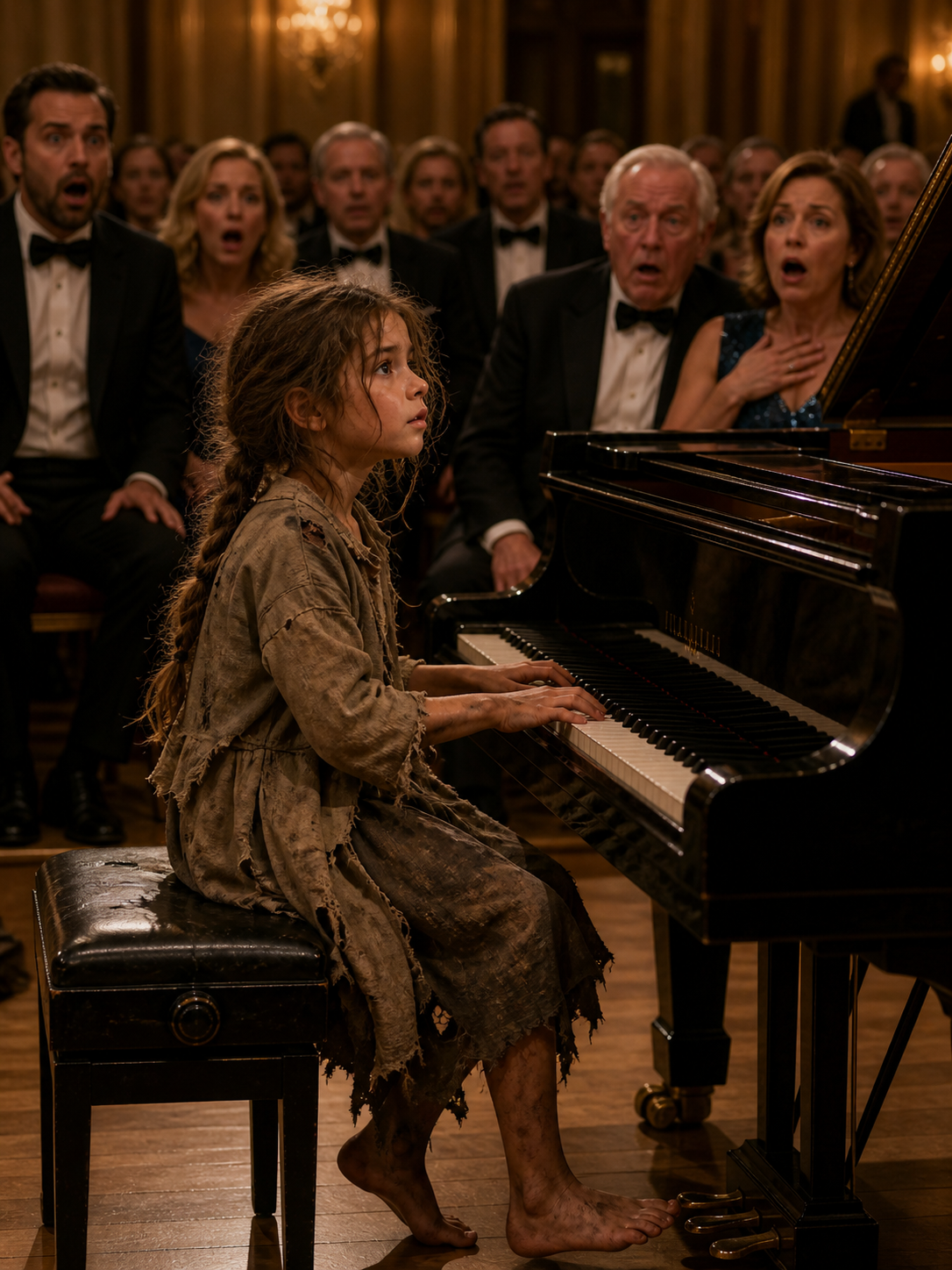
She didn’t belong there. Torn dress. Dust on her face. Hunger in her eyes.
In a room dripping with gold and luxury, she looked like a mistake.
“May I play… for food?”
The silence lasted one second.
Then came the laughter—sharp, loud, cruel enough to make anyone walk away.
But she didn’t.
Her hands were shaking. Her eyes filled with tears.
Still… she sat down.
And when her fingers touched the keys—everything changed.
The melody was fragile, aching… impossibly beautiful.
Laughter died mid-air. Conversations collapsed.
Even the richest people in the room suddenly felt small.
Then a man stepped closer… staring at her like he had just seen a ghost.
“That song…” he whispered.

The melody lingered in the air long after the final note faded—but no one in the ballroom dared to move.
The older man stood beside the piano, his face drained of color, his eyes locked on the little girl as if he were staring at something impossible… or something he had lost a lifetime ago.
When the silence finally settled, he spoke—his voice unsteady, barely holding together.
“Who taught you that?”
The girl didn’t look up. Her small fingers rested on the keys, as if letting go would make everything disappear.
“My mother.”
The words struck him like a blow.
Because years ago… he had written that melody for one woman. Only one.
He had played it for her in secret—on that very piano—when the ballroom was empty and the world felt far away. She used to clean the floors after midnight, and he had loved her more than he feared the weight of his powerful family’s name.
And then… she was gone.
They told him she had taken money and disappeared.
Later, they told him she was dead.
He believed both lies—because searching would have broken him.
The girl reached slowly into the pocket of her torn dress and pulled out a folded piece of paper, worn at the edges.
“She said if people laughed,” the girl whispered, her voice trembling, “I should still play it. She said if you heard it… you would know me.”
His hands shook as he took the note.
The moment his eyes fell on the handwriting, something inside him collapsed.
If our daughter finds you, please don’t let them turn her away the way they turned me away.
The room disappeared around him.
He looked back at the child.
The same eyes.
The same chin.
The same quiet strength—the way she was trying so hard not to cry in front of strangers.
His breath broke.
Slowly, he dropped to his knees beside the piano, no longer aware of the watching crowd, the whispers, the weight of judgment in the room.
“What is your name?” he asked, his voice softer now… afraid of the answer and needing it all the same.
The girl’s lip trembled.
“Clara.”
He closed his eyes.
That name—their name.
The one they had chosen together, years ago, before fear, power, and pride tore everything apart.
Around them, the guests who had laughed just moments ago stood frozen—silent, ashamed, unable to look away.
He reached for her small hand, his fingers trembling as they wrapped gently around hers.
And then Clara spoke again, her voice barely more than a breath—
“My mom is outside.”
He looked up sharply.
“She’s sick,” Clara continued softly. “She said… if you still loved us… you would come before it’s too late.”
And in that moment, nothing else in the world mattered anymore.
He did not remember standing. He only remembered that the crowd parted without being asked, and that he was holding Clara’s hand tightly enough that she winced, and that he loosened his grip and kept walking.
The service entrance opened onto an alley behind the hotel. A woman sat on the low wall under the lamp with a coat pulled around her, thinner than the girl he remembered, her hair cut short as if someone had done it in a hurry. She looked up and did not seem surprised.
“You played it,” she said to Clara, and Clara nodded and ran to her.
He stood a few steps away, because he had no right to come closer and because he did not know what to say after so many years.
“They told me you took the money,” he said at last.
“I never touched it.” She smiled, tired. “They told me you said you never wanted to see me again.”
Neither of them said the obvious thing, that they had both believed it because it was easier than looking.
He took off his jacket and put it around her shoulders. Then he called his driver, and he did not call his family.
At the hospital a doctor told him there was a treatment, an expensive one, and that there was time if they started tonight. He signed every form himself, under his own name and nobody else’s.
Near midnight he sat in a chair beside her bed while Clara slept curled in another. The woman opened her eyes.
“Is the piano still in tune?” she asked.
“I’ll have it checked,” he said. “You can tell me tomorrow.”
It was not forgiveness, not yet. But she reached out and held his hand, and he did not let go until morning.