Fiction. This story is a dramatized work created for entertainment. Names, characters, events, and circumstances are fictional.
PART 1 — Beside the Garbage
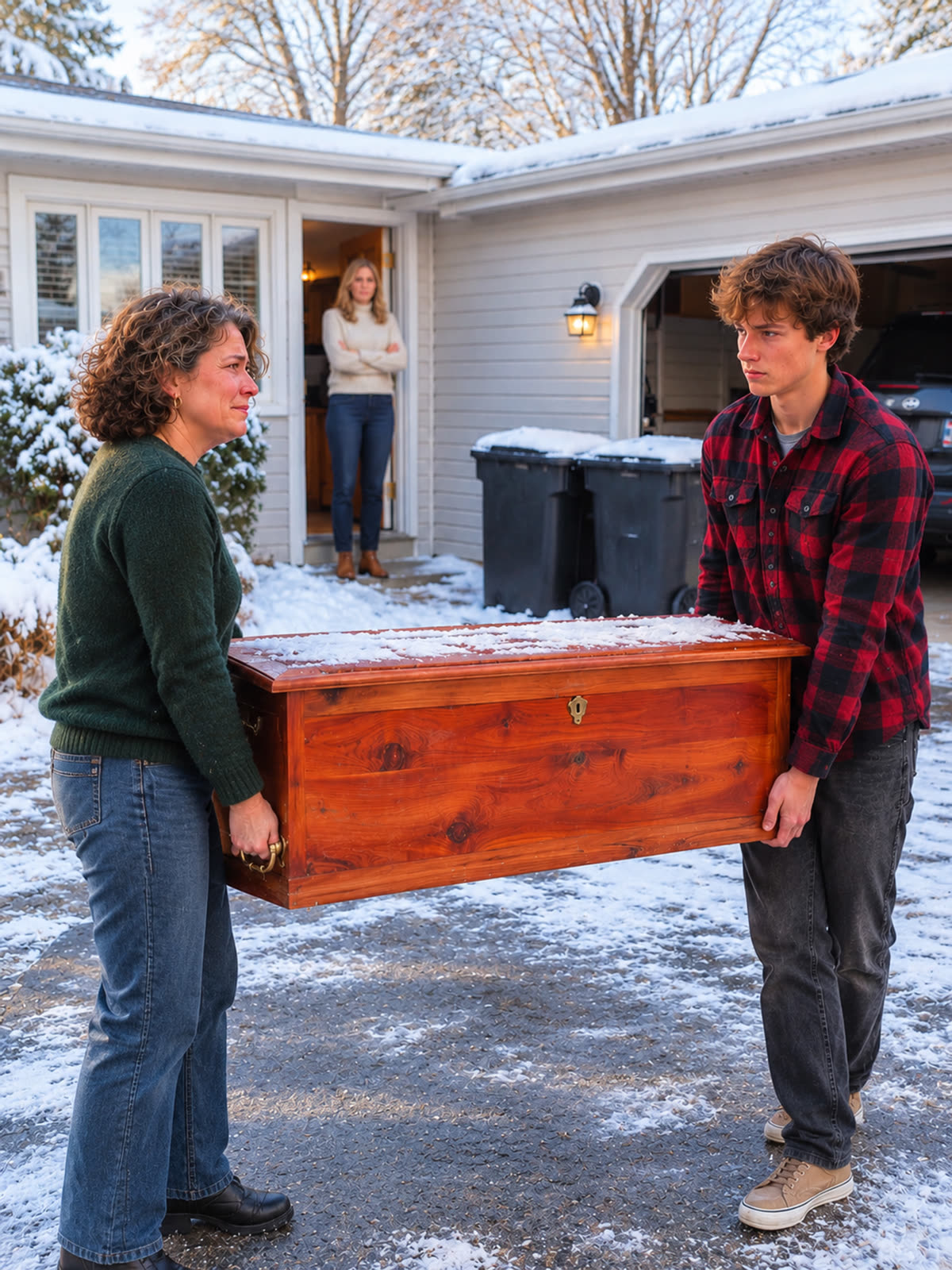
“Mom,” my son said. “It’s by the garbage.” Rowan stood at the entrance of my brother’s living room in his red flannel shirt, no coat on, snow melting in his hair. He had gone out to our van for one more gift for his grandmother, a small box of her favorite peppermint bark from the candy shop in De Pere. He came back with nothing in his hands. His face had drained of color, and he spoke so quietly that for a moment I couldn’t grasp what he meant. I was sitting at the end of Danica’s white sectional with a cup of coffee, scraps of Christmas paper scattered around my shoes. I looked up. “What is?” “The chest,” Rowan said. “Grandma’s chest. It’s out by the garbage cans.”
I set my coffee on the glass table, got up, and walked to the big front window. Christmas afternoon sun lay over the cul-de-sac. Clean snow blanketed the roofs and lawns, topped the mailboxes, and clung to the pine wreath across the street. My brother’s driveway had been shoveled that morning, and his garage door stood open. Two black plastic bins waited beside it. Next to them sat the cedar chest Rowan had spent four months building for his grandmother. Someone had left it in the snow as if it were worn-out furniture put out for the curb. Sunlight flashed off the brass handles, and a thin layer of snow was already gathering on the lid. I stood there trying to take in the sight of my son’s hard work resting among the trash.
Rowan had begun that chest in September and finished it the last week before Christmas break. He paid for the wood by mowing lawns all summer. Every Saturday from June through August he pushed our old Toro around eleven yards in our Ashwaubenon neighborhood, charging twenty-five dollars a lawn, and every dollar went into a coffee can on his dresser. The aromatic red cedar from the lumberyard in Green Bay cost a hundred and eighty-five dollars. The school shop fee was thirty-five, and the brass handles he picked out at Menards were another twenty-two. He drew the plans himself on graph paper at our kitchen table. In Mr. Kowalczyk’s woodworking room at Ashwaubenon High School, he cut each board on the table saw, glued and clamped each joint, and leveled the lid with a hand plane. Nothing about it came ready-made. It was nobody else’s work with his name added afterward.
He kept sanding long after most boys would have called the chest done. In November, Mr. Kowalczyk actually phoned me. He had taught shop for twenty-three years, he said, and had never had a student so set on sanding one project. Rowan was staying after school three afternoons a week. “Mrs. Tanner, I had to take the sandpaper away from him. He was going to sand it into sawdust.” I had remembered that call with pride. Now I stood at my brother’s window while the finished chest collected snow beside his garbage cans. When I turned around, Danica was in the armchair by the Christmas tree, carefully creasing used wrapping paper into neat squares to save for next year. Nothing in her manner suggested anything unusual had happened.
You need to understand what Rowan is like. He is fifteen, a sophomore, tall and thin, with more knees and elbows than he knows what to do with. He has Brett’s dark hair and my father’s long hands. Talking has never come easily to him. As a little boy, while other kids chased soccer balls or video games, he liked to sit in his grandfather’s garage and watch him build birdhouses. My father died when Rowan was nine. Afterward, something in my son seemed to go quiet, and for years I wasn’t sure it would ever find its way out. Then he took shop. He had signed up for Woodworking One as a freshman only because it fit his schedule. By October he was staying late. Before the year ended he had made himself a bookshelf, me a spice rack, and his grandmother a little step stool. Mr. Kowalczyk let him into Woodworking Two the following year, though that class was usually for juniors.
That August, Rowan came to the kitchen table with a sheet of graph paper. “I want to build Grandma a cedar chest,” he said. “For Christmas. For her sweaters.” His pencil drawings showed the front, side, and top, every measurement marked: forty inches long, twenty deep, eighteen high. He had planned brass hinges for the lid, brass handles on each end, and a narrow molding around the base. “Why cedar?” I asked. “Because of Great-Grandpa Emil,” he said. My grandfather, Emil Jaskolski, was a Polish farmer in Pulaski, Wisconsin, who died in 1992. His farmhouse had a cedar-lined closet where he kept his wool coats and Sunday suit. Mom used to tell us she hid there as a child during thunderstorms because the scent made her feel safe. She had told Rowan the same story years ago. I hadn’t known he still carried it. “She says she misses it,” Rowan said. “Grandma. She told me last time we were over. She said she hasn’t smelled cedar since Grandpa Emil’s farm got sold.”
He worked straight through: cutting boards in September, joining panels in October, fitting the lid in November. Then came three weeks of sanding and three coats of finish, which brought out bands of red and cream until the cedar seemed to hold a sunset. On the last school day before break, he borrowed Mr. Kowalczyk’s wood-burning pen and added something under the lid. He wouldn’t show me. That part, he said, was a surprise for Grandma. My mother, Lorraine Jaskolski Brandt, is seventy-four. She worked thirty-eight years as a nurse at St. Vincent Hospital in Green Bay. She raised my brother Kyle and me in a small ranch house on the west side and lived there alone for six years after Dad died. Then, two winters ago, she slipped on her icy driveway while getting the mail and broke her hip in two places. She lay in the snow for forty minutes before a neighbor found her. Surgery at Bellin Hospital was followed by six weeks of rehab in De Pere. Afterward, stairs were out of the question, and her laundry was in the basement.
Brett and I couldn’t take her home. Our two-bedroom place in Ashwaubenon has a steep front stoop and its only bathroom upstairs. Kyle and Danica had a newer four-bedroom house in Hobart, with a main-floor bedroom and a walk-in shower. Mom moved in with them after rehab. Her old house sold for a hundred and sixty-two thousand dollars, and she gave them forty-eight thousand to adapt the downstairs bedroom: wider doorways for her walker, new flooring, and an accessible bathroom with grab bars and a shower seat. Kyle said it was only fair since she would be living there. Nothing was put in writing. Mom simply handed them a check. Yet Danica kept calling the space the guest room. On my first visit after the renovation, she showed me the bathroom and the widened doorway. “And this is the guest room,” she said. “Where your mom’s staying.” Staying, as though Mom had come with an overnight bag and would soon be leaving.
The room was lovely the way a magazine photo is lovely: gray walls and rug, white trim, a white bed with gray pillows, a white dresser, a white lamp. Almost nothing in it belonged to my mother’s old life. Her furniture had gone at an estate sale. Her photographs sat boxed in Kyle’s basement. Her sewing machine, quilts, and inherited rocking chair were gone because, Danica said, there was no room and they didn’t match. I knew a little about why the house mattered so much to her. Once, after a few beers at a Packers game, Kyle told me about her childhood near Shawano. Her mother had raised four kids on a failing dairy farm. When Danica was eight they lost their house and moved into an old milking barn an uncle had half converted. For six years, home meant concrete floors, a wood stove, and the lingering smell of hay and cattle. She had washed her clothes in the school bathroom, desperate to stop other kids from smelling the barn on her. She put herself through nursing school at UW Oshkosh, married Kyle, and went to work in billing at Bellin Health. The spotless white-and-gray house in Hobart was the thing she had finally made perfect. I understood that. But understanding didn’t make it acceptable to set a boy’s Christmas gift beside the garbage.
We had arrived that afternoon with the chest wrapped in an old moving blanket. Brett was out driving a Brown County snowplow, as he had every Christmas for twelve years. The storm had called him out at four that morning, and at noon he sent a photo from County Road EB: a coffee thermos, working wipers, and a Santa hat on the dashboard. Rowan had loaded the chest into our van himself, refusing help, and ridden with one hand stretched back against it. Kyle was shoveling when we pulled in. “That it?” he asked. “The famous chest?” “That’s it,” Rowan said. “Let’s get it in before Mom sees it,” Kyle said. “Danica’s got her in the living room with the presents.” Together they carried it inside. Mom sat by the window in her recliner, a red Christmas sweater under the blanket on her knees. “What on earth?” she said as they approached. Rowan pulled off the moving blanket after they set the chest in front of her. She studied the glowing cedar, the handles, and the molding, then leaned carefully forward and rested her fingers on the lid. “Rowan,” she said. “You made this?” “In shop class,” he said. “Since September.” She lifted the lid and breathed deeply, eyes closed. Her face softened until she looked like a little girl. “Oh, honey,” she said. “That smells like my dad’s closet.”
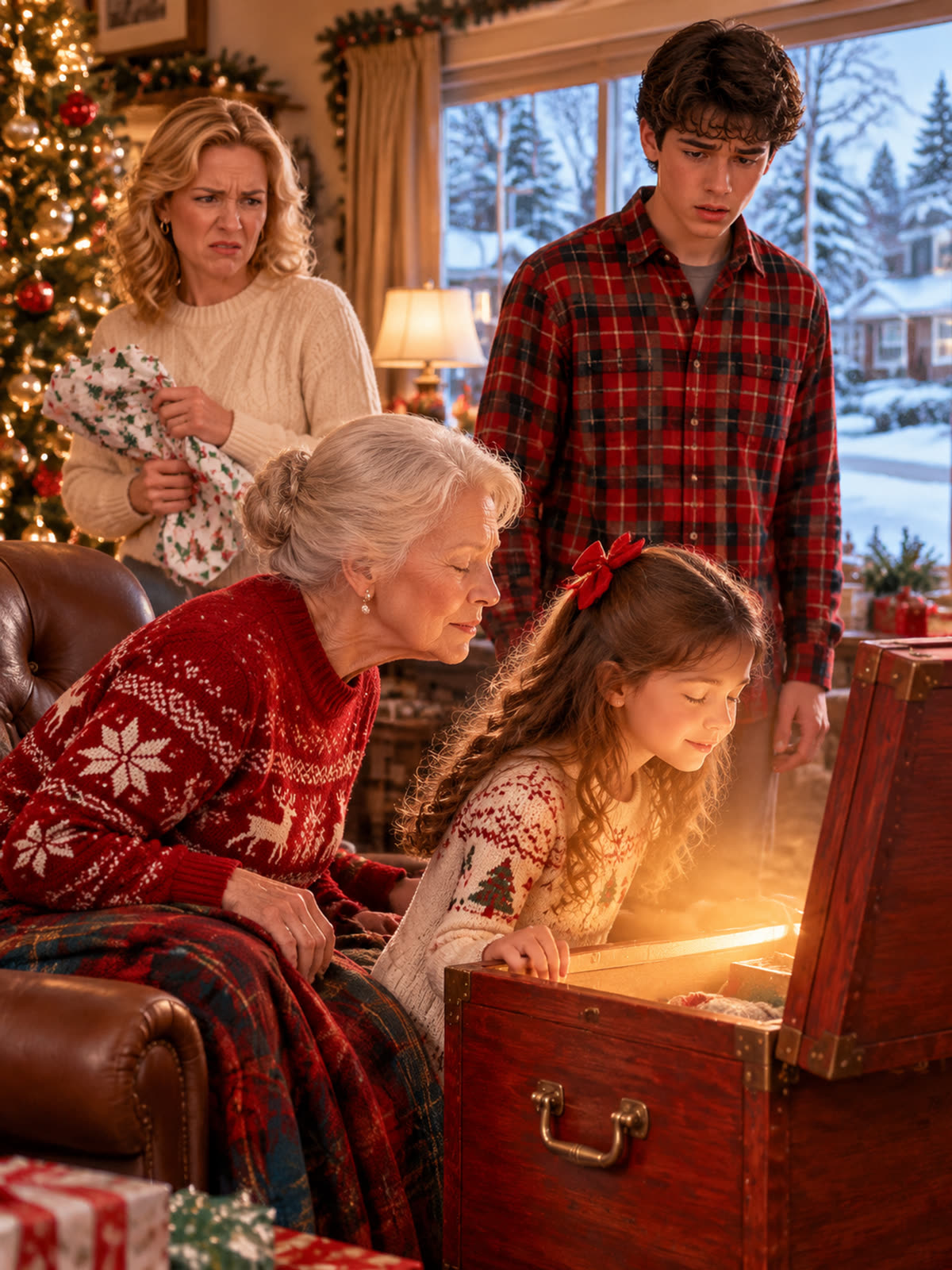
Danica stood behind the couch holding a pile of wrapping paper. The scent reached her too. Her nose tightened. “It smells like a barn,” she said. No one laughed. Mom opened her eyes and looked at her. Rowan stayed beside the chest, hands hanging at his sides. Kyle glanced from his wife to the floor. Then his phone buzzed. Dave Lindgren, three houses down, couldn’t start his truck in the cold and needed a jump. Kyle hesitated, but Mom told him to go, so he grabbed his coat and jumper cables and went out. The rest of us went back to the presents. Mom unwrapped the slippers Kyle had bought her and the crossword book I had brought. Rowan opened his grandmother’s gift, a Menards gift card, and broke into a grin. The chest sat right in front of Mom, part of the afternoon, part of everything we had come there to celebrate.
I can’t say exactly when Danica took it. I never saw her leave with it. About ten minutes into the next round of gifts, she got up, saying she needed to check the ham. I thought nothing of it then. Looking back, she must have gone through the kitchen into the garage, then through the garage’s side door to the hallway. Kyle keeps a red hand truck for hauling bags of water-softener salt. She must have wheeled the chest out on it. We were opening presents barely twenty feet away, with A Christmas Story playing softly on the television. Somehow, while we were busy with paper and ribbon, she carried my son’s work out of the house. When she came back, she sat in the armchair by the tree and went on smoothing and folding used wrapping paper. Another ten minutes passed before Rowan went to the van for the peppermint bark.
Then he came back without it, still in only his flannel shirt. “Mom,” he said. “It’s by the garbage.” After looking through the front window, I looked again at the patch of carpet where the chest had stood. Empty. Then I looked at my mother. Her hands were folded neatly over the blanket in her lap, and she sat with an unnatural stillness. I understood from her face that she had watched it happen. She had seen Danica carry away her Christmas gift. She had sat there, in the house where she lived, and said nothing. That realization hurt almost as much as the sight outside. Rowan had made her something that belonged to her, something carrying a memory no white dresser or matching pillow could replace. Now it sat beside two garbage cans, and she kept her hands folded as if she had no right to object.
Danica was creasing a square of red paper printed with little snowmen when I turned to her. She didn’t raise her eyes. “It doesn’t go with anything,” she said. “It can go to the curb or to your house.” Heat climbed my face. More words waited behind my teeth than I could trust myself to say. I wanted to tell her about every lawn Rowan had mowed, every afternoon in the school workshop, every measurement he had checked at our kitchen table. But it was Christmas. My mother lived there. My son stood in the room, already hurt enough. I would not turn his gift into the center of a shouting match. Instead, I went to put on my boots. Whatever Danica thought of the color or the scent, I was going to get that chest. By the time I reached the door, Rowan was already outside, and I had no idea what waited for us when we carried it back in.
PART 2 — The Same Smell, a Different Ending
Rowan’s jaw was set in a way I knew at once. Brett gets that same look when somebody cuts in front of his salt-loaded plow: no outburst, just a small muscle jumping beside his mouth. My son strode down the snowy driveway toward the trash cans in his flannel and sneakers, still without a coat. I followed him to the chest. He took one end and I took the other. Forty inches of solid cedar with an inch-thick lid made a serious weight. The brass handles had sat in the snow for ten minutes and were cold enough to sting my bare fingers. I held on anyway. As we lifted, the loose snow slid off the polished lid onto the driveway. Nothing about what we carried was disposable. It was heavy in our hands, carefully made, and painfully familiar.
“Don’t look at the house,” I told him. “Look at me.” He did. His eyes were wet. He was fifteen and six feet tall, and I hadn’t seen him cry in front of me since his grandfather’s funeral. Now he was fighting not to. “Just look at me,” I said again. “We’re going to carry this inside and put it where it belongs. That’s all.” I needed him watching me instead of the doorway, thinking about the next step instead of who might be watching. We had two handles between us and a front walk ahead. For the moment, that was enough. I couldn’t erase what he had already seen, but I could help him carry his work back inside.
Danica stood at the front entrance with the storm door open, wearing a white sweater, arms folded across it. She neither spoke nor moved to block us. We came up the walk and through the doorway, passing close enough that I could have touched her. We went down the hall, past the living room, and into Mom’s room at the far end. Mom was already there. To this day I don’t know how she moved so fast with that hip and her walker. She must have stood the moment we went outside. Now she sat against the gray pillows, slippers on, walker within reach. “Foot of the bed,” she said. “Facing the window.” We lowered the chest onto the gray rug in front of the white bed, its front toward the broad window and the snowy backyard.
“Now the sweaters,” she said. “Bottom drawer first.” I pulled open the lowest drawer of the white dresser. Her sweaters were packed tight. The drawers were small and Mom owned plenty of sweaters; since her fall she seemed to feel cold all the time. We began taking them out and folding them. There was her navy cardigan, the one she had worn over her St. Vincent scrubs for twenty years, its little pocket once used for pens. There was the gray sweater with wooden buttons Dad had bought her at a Door County shop for their fortieth anniversary. We found a blue one, a green one, and the brown sweater with leather elbow patches. Each had its place in the life she had brought with her, whether or not it suited the room’s careful colors.
Then came the Christmas sweater Aunt Bea had knitted in 1979, the first Christmas after I was born. Bea died in 2004, but the sweater remained: red, white, and green, a row of reindeer across the chest, one with a red pom-pom nose. Mom had worn it every Christmas Eve for forty-six years. One elbow had a hole she had mended three separate times. From the bed, she directed the folding. Sleeves tucked in, then the body folded in thirds. Rowan and I followed her instructions and laid the sweaters in the chest. Navy first, then brown, then blue and green, then the gray one with wooden buttons. “The reindeer last,” she said. “On top. So I can get to it.” Rowan raised the lid farther to give us room.
That movement revealed what he had kept hidden from me. In the middle of the lid’s underside, careful brown lettering had been burned into the red cedar: For Grandma. Love, Rowan. 2025. Beneath the words was a smaller picture, a farmhouse with a cedar tree beside it. He had copied Great-Grandpa Emil’s farm in Pulaski from the old photograph in my hallway. It was all there, worked into the wood by my quiet fifteen-year-old: the gift, the memory, and the reason he had chosen cedar in the first place. Mom laid her palm flat against it. For a long time she said nothing. Rowan stayed beside her, holding the lid, and her hand remained over his careful work.
A truck door shut outside. Boots stamped snow off the front step. From the kitchen came Kyle’s voice, asking where everyone had gone. A moment later his footsteps came down the hall. He stopped at Mom’s doorway in his winter coat, snow on his shoulders, jumper cables looped in one hand, cheeks reddened by the cold. Mom sat on the edge of the bed holding the reindeer sweater in both hands. The chest stood open before her, the other sweaters stacked inside. Rowan knelt beside it, supporting the lid. Danica appeared behind Kyle with her arms crossed. He looked at the chest, then at his wife. No one offered an explanation.
The silence lasted long enough for me to notice the furnace and the television down the hall, where Ralphie’s mother was saying something about the leg lamp. Finally Kyle spoke. “Dave said there was a chest by our garbage cans,” Kyle said finally. Quietly. “When I walked back up the street. He said, Kyle, did you mean to throw that out? It looks brand new.” He looked at Danica. “I told him no. I told him Rowan made it for Mom. And then I came up the driveway and it was gone, and there were footprints in the snow.” Danica gave him no answer. “Did you put it out there?” Kyle asked her. She lowered her arms, then folded them again. Everything in the little room seemed to wait while she decided what to say.
“It doesn’t go with anything, Kyle,” she said. “Look at it. It’s orange. It smells. The whole room smells like a barn now. I spent forty-eight thousand dollars on this room.” “Mom spent forty-eight thousand dollars on this room,” Kyle said. Danica flushed. Her mouth opened, then closed without an answer. My brother has never liked confrontation. He is an accountant for a paper company in Green Bay and has always been the one to steer an argument elsewhere, smooth over an awkward moment, or remind everyone not to fight on a holiday. I had never heard him speak to his wife that way. He set the coiled jumper cables on the hallway floor and stepped into Mom’s room.
At the foot of the bed he paused over the folded sweaters and the inscription under the lid. He read Rowan’s words and studied the little farmhouse beside the cedar tree. Then he lowered himself onto the gray rug next to his nephew and rested his hand on the lid beside Mom’s. “Grandpa Emil’s closet,” he said softly. “God, Mom. I forgot about that closet.” Mom looked at him with tears in her eyes. “I hid in it,” Kyle said. “Remember? When I was six. The night Grandpa died. I hid in his closet with his coats, and you found me in there in the morning, asleep.” “I remember,” Mom said. Kyle knelt beside Rowan for another long moment, his hand next to our mother’s, my son holding up the lid he had worked on for months. Finally Kyle stood and turned to Danica. “Danica,” he said. “Can I talk to you? In the kitchen?”
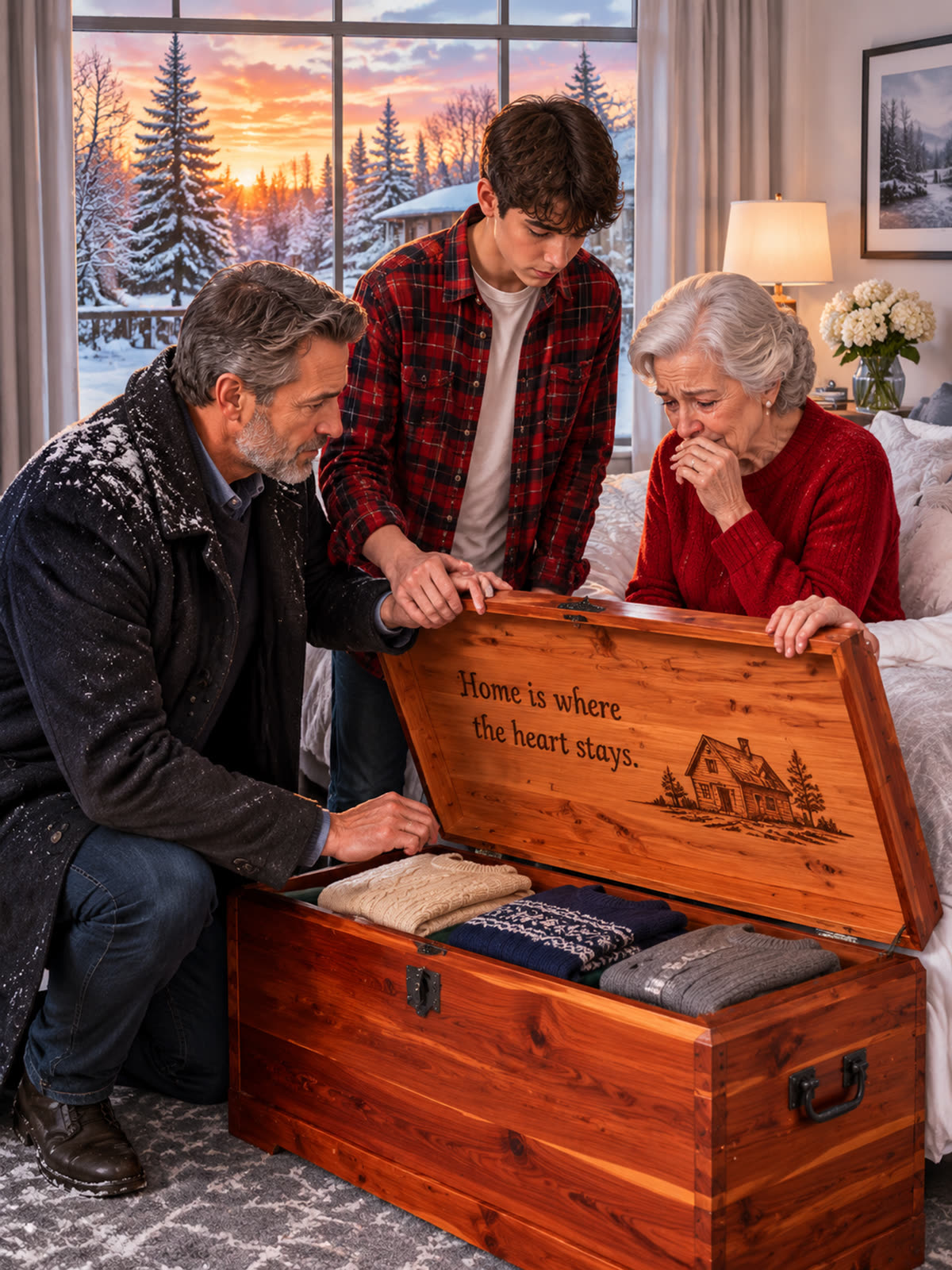
They stayed in the kitchen a long while. Mom, Rowan, and I stayed where we were. Through the wall came their voices, quiet at first, then rising, then dropping again. I couldn’t make out the words and didn’t try. Mom placed the reindeer sweater on top of the others and smoothed its knitted surface with her hand. Then she sat looking down into the chest. The room had the same gray rug, the same white bed, the same matching furniture. Yet the open cedar chest, filled at her direction, had already changed how it felt. It held things she recognized, things she had chosen to keep, things that didn’t need to match anything.
“She’s not a bad person, Lainey,” Mom said quietly. “Danica.” I turned to her. “She’s scared,” Mom said. “All the time. I’ve lived in this house two years. I see it every day. She cleans when she’s scared. She cleans until her hands are raw. She bought a new set of white towels last month because one of them had a little stain on it.” Mom shook her head. “She’s never once been mean to me. Not really. She brings me tea. She drives me to my doctor’s appointments. She sits with me when Kyle works late. She’s just…” She paused, searching for the words. “She’s just never once let me have anything of mine in here.” I heard the distinction she was making. She wasn’t pretending the hurt hadn’t happened. She was trying to explain the woman who caused it.
“Why didn’t you tell us?” I asked. Mom kept her eyes on the chest. “Because I’m a guest,” she said. “That’s what she calls this room. The guest room. And a guest doesn’t complain.” Rowan was still on his knees beside the chest. He lifted his face to her. “You’re not a guest, Grandma,” he said. “You paid for this room.” She watched him for a long moment, then reached out and laid her hand on his dark hair. Neither of them added anything. From the kitchen, the voices eventually stopped. Footsteps sounded in the hall. Danica appeared alone in the doorway; Kyle stayed behind. She had been crying, and dark streaks of mascara marked the skin beneath her eyes. Her hands were clasped in front of her white sweater. She didn’t look at me. She looked at the chest.
“Can I come in?” she asked. Mom nodded. Danica crossed the gray rug slowly and stopped at the foot of the bed. For a moment she studied the open chest and the row of reindeer on the top sweater. Then she turned to Rowan, still kneeling beside it. “Rowan,” she said. “I’m sorry.” He looked up without speaking. “It’s beautiful,” Danica said. “It is. It’s the most beautiful thing in this house.” Her voice broke. “And when your grandma opened it and I smelled it, I was eight years old again. In my uncle’s barn. In the winter, with the wood stove going and the walls sweating and that smell. Old cedar boards and hay and animals.” She closed her eyes. “My uncle lined the walls of the room where we slept with old cedar planks he pulled off a corncrib. To keep the mice out. It never got the smell out of anything. I smelled like that barn for six years.”
Rowan stayed motionless. “Every kid in my school knew,” Danica said. “They’d hold their noses when I sat down. They called me Barn Girl. All the way through eighth grade.” She opened her eyes again. “And when I smelled that chest, I just panicked. I couldn’t breathe. I wanted it out. I wanted it gone. I didn’t even think. I just got the hand truck.” She stood looking down at the wood for a long while before going on. “And then I sat there folding wrapping paper,” she said, “like it was nothing. Because if I act like it’s nothing, maybe it is.” She shook her head. “That’s what I’ve done my whole life. I put things out with the trash and act like they were never there.” Mom listened without interrupting and let Danica finish all she had come to say.
Afterward Mom sat with her hands in her lap. Then she said something I had never heard from her. “Danica,” she said. “Sit down. Next to me.” Danica hesitated, then lowered herself onto the white bed beside her mother-in-law. “I lived in a barn too,” Mom said. Danica turned to her in astonishment. “In 1958,” Mom said. “When I was seven. My father’s house burned down in March. The whole farmhouse, in Pulaski. A chimney fire. We lived in the hay barn for a whole summer while he rebuilt it. Me and my mother and my sister Bea and my father. On cots, in the hayloft.” A small smile crossed her face. “I’d forgotten it. I hadn’t thought about it in years. Until you said that.”
“I didn’t know,” Danica whispered. “Nobody knows,” Mom said. “We didn’t talk about it. You didn’t, back then. It was something you were ashamed of. Poor people lived in barns.” She reached across and took Danica’s hand. “When my father rebuilt the house, the first thing he did was line one closet with cedar. Just one. Because cedar’s what he could afford. And he told me it was the safe place. The place that was ours. That nothing could take from us.” Danica began crying again. “That’s why I hid in it, during storms,” Mom said. “That’s why it smells like home to me. To you, it smells like the barn. To me, it smells like getting out of the barn.” She tightened her hand gently around Danica’s. “Same smell. Different ending.”
No one spoke. Rowan had settled back on his heels, staring up at his grandmother. “Danica,” Mom said. “I want to tell you something, and I want you to hear it. This house is beautiful. You made it beautiful. You came from nothing and you made something perfect, and I’m proud of you. I’ve told Kyle that a hundred times.” She paused. “But I don’t live in a magazine. I live in this room. And I’m seventy-four years old, and I’ve lived in it for two years, and there’s not one thing in it that’s mine.” Her eyes moved over the white walls, the gray rug, the white dresser, and the gray lamp. The words were quiet, but nothing about them was uncertain. “I’m not a guest,” she said. “I’d like this to be my room. With my things in it. And I’d like that chest to stay at the foot of my bed. And if it smells like a barn, then that’s all right. It smells like my father too.” Danica sat beside her a long time, their hands still joined, and finally nodded. Kyle stood in the doorway, and I had no idea how long he had been listening. Mom had said what none of us had understood she needed to say. But a forty-eight-thousand-dollar check still hung over all of us, and nobody had ever put a single word of that arrangement in writing.
PART 3 — The Year Left Blank
We stayed for Christmas dinner, every one of us. There was ham, scalloped potatoes, green bean casserole, and a pan of Mom’s kolaczki, the little apricot-filled Polish cookies she had taught Danica to bake her first Christmas in the house. Brett arrived at six, straight from his county plow shift in his work coveralls. He ate three platefuls, pulled off his boots, and fell asleep on the white sectional. Danica spread a blanket over him without a word about the couch. After the meal she and Rowan took care of the dishes while Kyle and I sat at the kitchen table with coffee. The afternoon hadn’t vanished and couldn’t be undone. But we were still together, eating the dinner Danica made and the cookies Mom had taught her to make.
“I didn’t know,” Kyle said. “About the room. About Mom feeling like a guest. I work twelve-hour days in tax season. I come home and she’s in her room and Danica’s made dinner, and everything looks fine.” He shook his head. “I should’ve seen it.” I had been thinking about something else, something that had troubled me long before Rowan found the chest outside. “Kyle,” I said. “Can I ask you something? About the forty-eight thousand.” He looked across the table. “Did anybody write anything down?” I asked. “When she gave you the money?” He didn’t answer right away. When he did, he spoke quietly. “No,” he said finally. “She just wrote us a check. We put it in our account and paid the contractor.”
A conversation at work had stayed with me for about a year. A woman in the Aurora BayCare billing office, where I work, had told me what happened in her own family. Her mother had given her brother money toward a house. Three years later the mother needed nursing-home care. Medicaid pays for much of that care in Wisconsin once a person’s money runs out, but the program examines money given away during the previous five years. Without documentation, a transfer to a child may be treated as a gift. A penalty can follow, leaving a family to pay privately for months before help begins. I explained the whole thing to Kyle: the money, the missing paperwork, and why that family’s experience had made me uneasy about Mom’s check.
“Mom’s seventy-four,” I said. “She’s got a bad hip. She might need a nursing home someday. And if she does, and the state looks at that forty-eight thousand dollar check with nothing in writing, she could be stuck.” Kyle stared at me. As an accountant, he grasped the implications faster than I had when my coworker first described them. I could see him working through what the undocumented payment might mean. The renovation had happened, and Mom had paid for it. We all knew what the money was meant to accomplish, but knowing among ourselves was not the same as having an agreement. “We need an elder law attorney,” he said slowly. “We need an elder law attorney,” I said.
In January we found Patricia Novak in De Pere, who had practiced elder law for nineteen years. Kyle, Danica, Mom, and I went to her office together on a Thursday afternoon and listened as she walked us through the situation. She said there were ways to address it. Then she drew up an agreement for everyone to sign, stating that Mom’s forty-eight thousand dollars had purchased the right to occupy that room for the rest of her life. She called it a life lease, with its value calculated by formula instead of leaving the payment looking like a gift. Patricia said the arrangement should protect Mom if she ever needed care. For the first time, what that room meant was written down rather than assumed.
Danica was the first to sign. She put her name beneath the provision stating that the room at the end of the hall belonged to Lorraine Brandt for as long as she lived. It was no longer just a check everyone remembered or an understanding that could be described differently later. Mom’s place in the house had been put into words. After signing, Danica turned to her. “Lorraine,” she said. “I’m going to make you a sign. For your door.” It was such a small thing to promise after the conversation we had just had, a sign on an inside door. Yet I thought of the two years Mom had spent being told, one way or another, that she was staying in a guest room.
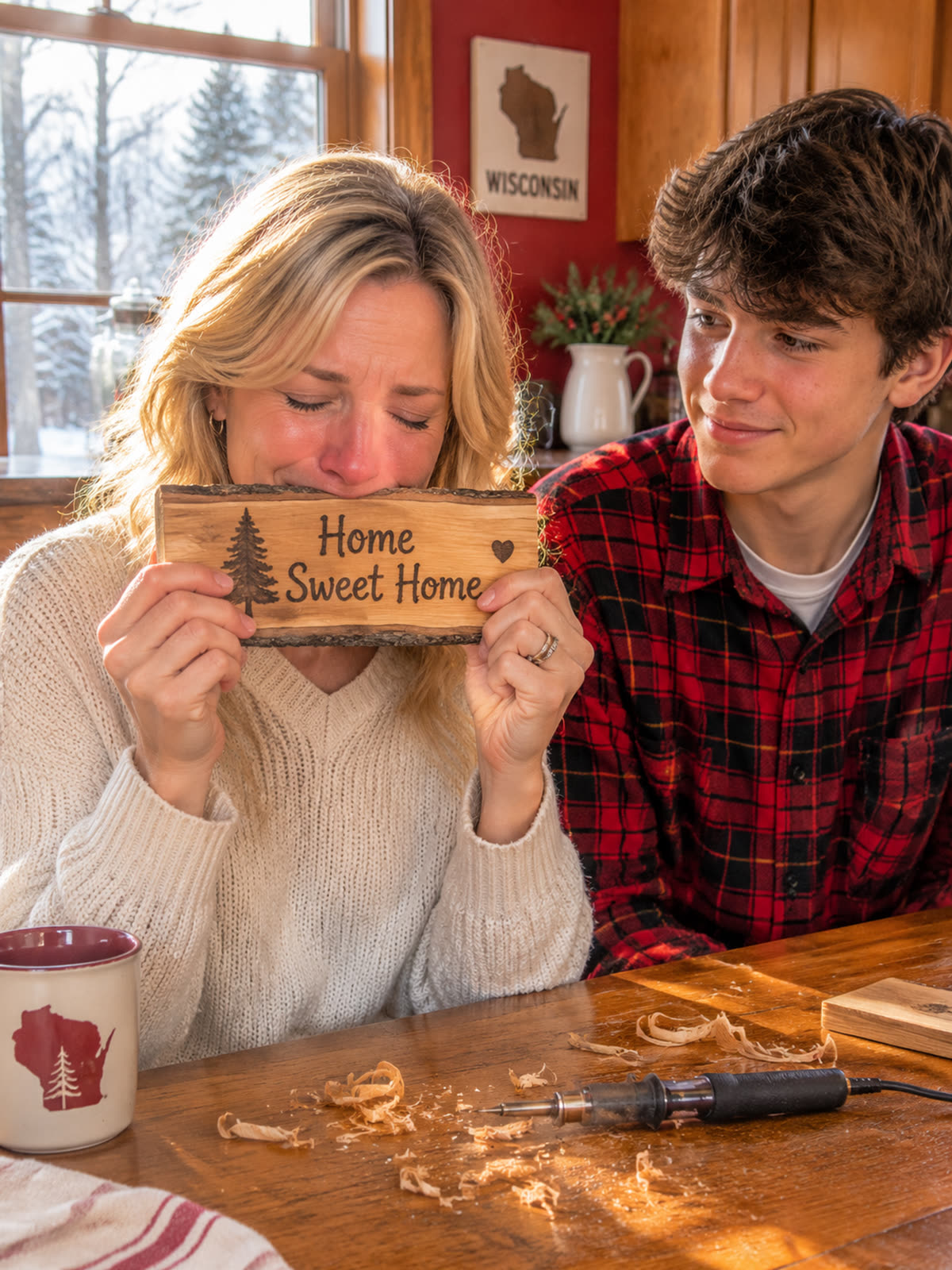
Danica kept that promise in February. She decided to make the sign herself, from cedar. One Saturday she called Rowan and asked if he would help. The request surprised him, and it surprised me too. She drove her white SUV to our house in Ashwaubenon and sat down at the kitchen table with him. He had a scrap left from the chest, a small piece of the same red wood she had once been unable to bear inside her home. Now it lay between them on our table. Rowan showed her how to sand it and how to handle the wood-burning pen. The boy who had kept the inscription under Grandma’s lid secret was teaching his aunt how to make another piece of cedar say that his grandmother belonged.
She wasn’t good at it. Her hand shook. The letters wouldn’t stay straight, and twice she burned her thumb. Still she kept going. Rowan stayed beside her while she worked, both of them bent over the little board. She never handed it over for him to finish neatly. For three hours that Saturday afternoon she worked through the letters herself. There was nothing magazine-perfect about the result, nothing that could be mistaken for the matching pieces she usually chose for her house. It was a scrap of cedar with crooked lettering, made at our kitchen table under the instruction of my fifteen-year-old son. But the words were clear.
LORRAINE’S ROOM. Danica had burned every letter herself. When the lettering was done, she sanded the sign and rubbed oil into the wood. The red cedar brightened under her hands, just as the boards of Rowan’s chest had brightened under their coats of finish. It was the same wood, the same unmistakable scent, yet this time she had chosen to sit with it. Rowan had shown her the tools, but she had done the work. The uneven sign would go on the door at the end of the hall, where the guest room had been. It would not announce a visitor or a temporary arrangement. It would carry my mother’s name.
When she finished, Danica lifted the little sign to her nose and took a breath. Then she shut her eyes. “It’s not so bad,” she said quietly. “When it’s yours.” She hung it on Mom’s door that very day. At the end of the gray hallway in the spotless white-and-gray house in Hobart, the small red cedar sign sat against the white door. It was a little crooked. It was also the only red thing in the entire hall. Months earlier, that color and that smell had been reasons to wheel a gift outside. Now Danica had carried them into the house herself and fixed them where everyone could see.
Over the next two months, pieces of Mom’s life began coming back to her room. Kyle went into the basement and brought up the box of photographs. Her wedding picture took its place on the dresser. On the nightstand went a photograph of Dad holding Rowan as a baby. The picture of Great-Grandpa Emil’s farm in Pulaski was hung near the window. Danica found the family rocking chair at a resale shop in Shawano, where it had ended up after the estate sale, and paid sixty dollars to bring it back. She set it in the corner by Mom’s window, beside the cedar chest. The room no longer looked as though every item had been picked from the same photograph. There were faces in it now, and memories, and a chair with a life before that house.
In March, Danica came to see us again, this time alone. She carried a cardboard box. “Rowan,” she said. “I need help with something.” Inside was a small wooden keepsake box, old and damaged. Its lid had split in two, and rust covered the hinges. It looked like something a child might use for precious little things. “My grandma made this for me,” Danica said. “When I was seven. Before we moved into the barn. She died when I was nine.” She looked at Rowan. “It got broken when we moved. I’ve kept it in the back of my closet for thirty years. I never let anybody see it.” Rowan lifted the box out and turned it over in his long hands. He examined the split lid, the old hinges, and the dried wood. “It’s cedar,” he said. Danica nodded slowly. “It’s cedar.”
He repaired it after school in Mr. Kowalczyk’s workshop. The job took six weeks. He glued the broken lid and held it in clamps, then sanded the wood and fitted small brass hinges from Menards. He worked oil into it until it glowed again. It was a much smaller project than the chest, but he gave it the same attention: the damaged wood, the joins, the hardware, the finish. When he returned it, Danica sat in her car in our driveway and lifted the lid. She breathed in the scent and cried so hard that Rowan went back into the house, not knowing what else to do.
The following Christmas, we went to Kyle’s again. Snow covered every roof around the cul-de-sac. Brett was out with his plow once more, sending photos of the Santa hat on his dashboard. Rowan was sixteen now and taller still. He had his driver’s license and drove us to Hobart himself, hands carefully at ten and two. When we stepped through the front door, I noticed the cedar at once. It wasn’t overpowering, just a faint fragrance drifting from the room at the end of the hall, the one with the uneven sign. It mingled with the ham in the oven and the pine tree in the living room, sweet and sharp at once, like an old closet in a Polish farmhouse. Danica greeted us in a red sweater. Not white. Red. I had never seen her wear that color. She hugged Rowan first, then wrapped her arms around me. “Your grandma’s waiting for you,” she said to Rowan. “She’s been up since six. She won’t tell me why.”
Mom sat by her window in the recovered rocking chair, wearing the 1979 reindeer sweater with its mended elbow. The cedar chest stood exactly where she had directed us to put it the year before, at the foot of her bed and facing the window. Photographs stood on the dresser and hung on the walls. A quilt she had made in 1985 lay folded across the white bed. The room no longer resembled a magazine spread. It looked like my mother. “Rowan,” she said when he came in. “Come here. I’ve got a Christmas present for you. And I need you to do something for me.” She nodded toward the chest. He knelt and opened the lid. On her sweaters sat a small paper shopping bag from Menards. Rowan pulled out a new wood-burning pen, still sealed in its packaging. “Your own,” Mom said. “So you don’t have to borrow Mr. Kowalczyk’s anymore.” He studied the package, then looked at her. “And I want you to use it,” she said. “Right now. On my chest.” He stared. “Grandma, it’s finished.” “Not quite,” she said.
She leaned forward slowly, careful of her hip, and touched the underside of the raised lid. Her finger rested beside the lettering he had burned a year earlier: For Grandma. Love, Rowan. 2025. “Under that,” she said. “I want you to write something else.” By then Danica had come to the doorway behind us, Kyle just beyond her. “Write: Then back to Rowan,” Mom said. “With the year left blank.” The room went very quiet. Rowan stayed on his knees, the new pen in his hand. He understood what she meant. So did the rest of us. “Grandma,” he said. His voice cracked. “I don’t want to.”
“I know, honey,” she said gently. “That’s why I’m asking you now. While I’m here to watch.” She laid her hand on his head. “Your great-grandpa built a cedar closet to be the safe place. The place that was ours. And then he died, and it got sold with the farm, and I never got to keep it.” Her gaze settled on the chest. “I’m not letting that happen twice. This goes back to you. Someday. And then you put your own grandbaby’s sweaters in it. And you tell them about Emil’s closet, and the barn in Pulaski, and the Christmas your aunt put it out with the garbage and you carried it back in.” Rowan looked toward Danica in the doorway. Tears ran down her face, but she was smiling too. “Tell them that part,” Danica said softly. “Please. Tell them I learned.”
He plugged in the new wood-burning pen and waited for it to heat, kneeling at the foot of his grandmother’s bed. Outside the window, snow kept falling. The ham was in the oven, and the house smelled of cedar. Beneath the inscription he had made a year earlier, he carefully burned the words she had asked for: Then back to Rowan. Where a year would someday belong, he left the wood untouched. When he finished, Mom leaned forward in her rocking chair and studied the new lettering for a long time. Then she pressed her palm flat against the lid, just as she had when she first found the farmhouse he had drawn there. She said nothing. There was no need. Instead she reached into the chest and lifted out the reindeer sweater from the top of the stack, the one she was wearing a twin of. She held it out to Danica. “You’re cold,” she said. “You’re always cold in this house. Put this on.”
Danica looked down at the sweater in her hands. Red, white, and green. Reindeer crossing the front. Knitted in 1979 by a woman she had never known. She raised it to her face and breathed in the cedar. Then she put it on. And beneath the chest’s lid, below the words that would someday send it back to Rowan, the space for the year stayed blank, waiting for a hand that hadn’t been born yet to fill it.
Disclaimer: This story is a work of fiction inspired by real-life themes. Names, characters, places and events are fictionalized, and any resemblance to real persons is purely coincidental. Images are for illustration purposes only.