
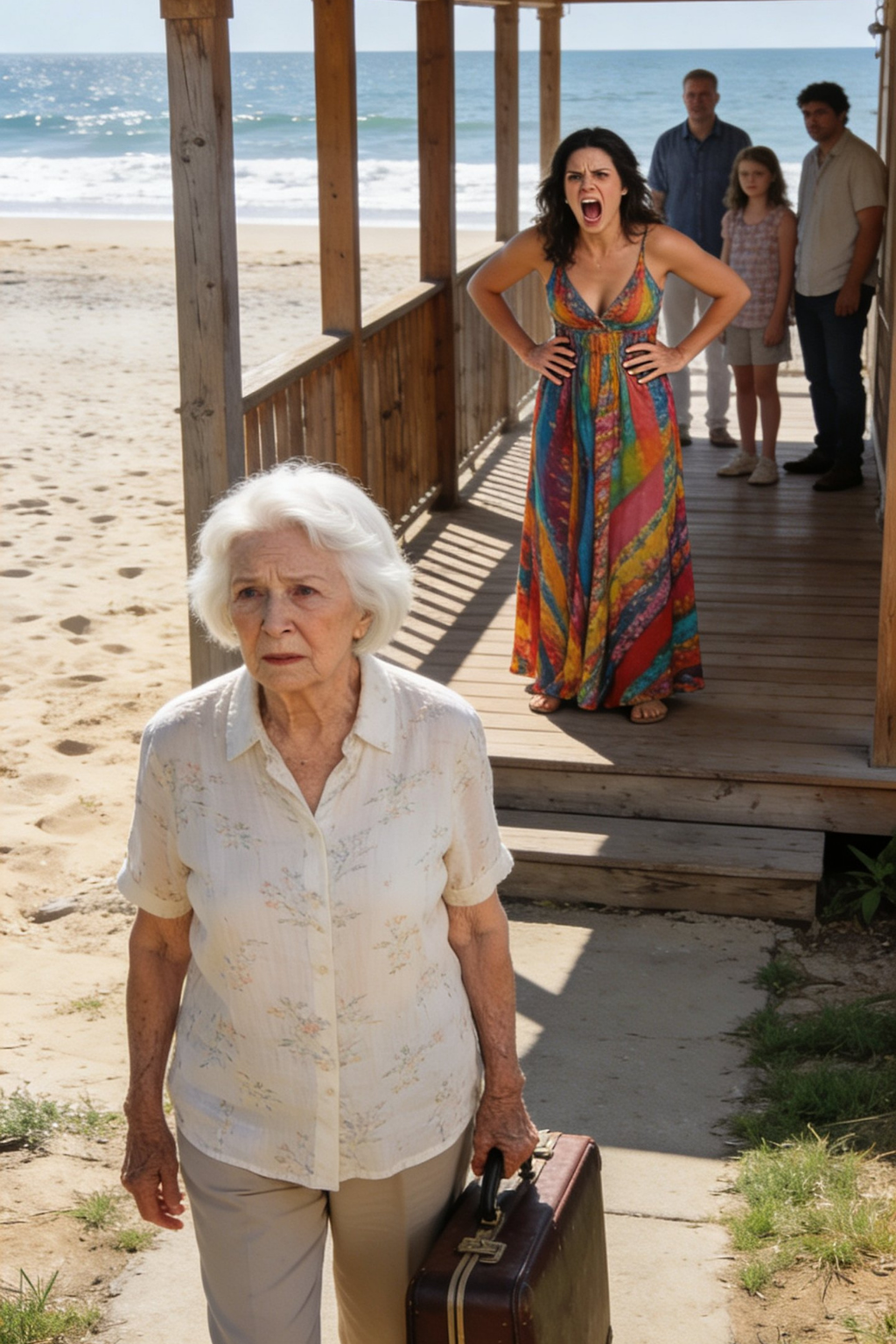

As Clara drove away from the beach house, the ocean wind moved softly through the cracked window beside her, carrying traces of salt air and the fading echoes of laughter that had poisoned the peaceful sanctuary she had spent years building. The image of Megan standing barefoot on her deck with a wine glass in hand, acting as if the property belonged to her, replayed in Clara’s mind over and over again. The humiliation still burned, but underneath the anger something colder had begun to settle into place.
Resolve.
Clara had learned long ago that rage disappears quickly, but strategy survives long enough to win.
So instead of turning the car around and screaming at her daughter-in-law the way Megan probably expected, Clara pulled over beside a quiet stretch of coastline where the waves crashed steadily against the rocks below. The ocean had always helped her think clearly. Years earlier, after her husband died, she used to sit in that exact spot reminding herself that grief only destroys you if you stop moving through it.
Tonight, she reached for her phone and called the one man she trusted completely.
Harold Edwards.
The attorney who helped her purchase the beach house after decades of careful saving, overtime shifts, and sacrifices nobody in her family had ever fully understood.
After several rings, his warm voice answered.
“Clara, it’s good to hear from you.”
“I wish it were under better circumstances,” she replied quietly.
And then she told him everything.
The unauthorized move-in. Megan changing furniture. Robert remaining silent while his wife treated Clara like an unwanted guest inside her own property. The laughter. The entitlement. The absolute certainty in Megan’s voice when she declared the house belonged to them now.
By the time Clara finished speaking, Harold’s tone had completely changed.
“This is unacceptable,” he said sharply. “And legally, they don’t have a leg to stand on.”
For the first time that day, Clara exhaled fully.
They discussed ownership records, occupancy laws, trespassing notices, and immediate legal options. Harold instructed her to gather every document connected to the property — deeds, tax payments, insurance statements, utility records.
“We move fast,” he told her firmly. “People like this gain confidence the longer nobody challenges them.”
As the sun disappeared beneath the horizon, Clara ended the call feeling something she hadn’t felt since arriving at the beach house earlier that afternoon.
Control.
Back in her city apartment, she spent hours pulling documents from filing cabinets and old lockboxes. Every paper told the story of what that house truly represented. Years of sacrifice. Years of working overtime after her husband’s death. Years of quietly choosing responsibility over luxury so she could someday own one peaceful place entirely for herself.
And now Megan had walked into it wearing sandals and arrogance, treating Clara’s hard-earned sanctuary like free vacation property.
The next morning, Clara sat across from Harold Edwards in his office while he slid a neatly prepared eviction packet across the desk.
The papers looked simple.
But they carried authority.
The kind of authority Megan never imagined Clara would actually use.
“Are you prepared for what this may do to your relationship with Robert?” Harold asked gently.
Clara stared at the eviction notice for several seconds before answering.
“My son already chose his side the moment he watched his wife humiliate me and said nothing.”
Harold nodded slowly.
Then the papers were served.
And chaos exploded almost immediately.
Megan called first.
“How DARE you embarrass us like this?” she screamed through the phone. “We’re FAMILY!”
Clara remained calm.
“Family doesn’t steal.”
“You’re overreacting! Robert said we could stay there temporarily!”
“Robert does not own that house.”
Then Megan’s voice changed completely.
Cold.
Threatening.
“You’re going to regret this.”
But Clara had spent too many years surviving harder things than an entitled woman throwing tantrums.
For the next two days, Megan flooded Robert’s family group chats with long emotional messages painting herself as the victim. She claimed Clara was “abandoning her grandchildren,” “destroying the family,” and “choosing property over people.”
What Megan conveniently ignored was the truth.
Nobody had asked permission.
Nobody had shown gratitude.
Nobody had treated Clara like family at all.
Then Robert finally called.
His voice sounded exhausted.
“Mom… did you really have to involve lawyers?”
Clara stood silently in her kitchen for several seconds before answering.
“Did you really have to stand there while your wife laughed at me inside my own home?”
Robert didn’t answer immediately.
And that silence hurt more than shouting ever could.
“You know Megan gets carried away sometimes,” he muttered weakly.
“No,” Clara replied calmly. “What I know is that your father spent thirty years teaching you to respect what people work for. Apparently only one of us remembered.”
Robert became defensive after that.
He complained about money problems. Housing costs. Stress. The children needing stability.
But Clara noticed something painful during the conversation.
Not once did he apologize.
Not once did he ask how humiliating that afternoon had felt for her.
And that was the moment Clara finally stopped feeling guilty.
Three days later, she returned to the beach house with Harold, two sheriff’s deputies, and a locksmith.
Megan opened the door wearing Clara’s silk robe.
The smugness on her face disappeared instantly when she saw the deputies standing behind Clara.
“What is THIS?” Megan snapped.
“The consequence of mistaking kindness for weakness,” Clara answered calmly.
Robert appeared seconds later looking pale and panicked.
“Mom, please… let’s talk about this.”
“We had the opportunity to talk,” Clara replied. “You stayed silent.”
The deputies supervised while Megan angrily packed designer bags and decorative pillows she had already purchased for “her new home.” She slammed drawers, cursed under her breath, and cried loudly enough for neighbors to hear.
But nobody stopped Clara.
Because legally…
Morally…
The house was hers.
As Megan dragged her final suitcase toward the driveway, she spun around furiously.
“You care more about this stupid house than your own family!”
Clara looked at the beach house quietly for a moment before answering.
“No. I care about respect. And somewhere along the way, all of you stopped giving me any.”
Then she stepped inside and closed the door herself.
The silence that followed felt different this time.
Not lonely.
Peaceful.
The ocean breeze drifted gently through the open balcony doors while sunlight spread across the hardwood floors again exactly the way Clara remembered. Megan’s perfume was gone. The loud television noise was gone. The tension poisoning the rooms was gone.
Clara slowly walked through the house touching familiar surfaces like she was reclaiming pieces of herself one room at a time.
Then she reached the back porch overlooking the water.
For several minutes, she simply stood there listening to the waves.
Months later, Robert attempted reconciliation more than once. Sometimes through texts. Sometimes through awkward phone calls. Sometimes through grandchildren asking innocent questions that clearly came from adults standing nearby.
Clara never cut him out of her life completely.
But something fundamental had changed.
Because love without respect eventually becomes permission for mistreatment.
And Clara had finally learned that protecting her peace was not cruelty.
It was survival.
One quiet evening near the end of summer, Clara sat wrapped in a blanket on the porch while the ocean rolled endlessly beneath the fading gold sky. A cup of tea warmed her hands, and for the first time in years, the beach house felt fully hers again.
Not because the legal battle was over.
But because she finally understood something important:
Home is not simply the place you build.
It is the place where nobody is allowed to make you feel small inside your own life.






Leave a Reply