
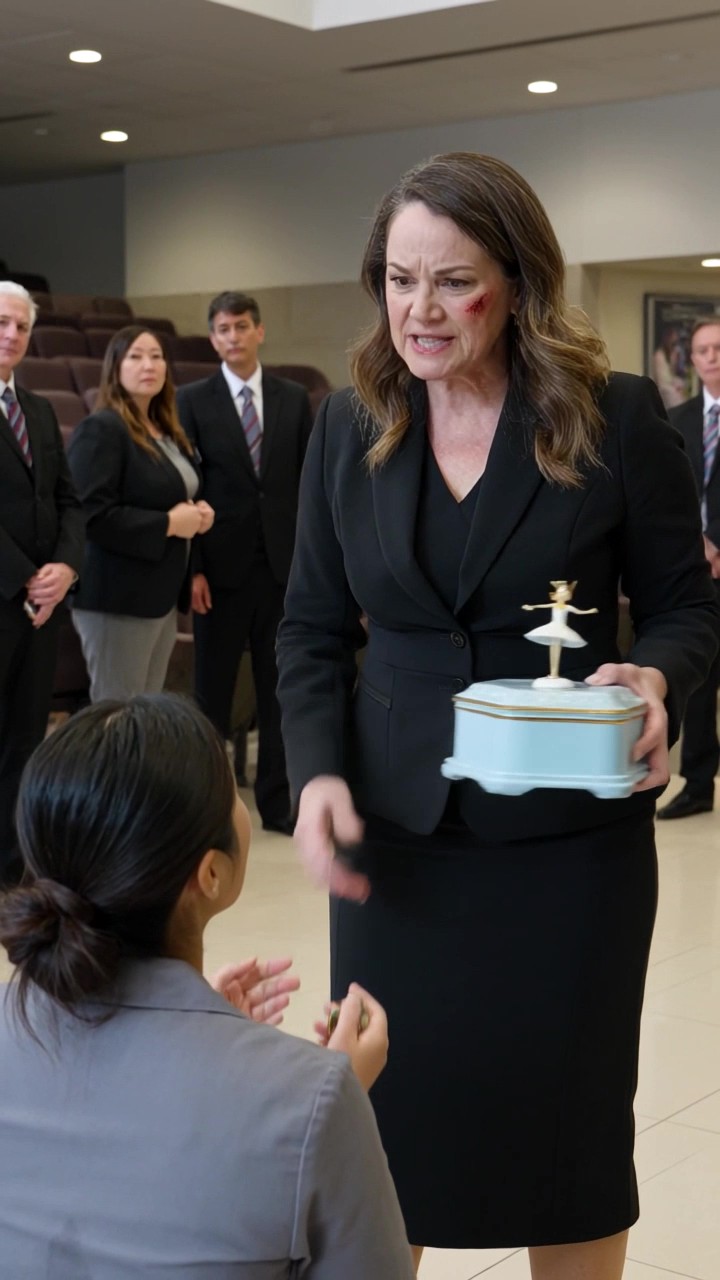
No one moved in the lobby.
Mrs. Wells lowered her hand.
Elena stood with the tiny metal dancer in her palm, one cheek red, eyes fixed on her daughter at the piano.
Sophie was twelve, small for her age, wearing a blue dress borrowed from the school costume room because Elena could not afford recital wear.
She had stopped in the middle of the most important performance of her life.
But she did not look ashamed.
She looked angry.
Dr. Helen Brooks opened the auditorium doors fully.
“Mrs. Park,” she said, voice tight with controlled fury, “please come in.”
Elena looked at her uniform.
“I’m wet from work.”
Sophie said, “Mom.”
That was all.
Elena walked in.
Every parent saw the cleaning logo on her shirt.
Every student saw the red mark on her face.
Every judge saw the broken music box.
Sophie left the piano bench and met her halfway down the aisle.
Mrs. Wells whispered, “The performance rules—”
Dr. Brooks cut her off.
“The performance has already taught us enough about rules.”
Sophie took the music box from her mother and held it up.
“My dad was a janitor,” she said, voice shaking but clear. “My mom is a janitor. When I was little and they couldn’t afford lessons, my dad wound this box in the school mop closet and taught me to count rhythm while Mom cleaned classrooms.”
The room was silent.
Sophie continued.
“He died before I ever played on a real piano. But the first song I learned was the song inside this broken box.”
She walked back to the stage, carrying the music box.
Elena tried to stop her.
“Sophie, you don’t have to—”
“Yes,” Sophie said. “I do.”
She placed the broken music box on top of the grand piano.
The metal dancer lay beside it.
Then she looked at the judges.
“I would like to start over.”
One judge nodded immediately.
Sophie did not play the competition piece.
She played the mop closet song.
Simple at first.
Three notes.
A pause.
Four notes.
A child’s melody.
Then she built it into something larger, something aching and bright, something that sounded like fluorescent lights, empty hallways, wet floors, a father laughing quietly, a mother working past midnight, and a little girl learning beauty from people the world called invisible.
By the time she finished, Elena was crying into both hands.
The judges stood.
Not because the piece was technically perfect.
Because it was true.
Mrs. Wells apologized in the lobby afterward.
Elena listened.
Then said, “You thought my uniform would lower the room.”
Mrs. Wells lowered her eyes.
“Yes.”
Elena looked toward the auditorium.
“It raised my daughter.”
Westbridge Arts Academy changed its recital policy after that night.
Parents arriving from work could enter between pieces, without penalty, without shame, regardless of uniform, job, or lateness caused by shift work.
A new scholarship fund was created for children of night workers, cleaners, security guards, cafeteria staff, delivery drivers, and maintenance workers.
Sophie won a conservatory interview.
But what mattered more was that the school repaired the music box.
They did not replace the broken corner.
They did not polish away the scratches.
They stabilized the dancer so she leaned but still turned.
In the music wing, under glass, the box sat with a plaque:
Great music does not always begin in grand rooms.
Elena still cleaned offices at night.
But once a week, she sat in the back of the academy auditorium while Sophie practiced.
Sometimes Sophie played Bach.
Sometimes Chopin.
Sometimes the mop closet song.
Every time Elena heard the first three notes, she saw her husband again, leaning against a mop bucket, turning poverty into music with a broken box and a tired smile.
And she knew that no uniform could make that memory small.





Leave a Reply