
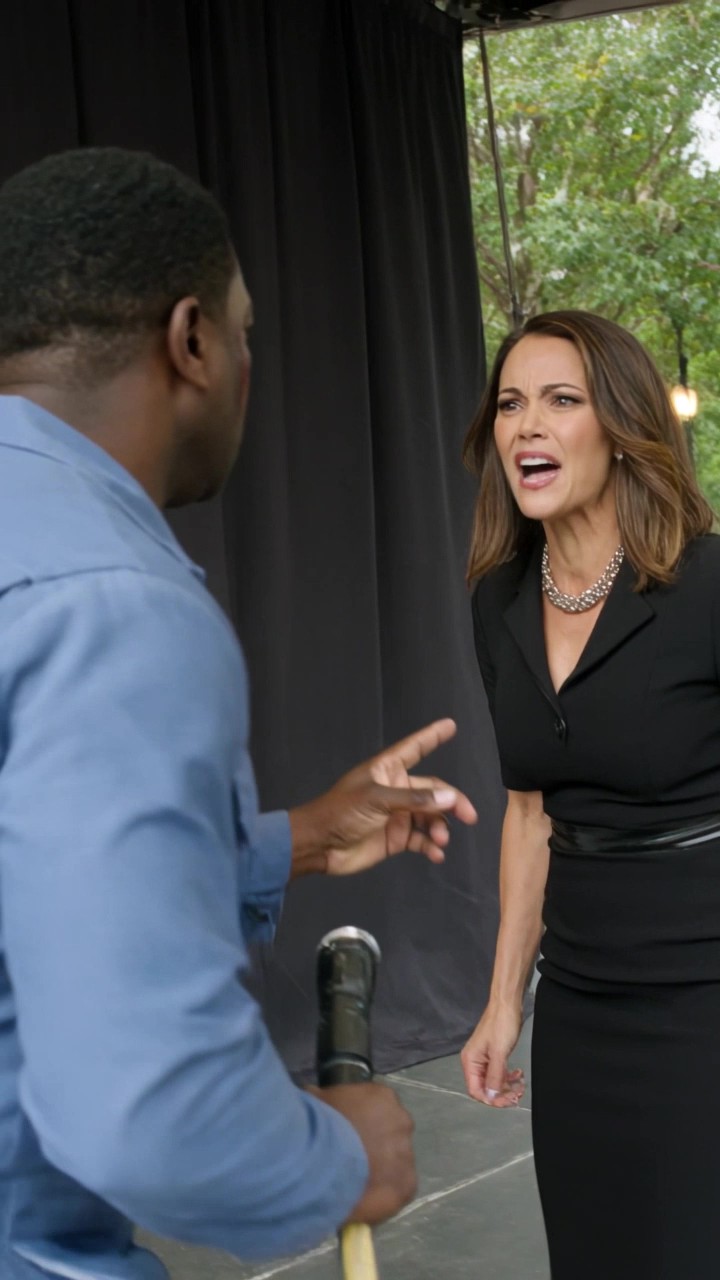
The park went silent except for the hiss of the damaged wiring.
Smoke curled from the firework rack.
The rear curtain had a blackened tear where the first blast had hit.
Caleb Brooks stood at the front of the stage, pale, one hand gripping the microphone stand.
Jared Cole stood beside him, cheek red, breathing hard, eyes still scanning the wires instead of looking for sympathy.
Marshal Helen Brooks pointed toward the crowd.
“Clear the first ten rows. Shut down all pyrotechnics. Kill the stage power.”
This time, everyone moved.
The event director Preston Hale tried to speak.
“Marshal, we had inspection approval.”
Helen turned on him.
“You had pre-rain approval. Did anyone recheck the tarp seals?”
Preston looked toward the technician.
The technician said nothing.
That was enough.
Vivian Brooks held Caleb by both shoulders.
“He could have been burned.”
Jared looked at her.
“Yes.”
The word was not cruel.
It was simply true.
Caleb turned toward him.
“You pushed me because you saw it?”
“I heard it first.”
“Heard what?”
“The wire arcing.”
Caleb stared at him.
“I thought you were some guy running on stage.”
Jared nodded.
“I know what it looked like.”
Vivian’s face crumpled.
She had built her life around controlling appearances. Tonight, appearance had told her a pool cleaner was a threat and a polished stage was safe.
Both had been wrong.
“I slapped you,” she whispered.
Jared looked at the smoking rack.
“Your son is standing.”
It was not forgiveness.
It was perspective.
Marshal Brooks crouched by the cracked hose nozzle.
“You worked carnival maintenance?”
Jared shook his head.
“My brother did. I was fourteen when he died. He told a supervisor about a wire near a dunk tank. Supervisor said the show had to go on.”
The fire marshal’s expression softened.
“And today you heard the same sound.”
Jared nodded.
“Some sounds don’t leave you.”
The mayor arrived then, shaken and furious, but not at Jared.
At the event team.
At the shortcut.
At the city staff who had let cameras matter more than rain safety.
The show was canceled.
Some people complained.
Then the fire marshal showed the damaged rack and the wet wiring path to reporters.
No one complained after that.
Preston Hale was removed from event management pending investigation. The pyrotechnics contractor lost its permit. A new city rule required post-weather safety checks for all temporary electrical structures before any public event could resume.
Jared expected to go back to fixing pumps.
Instead, Marshal Brooks asked him to join seasonal event safety training.
“I’m not a speaker,” he said.
“Then demonstrate,” she said. “People remember what they can hear.”
So he stood in front of city workers with two wires, a pump motor, and a soaked piece of tarp, showing how a tiny crackle could become a blast if pride kept people from stopping.
Caleb attended the first training.
Not as punishment.
By choice.
Afterward, he walked to Jared with a new hose nozzle.
“My mom said this belonged to your work kit.”
Jared took it.
“Your mom bought it?”
“My mom apologized badly. I’m trying to do better.”
Jared almost smiled.
“That’s a start.”
Months later, Westbridge Park installed a small sign near the stage power panel:
A warning is not disruption. It is protection arriving early.
Jared still cleaned fountains.
Still wore rubber boots.
Still smelled like chlorine.
But now, when he said, “Kill the power,” nobody asked whether a pool cleaner had authority.
They moved first.
Asked later.
Because sometimes saving someone looks rough.
Sometimes it looks like a shove.
And sometimes the truth arrives one second later, in smoke, sparks, and the empty space where a child almost stood.



Leave a Reply