
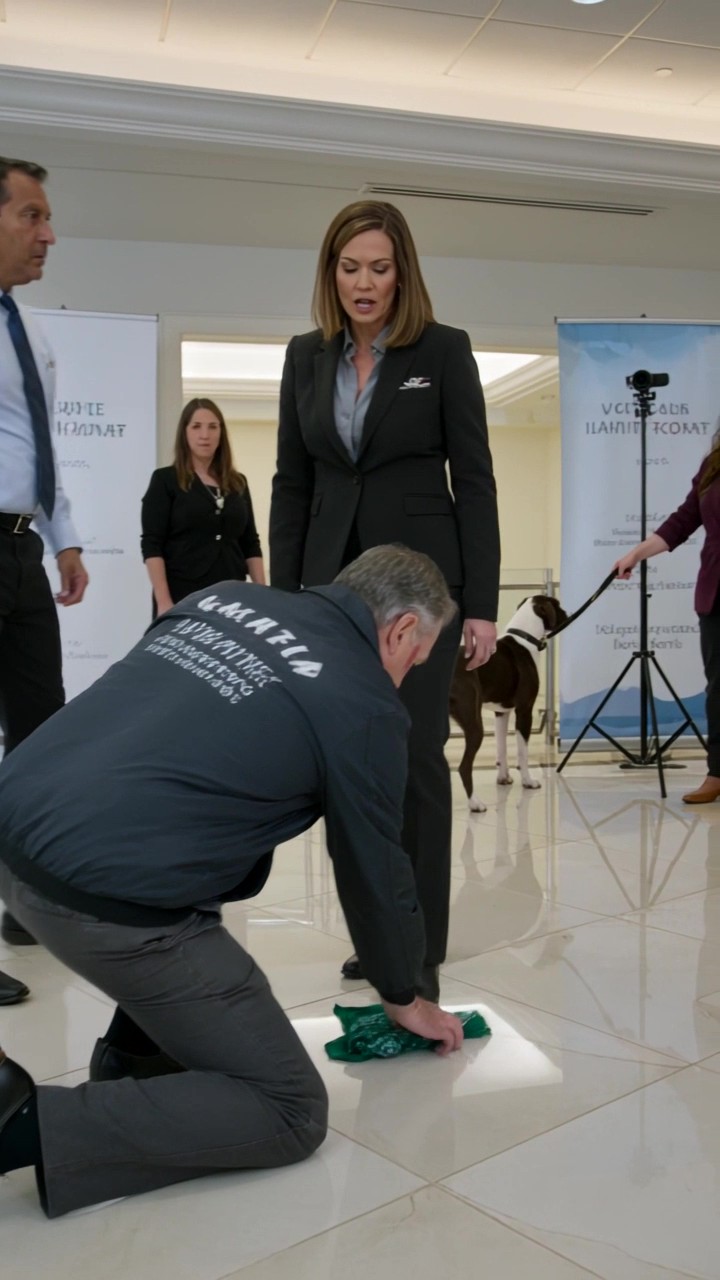
No one reached for the leash.
The dog lay across Samuel’s boots with the green bandana under his chest, as if the faded cloth and the old man were the only safe floor in the room.
Madison Whitmore began to cry.
Not loudly.
Quietly, with the helpless shame of a child realizing the adults have turned something living into something owned.
Vivian looked furious because she did not know where to put the cameras now.
Captain Helen Brooks walked toward Samuel.
“Sam.”
Samuel nodded once.
“Captain.”
She knelt with effort and let the dog smell her hand.
“Scout,” she said softly.
The dog lifted his head and thumped his tail once.
Madison whispered, “His name really is Scout.”
Helen looked at Preston.
“It always was.”
Preston swallowed.
“The shelter renamed him during rebranding.”
Helen’s eyes sharpened.
“Rebranding a disaster dog?”
The words carried across the hall.
Helen turned to the guests.
“During the Alder River flood, this dog and this man worked the school shelter for nine straight nights. Sam slept beside the supply closet because Scout would panic when thunder hit the metal roof. Together they found two children trapped behind the bleachers after a generator failed. Scout barked until Sam crawled under the collapsed divider.”
Samuel looked down.
“They were scared.”
Helen nodded.
“And alive.”
Madison stepped closer to her mother.
“Mom, we can’t take him.”
Vivian hissed, “This is not your decision.”
Samuel looked at Madison.
“You are kind for seeing him.”
That hurt Vivian more than accusation would have.
Preston tried to regain control.
“The adoption paperwork is complete. The Whitmore donation is already processed.”
Helen turned slowly.
“Where are the county hold documents?”
Preston froze.
Samuel lifted his chin.
“I signed temporary care papers. Never surrender papers.”
The room shifted again.
That difference mattered.
Temporary care meant the dog had not legally been abandoned.
Surrender meant the shelter could adopt him out.
Helen looked at Preston.
“You told him the dog died.”
Preston’s face reddened.
“We could not hold animals indefinitely for unstable housing.”
Samuel flinched.
Helen’s voice hardened.
“So you lied to a flood-displaced volunteer and sold his dog’s story to donors.”
No one clapped now.
No one smiled.
The adoption was suspended immediately. County animal services opened an investigation. The Whitmore donation remained with the shelter, but Vivian could not buy silence with it.
Madison did something her mother did not expect.
She took the gold ATLAS collar off the dog.
Then she held it out to Samuel.
“I’m sorry.”
Samuel shook his head gently.
“You didn’t do it.”
“I held the leash.”
He looked at her for a long moment.
Then took the collar and placed it on the table.
“He does not need gold to know his name.”
The shelter later confirmed Samuel’s paperwork. Scout was returned to him under a support program for displaced owners. A local housing nonprofit helped Samuel move into a small pet-friendly apartment behind the old railroad station.
Scout walked through the door first.
He sniffed every corner.
Then climbed onto Samuel’s old blanket and sighed like he had been holding his breath for two years.
The green bandana was washed but not replaced.
Samuel tied it loosely around Scout’s neck during community visits.
Not for ownership.
For memory.
Madison began volunteering at the shelter after the investigation.
At first Vivian forbade it.
Then Madison said, “I want to learn how to help something without buying it.”
That sentence ended the argument.
Months later, a small display was placed inside the shelter lobby.
A photograph showed Samuel, soaked from the flood, sitting on a gym floor with Scout’s head in his lap and two rescued children wrapped in blankets nearby.
Under it were the words:
A collar can be changed. A bond cannot be renamed.
Scout still answered to one voice fastest.
Not because Samuel owned him.
Because Samuel had stayed.




Leave a Reply