
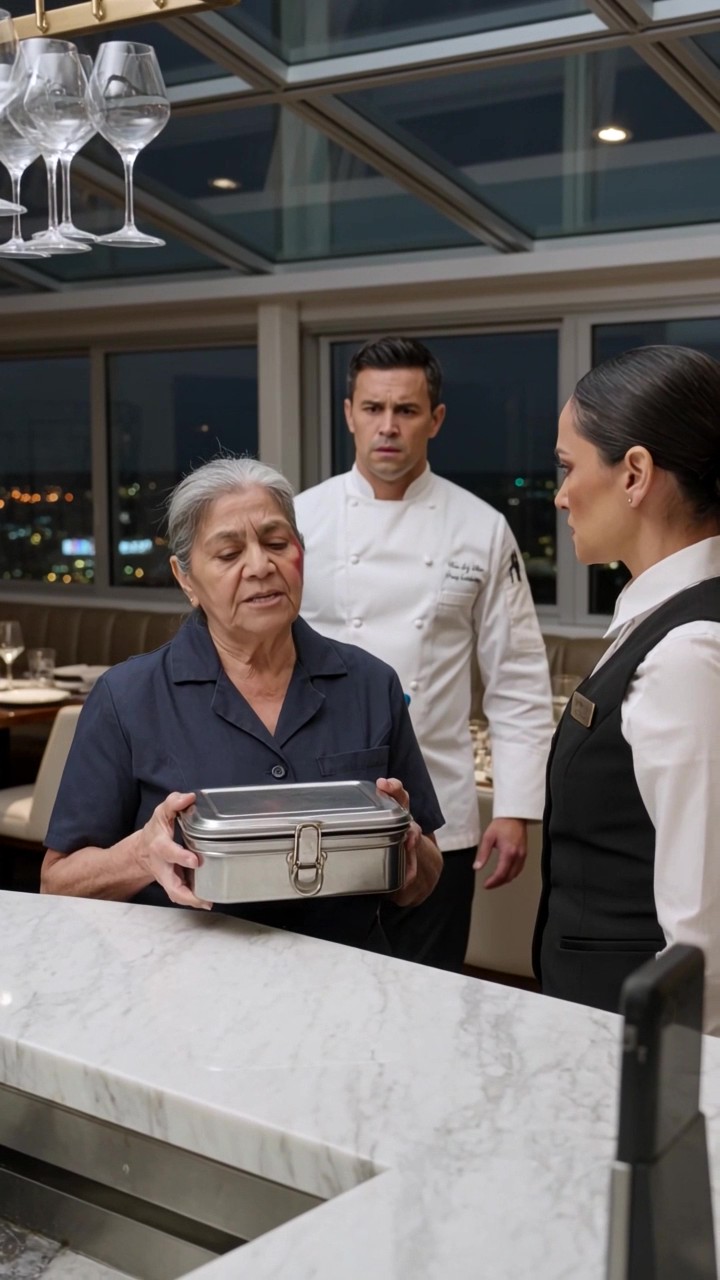
Adrian Vale stood frozen with the blue spoon in his hand.
The entire restaurant waited.
Aunt Helen rolled closer, her eyes locked on Rosa Bell.
“Rosa,” she whispered.
Rosa held one hand to her red cheek.
“Helen.”
Adrian looked between them.
“You know each other?”
Aunt Helen nodded.
“I came to Westbridge to pick you up after your mother’s last hospitalization. Rosa was there.”
Adrian swallowed.
“I don’t remember you there.”
Helen’s eyes filled.
“You were twelve. You had decided not to remember anything that hurt too much.”
Rosa closed the tin lunchbox gently.
“Your mother wanted to pack your lunch that morning. She could barely stand. She called the school and asked me to make tomato rice the way she did.”
Adrian’s voice was rough.
“My first course tonight…”
“I know,” Rosa said. “I read about it. Smoked tomato foam. Saffron rice crisp. Your mother would have laughed at the price, then asked if it filled anybody up.”
A few guests looked down at their plates.
Adrian felt heat behind his eyes.
Rosa continued.
“She told me, ‘He hates asking for seconds. Put extra at the bottom. Burn it a little. He likes scraping the pot.’”
That was the detail that broke him.
Nobody knew that.
Not critics.
Not investors.
Not Vivian.
Adrian used to scrape the bottom of the rice pot when his mother turned away, pretending he was just helping wash dishes.
He sat down on the restaurant step because his legs had stopped trusting him.
Aunt Helen looked at Vivian.
“This woman fed him when my sister was too sick to lift a pan.”
Vivian whispered, “I didn’t know.”
Adrian looked up, tears on his face.
“You didn’t need to know her history to not hit her.”
The sentence moved through the restaurant like a verdict.
Rosa opened the lunchbox again and removed the hard-boiled egg.
“It is too old to eat,” she said softly. “Not this one. I brought a fresh one today. But your mother always said tomato rice needed an egg so a boy could sleep without hunger.”
Adrian took it like a sacred object.
Then he stood.
He walked back into the open kitchen and lifted the perfect plates of smoked tomato foam one by one.
The investors stared.
The food writers leaned forward.
Adrian said, “Cancel the first course.”
His sous-chef whispered, “Chef?”
“Cook rice.”
“With what?”
“With tomatoes. Garlic. Onion. Stock. And leave the bottom alone when it catches.”
For the first time that night, the kitchen smelled like a home instead of a performance.
Rosa stood beside the stove and told him when the rice needed water.
Adrian listened.
Not as a celebrity chef.
As a boy with a spoon.
When the bowls went out, they were not beautiful in the usual way.
Red rice.
Half an egg.
A little burnt edge.
Guests took one bite and understood that they were tasting something too honest to critique like luxury.
Adrian served Rosa first.
She shook her head.
“Your mother made it for you.”
He looked at the bowl.
“No. You did when she couldn’t.”
Then he took the first bite.
The room blurred.
He saw his mother’s hands.
Rosa’s cafeteria apron.
A lunch table in winter.
The ache of leaving.
The kindness of being fed without being asked to explain hunger.
After that night, the restaurant changed its menu.
Not entirely.
Adrian still cooked beautifully.
But every service began with a staff meal served before guests arrived.
No worker cooked hungry.
No dishwasher ate standing up.
No line cook pretended coffee was dinner.
Once a month, the restaurant opened a lunch program for children whose parents were in hospitals nearby. No cameras. No sponsor wall.
The tin lunchbox was placed near the kitchen entrance.
Inside it sat the blue spoon.
Under it were the words:
Before memory became cuisine, it was lunch.
Vivian was dismissed.
Rosa visited every Thursday.
She never liked the elevator.
She said restaurants this high made food forget the ground.
Adrian always laughed.
Then he made rice.
Not foam.
Not crisp.
Rice.
Tomato rice with the bottom burned just enough to remember.





Leave a Reply