
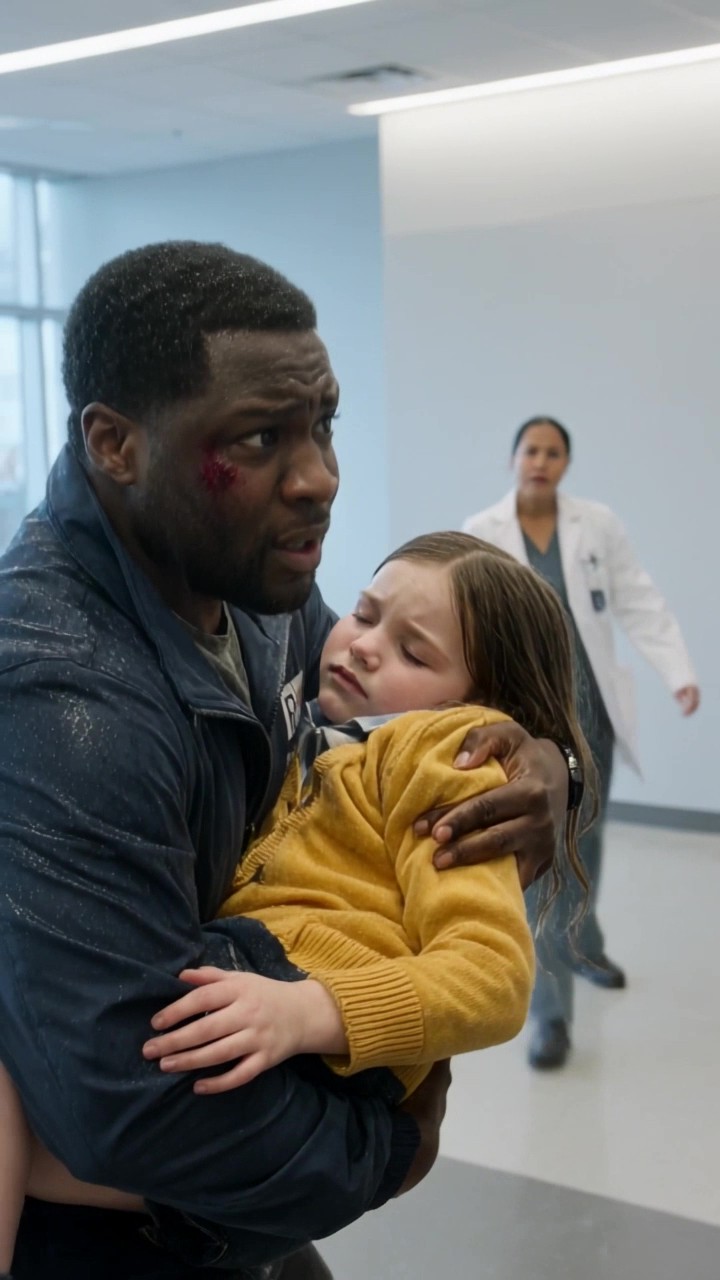
Dr. Helena Morris did not ask permission.
She took Lily from Marcus’s arms with the nurse beside her and said, “Treatment room now.”
Paul Whitman opened his mouth.
The doctor cut him off.
“Now.”
The nurse moved fast.
Marcus followed until a guard stepped in front of him.
Dr. Morris turned.
“He stays until the child’s guardian arrives. He brought her in.”
That was the first time anyone in the lobby said it correctly.
Brought.
Not took.
Not carried without documentation.
Brought.
Lily was treated immediately. Her breathing eased with oxygen and medication. Her grandmother arrived twenty minutes later, soaked, terrified, and crying so hard she could barely sign her name.
She had been stuck when her bus broke down three stops away. Lily had used the red pass every day to ride with her grandmother after school. The pass mattered because it told Lily she was going home.
Marcus stood outside the treatment room, wet jacket in his hands, cheek still red.
Dr. Morris came to him with the bus pass.
“You stopped at Alder Street Elementary?”
“Yes.”
“You knew her?”
“No.”
“But you stopped.”
Marcus looked at the floor.
“My sister died after a school trip because adults spent too long deciding who was responsible.”
Dr. Morris’s face changed.
“Nora Reed?”
Marcus looked up.
“You knew her?”
“My sister, Claire, was on the city council committee that investigated school transit delays after Nora died. She pushed for Route 14 safety stops before she passed. That bus line exists because your family fought for children not to be left waiting alone.”
Marcus swallowed.
“My mother fought. I just… stop when kids look wrong.”
“That is not small.”
Paul stood near the desk, pale.
Dr. Morris turned toward him.
“You threw away the child’s bus pass?”
Paul whispered, “I was trying to establish identity.”
“You had identity. A child in respiratory distress.”
He said nothing.
Dr. Morris continued, voice low and cold.
“You struck the man who brought her in while blocking assessment.”
The security guards looked away.
Marcus picked up the laminated photo from the floor. It was damp now, but still visible.
“My sister used to say the worst place to need help is a room full of adults arguing about rules.”
Dr. Morris looked at Paul.
“Mercy Ridge just proved her right.”
The hospital reviewed the lobby footage that night.
The result was immediate.
Paul was removed from patient-facing administration. The hospital changed policy: any child entering any door with breathing difficulty would receive immediate medical screening before security or paperwork questions. Staff were trained on good-Samaritan arrivals, especially when the adult bringing a child was not a parent.
But Marcus did not care about policy language until Lily’s grandmother called him one week later.
Lily wanted to return his delivery jacket.
She had washed it.
Badly.
It still smelled faintly like rain and pizza.
Inside the pocket, she had placed the red bus pass, now laminated, with a note in careful second-grade handwriting:
Thank you for not waiting.
Marcus kept it in his delivery bag beside Nora’s photo.
A month later, Mercy Ridge installed a small sign near the main entrance:
If a child comes through this door in distress, this is the emergency entrance.
Route 14 buses began stopping directly in front of the hospital during school hours.
Marcus still delivered pizzas.
Still drove in the rain.
Still looked like a man most polished lobbies would judge too quickly.
But now, whenever he passed Alder Street Elementary and saw a child standing alone, he slowed down.
Not because he wanted to be a hero.
Because he remembered what waiting had cost his family once.
And because Lily was alive to ride the bus home.







Leave a Reply