
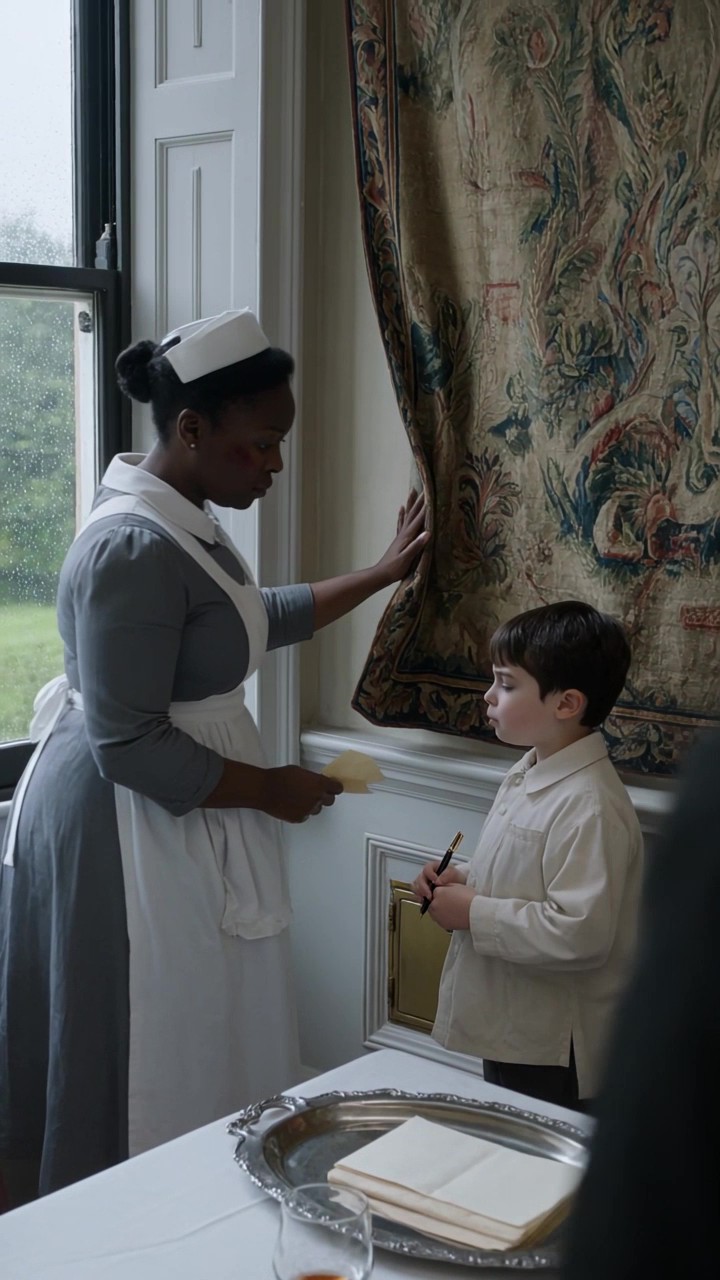
No one touched the dumbwaiter.
The dining room had become too still.
The sapphire heart locket hung from the typewriter carriage, turning slowly on its chain. Blue light moved across the wall like water.
Oliver stood beside Clara, shaking.
Richard looked at the open shaft as if the house had betrayed him.
Mr. Alden crossed the room and removed the locket carefully.
“Evelyn said the house would open when Clara brought the thimble.”
Clara touched her red cheek.
“She left it in my room.”
“Yes,” Mr. Alden said. “Because your grandmother worked here.”
Clara’s eyes sharpened.
“My grandmother?”
“Ruth Brooks. Evelyn’s personal maid when Evelyn was young.”
Clara stared at the typewriter.
Her grandmother had told stories about Briarwood, but never details. Only that rich houses had more locked doors than poor ones.
Mr. Alden placed the letters on the dining table.
“Evelyn wrote these during her final year. She feared Richard would destroy them if she gave them to the family directly.”
Celeste looked at her brother.
“Why would she fear that?”
Richard said nothing.
Mr. Alden opened the sapphire locket.
Inside was not a portrait.
It was a tiny folded hospital card.
He read the name aloud.
“Oliver James Briar-Miller.”
Oliver blinked.
“Miller?”
Mr. Alden nodded gently.
“Your mother’s name.”
Richard snapped, “His mother abandoned him.”
The attorney turned.
“No. His mother died after childbirth. Evelyn adopted him privately after your brother Daniel passed, because she believed Oliver was Daniel’s son.”
Celeste covered her mouth.
“My brother had a child?”
Mr. Alden looked at Richard.
“Your mother believed Richard hid the DNA confirmation because Daniel’s child would change the estate trust.”
Oliver stepped closer to Clara.
The room understood then.
This was not about a missing locket.
It was about inheritance.
About a child.
About a dead son’s line continuing where Richard wanted it erased.
Clara looked at Oliver.
“Your grandmother wanted you to know your name.”
Oliver whispered, “Did she love me?”
The question broke Celeste.
Mr. Alden answered.
“She built a locked wall to keep your truth alive after she was gone.”
He lifted one letter.
“To Oliver, when they tell you love must be proven by blood paperwork, remember I knew your laugh before I knew the law would catch up.”
Oliver began to cry.
Clara knelt beside him.
She did not hug him immediately.
She waited.
He leaned into her first.
Richard saw it and looked away.
Mr. Alden continued.
“Evelyn appointed Clara Brooks temporary household witness because Ruth Brooks helped hide Evelyn’s first letters from a controlling father decades ago. Evelyn believed the Brooks women understood how to protect truth from powerful men.”
Clara’s eyes filled.
Her grandmother had not simply cleaned Briarwood.
She had once helped a young woman keep her voice.
Now Clara had done the same.
The will proceedings halted.
Oliver’s legal status and trust rights were reviewed. Richard was removed as executor after evidence showed he had tried to suppress Oliver’s birth record and sell assets before the review period ended.
Celeste sat with Oliver in the dining room long after everyone left.
“I didn’t know,” she told him.
Oliver looked at Clara.
“She listened to the wall.”
Celeste nodded.
“We should have.”
The old dumbwaiter was repaired, not sealed.
The typewriter remained on display inside the dining room, beside the sapphire locket and Ruth Brooks’s brass thimble.
A plaque was placed beneath them:
Some houses speak only when someone humble enough listens.
Clara did not inherit a fortune.
She did not want one.
But Evelyn left her grandmother’s old room to her for life, along with a handwritten line:
For Clara, who knew a housekeeper’s ear can be more honest than an heir’s mouth.
Oliver visited her there often.
He brought school papers, broken toys, questions about his father Daniel, and once, a small wooden sign he made himself.
It said:
THE HOUSE WRITES WHEN PEOPLE LIE.
Clara laughed when she saw it.
Then she hung it above the repaired dumbwaiter door.
And sometimes, when the wind moved through the shaft, the old typewriter bell rang softly.
Not because of ghosts.
Because truth, once opened, refuses to stay quiet again.






Leave a Reply