
Nobody moved.
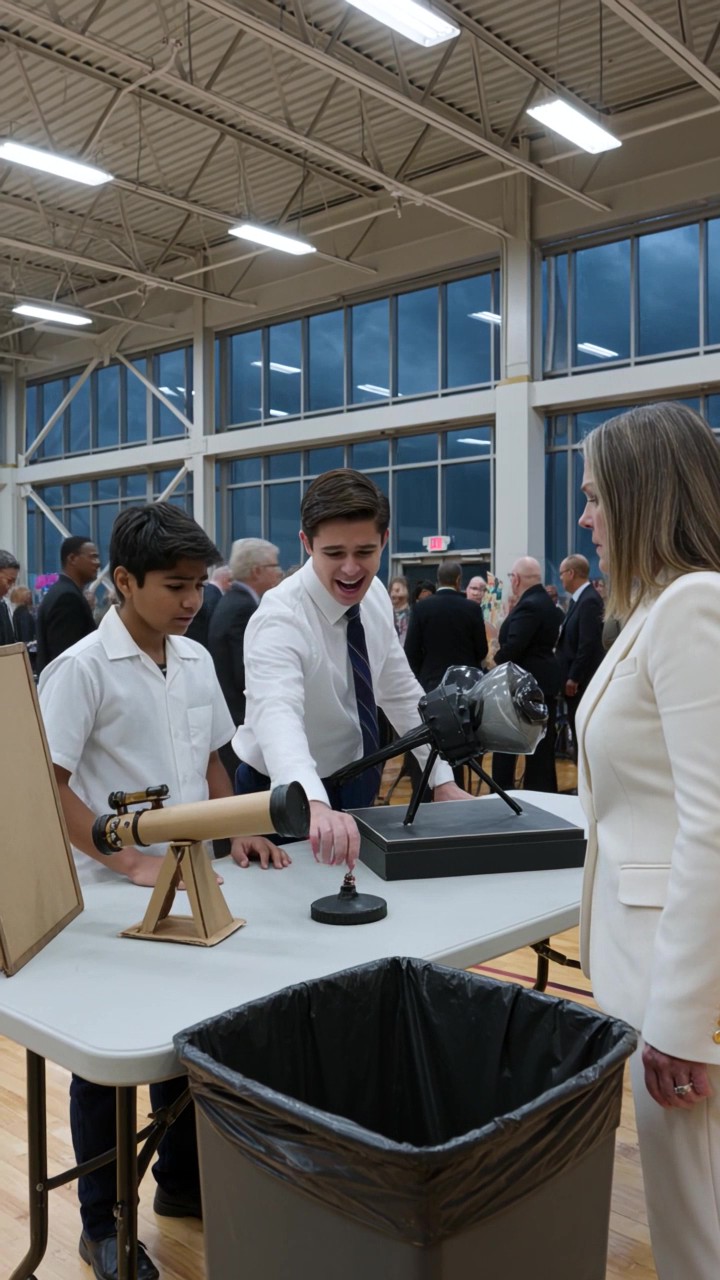
Captain Daniel Hayes stood beside Table 22 with the burned lens cap in his hand.
Mateo stared at him.
“You knew my uncle?”
The astronaut nodded slowly.
“I was one of the students Luis Rivera got out of Red Mesa Observatory.”
The gym shifted.
Carter’s face lost its smugness.
Mrs. Wells stood frozen, one hand still half-raised as if the slap had not fully left the room.
Captain Hayes looked at Mateo’s telescope.
“Luis used to say the best instrument is the one that survives long enough to help someone see.”
Mateo swallowed hard.
“He told me that too.”
The captain turned toward Mrs. Wells.
“And someone threw his lens cap in the trash?”
She whispered, “I didn’t know.”
Mateo looked at her.
“You didn’t need to know him to not hit me.”
The line landed across the gym harder than the storm.
Captain Hayes placed the burned cap on the table, beside the broken lens and torn cereal box.
Then he looked at the projected moon on Mateo’s display board.
“Did your telescope do that?”
Mateo nodded.
“The power went out, so the screens stopped. But the window still had light.”
The captain smiled.
“That is the point of low-cost science, isn’t it? It works where expensive systems fail.”
The judges gathered.
Mateo explained through a shaking voice.
He showed how the drainpipe tube focused light.
How the cracked camera lens could still be aligned.
How the burned cap protected the lens when stored.
How schools without electricity could still teach astronomy with moonlight, patience, and a window.
The room stopped looking at the duct tape.
They started looking through it.
Captain Hayes asked for the story of Red Mesa.
Mateo told it simply.
“My uncle was maintenance. During a lightning fire, he covered the main lens, opened the lower exit, and got the visiting students out before smoke filled the dome. He said nobody wrote about him because he wasn’t the astronomer.”
Captain Hayes’s voice tightened.
“I wrote about him. The letter was sent to the observatory. I never knew if his family received it.”
Mateo shook his head.
“We didn’t.”
The captain pulled out his phone and called his assistant.
“Find the Red Mesa letter from 1998. Tonight.”
Mrs. Wells stepped closer.
“I am sorry.”
Mateo did not answer quickly.
Then he said, “My project was not ugly because we were lazy. It looked like that because we used what we had.”
Mrs. Wells nodded.
“I was wrong.”
Captain Hayes looked at the parent committee.
“Presentation standards are not supposed to punish poverty. They are supposed to reveal thinking.”
By the end of the night, Mateo did not win the prettiest display.
He won the Innovation Access Award.
But the bigger thing happened two weeks later.
Captain Hayes found the old letter.
It said Luis Rivera had saved twelve students, protected the observatory lens, and stayed behind until every child was accounted for.
The academy held a new assembly.
Not in the gym.
Outside, under the night sky.
Mateo stood beside his repaired telescope while students lined up to look at the moon.
No tablets.
No LED lights.
Just sky.
Captain Hayes handed Mateo a framed copy of the letter.
At the bottom, he had added one sentence:
The person who opens the dome may teach more courage than the person who names the stars.
Mateo’s grandmother cried when she read it.
The burned lens cap was placed in a small case beside the telescope whenever Mateo presented.
Under it were the words:
Science belongs to everyone who looks up.
And every time a wealthy parent passed Table 22 in later years, they did not see plumbing trash.
They saw the moon.




Leave a Reply