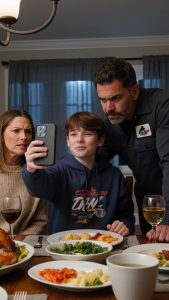
Marcus pushed the dining table against the front door while Claire called emergency services.
The stranger kept talking through the glass.
Calm.
Friendly.
As if he had been invited.
“Owen, tell them you know me.”
Owen stood behind Marcus, pale and shaking.
“I don’t know him.”
The man outside held up a gift card.
“You said you wanted this.”
That was true.
Three weeks earlier, Owen had joked on livestream that he wanted a rare game skin. NorthStarDad offered to buy it if Owen did a “real house tour.”
Owen had shown the upstairs hallway.
Not the address.
He thought.
But small details had built the map:
the school mascot on his hoodie,
the bus route visible through the window,
the street sign reflected in the microwave,
the blue curtains,
the nickname.
Marcus had noticed the account because the questions were never about videos.
They were about access.
Police arrived within minutes and detained the stranger near the side gate. He claimed he only wanted to give Owen a gift. Officers found screenshots of Owen’s streams, notes about the family schedule, and multiple saved images of the house.
No one at the table called Marcus paranoid after that.
But Marcus did not celebrate being right.
He sat beside Owen on the kitchen floor while an officer spoke with Claire.
Owen stared at his dead phone screen.
“Are they going to blame me?”
Marcus answered carefully.
“You made a mistake. That is not the same as inviting someone to frighten you.”
“I told people things.”
“You didn’t understand what those things became when someone collected them.”
Owen looked at him.
“Why didn’t you tell me without grabbing my phone?”
Marcus exhaled.
“I tried.”
“You talked like I was stupid.”
That landed.
Marcus nodded.
“I did.”
Safety had made him harsh.
Fear often does.
He apologized without adding a lecture.
The next week, Owen posted one video.
No house background.
No live location.
No family members on camera.
He said:
“I thought privacy meant hiding my address. It also means not giving strangers enough pieces to build it.”
Then Marcus appeared beside him.
Uncomfortable.
Arms crossed.
Owen added:
“My uncle was right about the danger and wrong about how he talked to me. Both things can be true.”
The video became his most shared post.
Not because it had a dramatic rescue.
Because families recognized the argument.
Parents used it to talk about oversharing.
Teenagers used it to explain why control without respect makes them stop listening.
Owen did not quit creating.
That would have turned fear into another prison.
He changed how he created.
Delayed uploads.
No school logos.
No house tours.
No private nicknames.
A moderator for livestreams.
A code word with his mother if anyone online became invasive.
Marcus helped build the safety settings.
Owen helped Marcus learn not to treat every conversation like an emergency.
At the next Thanksgiving, phones were allowed for one group photo.
Then they went into a basket until dessert.
Owen complained.
Marcus complained about the burnt rolls.
Grandma called them both dramatic.
The family laughed.
Before dinner, Owen checked the front curtains.
Not because he was afraid of the world.
Because he finally understood that being seen by thousands is not the same as being known by people who love you.

Leave a Reply