
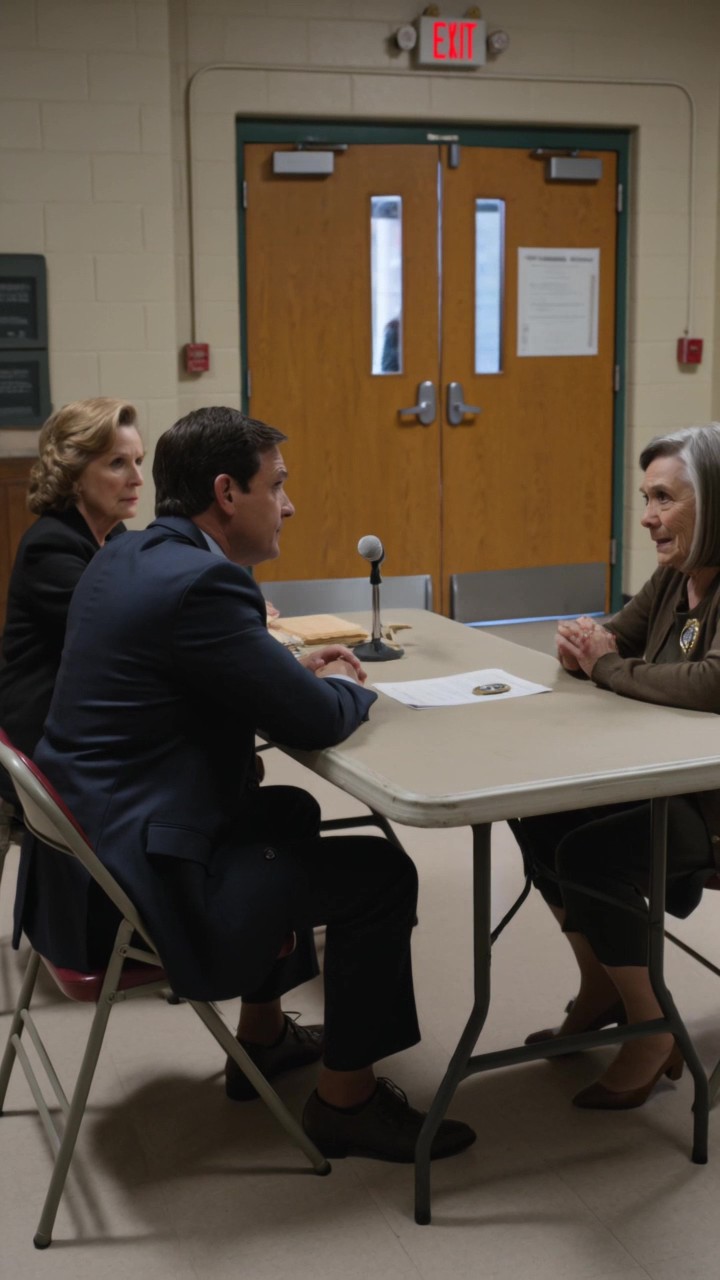
The auditorium did not move.
Maya Reed stood beside the woman the town had called a kidnapper.
Nora stared at her as if looking directly at sunlight after years indoors.
“You came,” she whispered.
Maya nodded.
“I was allowed to choose now.”
That sentence explained the eight-year silence better than any legal speech could.
Preston Hale recovered first.
“Ms. Reed, this hearing concerns district employment procedures. Your presence does not erase—”
“It erases the lie,” Maya said.
She took the microphone before he could object.
“When I was fourteen, my father violated a protective order and came to my school. The district knew there was a confidential safety plan. Mrs. Bell was one of three staff members trained to recognize my emergency signal.”
She lifted the green card.
“The silver star facing up meant he had found me.”
Parents in the audience lowered their eyes.
Some had called Nora dangerous online.
Some had signed petitions.
Some had taught their children to avoid her at the grocery store.
Maya continued.
“She locked me in the archive room because it had a fire door and no exterior windows. She disabled the entrance chime so he could not hear where I was. She did not call my home because my home was the danger.”
Vivian stood.
“My brother loved you.”
Maya looked at her aunt.
“He loved being obeyed.”
The words were not shouted.
They did not need to be.
Vivian sat down.
Maya turned back to the board.
“A protected transfer team took my mother and me to another county. Mrs. Bell drove with us because I was too frightened to enter the van without her.”
Preston looked at Nora.
“You could have told the board under confidential seal.”
Nora shook her head.
“The district attorney advised that the shelter plan had already been compromised. Every additional record created another place her father might search.”
Maya added, “The board wanted a public statement because the school’s reputation was damaged. Mrs. Bell would not use my abuse to repair the district’s image.”
That was the real betrayal.
Not Nora’s.
The district had allowed one quiet employee to carry public hatred because defending her would require admitting it had failed to keep a dangerous parent off campus.
Nora had lost her job.
Her friends stopped calling.
Her husband died before her name was cleared.
She missed his final months of peace because reporters still came to the house.
That was the cost.
Protection had not made her a secret hero living comfortably in the dark.
It had taken years from her.
Maya looked at Nora’s old brass badge on the table.
“May I?”
Nora nodded.
Maya picked it up and pinned it back onto Nora’s cardigan.
The audience stood without being asked.
Not everyone.
But enough.
Preston looked at the unsigned pension form.
“This hearing is suspended.”
Maya shook her head.
“No. Finish it.”
He looked at her.
“Excuse me?”
“Do not delay her dignity the way you delayed the truth.”
The board withdrew the revocation request that night.
Within a month, the district restored Nora’s pension, issued a formal correction, and opened an independent review of how confidentiality had been used to hide administrative cowardice.
Nora did not ask for her job back.
The library had been renovated.
The archive room was now a media lab.
The old book cart was gone.
Some places cannot be returned to simply because the truth arrives.
Instead, Maya asked Nora to help create a small reading room at a youth shelter in another county.
No public address.
No photographs of residents.
No names on the door.
Only shelves, warm lamps, and green library cards with silver stars available to any child who needed a silent way to ask for help.
On opening day, Maya handed Nora the first card.
Nora turned it over.
On the back, Maya had written:
You kept the door locked until my life could open.
Nora cried then.
Not because the town finally believed her.
Because the girl had survived long enough to choose when the story belonged to her.







Leave a Reply