
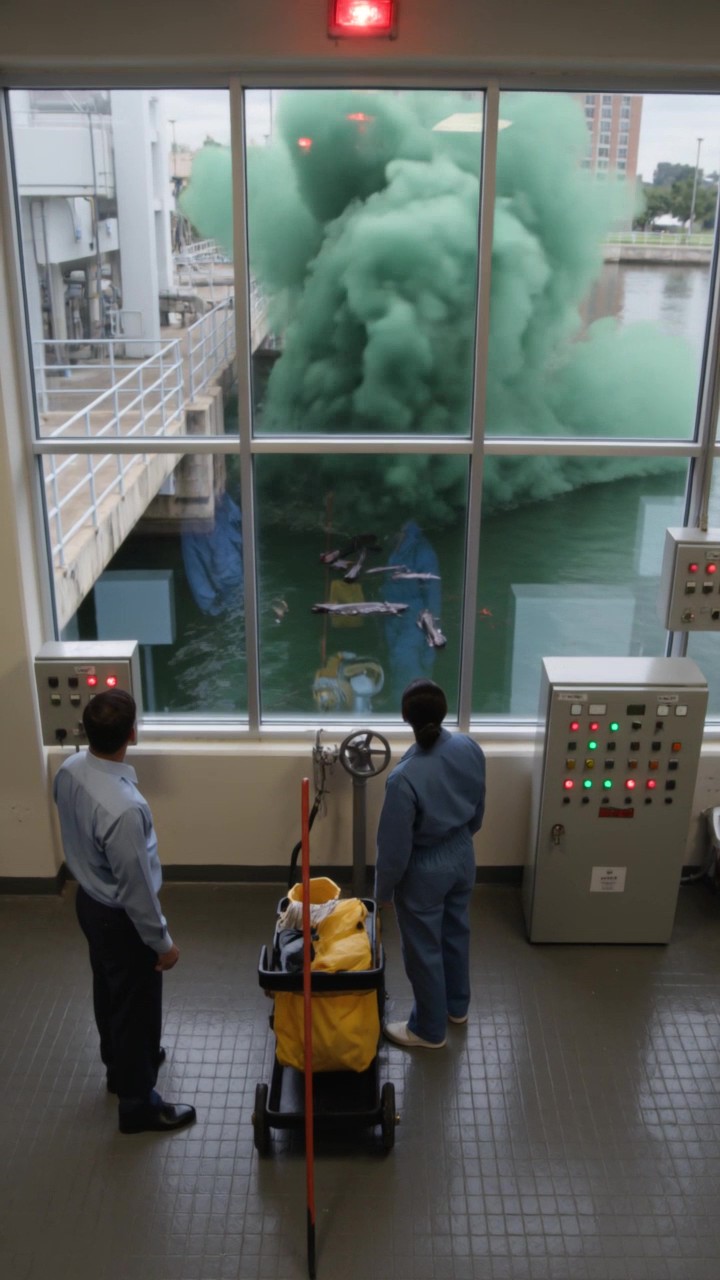
The first official chemical alarm sounded after Intake Gate 3 was fully closed.
By then, Mila Torres had already stopped the pumps.
The dark plume spread across the channel, carrying solvent runoff from an overturned industrial tanker two miles upstream. The spill entered a drainage canal that was not connected to the city’s central warning network.
The automated sensors sampled the wrong side of the river.
The cameras faced the wrong angle.
The only person watching the east wall was the woman who emptied trash and cleaned algae from the lower stairs.
Emergency teams arrived within minutes.
Reserve tanks maintained hospital pressure.
The festival opened late with bottled water stations.
Nobody became sick.
That absence became the evidence of Mila’s success.
Disaster prevention is strange that way.
When it works, people see inconvenience instead of victims.
Vivian Hart stood beside the control panels while technicians tested Mila’s sample.
The solution turned deep violet immediately.
The lab manager looked up.
“High concentration industrial solvent.”
Preston’s face went gray.
“How did you know before the sensor?”
Mila looked toward the river.
“The snails closed.”
He blinked.
“What?”
“My father taught me. Fish leave first. Snails seal. Then the water starts smelling sweet.”
Vivian picked up Mila’s wet brass key from the cleaning cart.
“Your father worked here?”
“Thirty-two years.”
“Why are his initials on an emergency key?”
“He cut replacement teeth by hand during the 1996 ice storm after the electric gate failed.”
The plant’s oldest mechanic heard her and nodded.
“Rafael Torres kept the intake from freezing shut. We never retired that key because no new one fit as cleanly.”
Mila looked at Preston.
“You called it nostalgia.”
He lowered his eyes.
“I was wrong.”
She did not rescue him from the discomfort.
“Yes.”
The city investigation found more than a missed spill.
Cleaning crews had reported strange odors near the canal three times that month. Their notes never reached operations because non-technical staff reports were categorized as housekeeping comments.
The river itself had been speaking through people no one considered qualified to hear it.
Mila’s suspension was canceled.
Vivian offered her a promotion to environmental observation coordinator.
Mila asked one question.
“Will the cleaners be allowed to stop the intake?”
Vivian hesitated.
“Under defined emergency conditions.”
Mila placed the brass key on the table.
“Then define them broadly enough to include being right before a computer is.”
The new policy did exactly that.
Any worker physically present at the river—cleaner, mechanic, security guard, groundskeeper, lab courier—could request an immediate five-minute intake hold without supervisor approval.
Five minutes for a human being to make the system look again.
The plant added east-wall sensors and wildlife observation logs.
Not because snails replaced science.
Because local knowledge could tell science where to look.
Mila accepted the new position but kept one cleaning shift each week.
She said offices made people forget what water smelled like.
The brass key was mounted beside the manual valve, not in a museum case.
It remained usable.
Under it, the plant installed a metal plate:
COMPUTERS WATCH NUMBERS. PEOPLE WATCH WATER.
Rafael Torres’s sentence.
Mila’s proof.
Months later, a group of schoolchildren toured the intake station.
One boy asked why the key looked old.
Mila handed him a clean replica.
“Because old does not mean useless.”
He pointed toward the river snails attached to the wall.
“Did they really save the city?”
Mila smiled.
“They warned us.”
“Then you saved it?”
She looked at the closed emergency gate, the new sensors, and the cleaners recording what they saw on waterproof cards.
“No,” she said. “We finally listened in time.”





Leave a Reply