
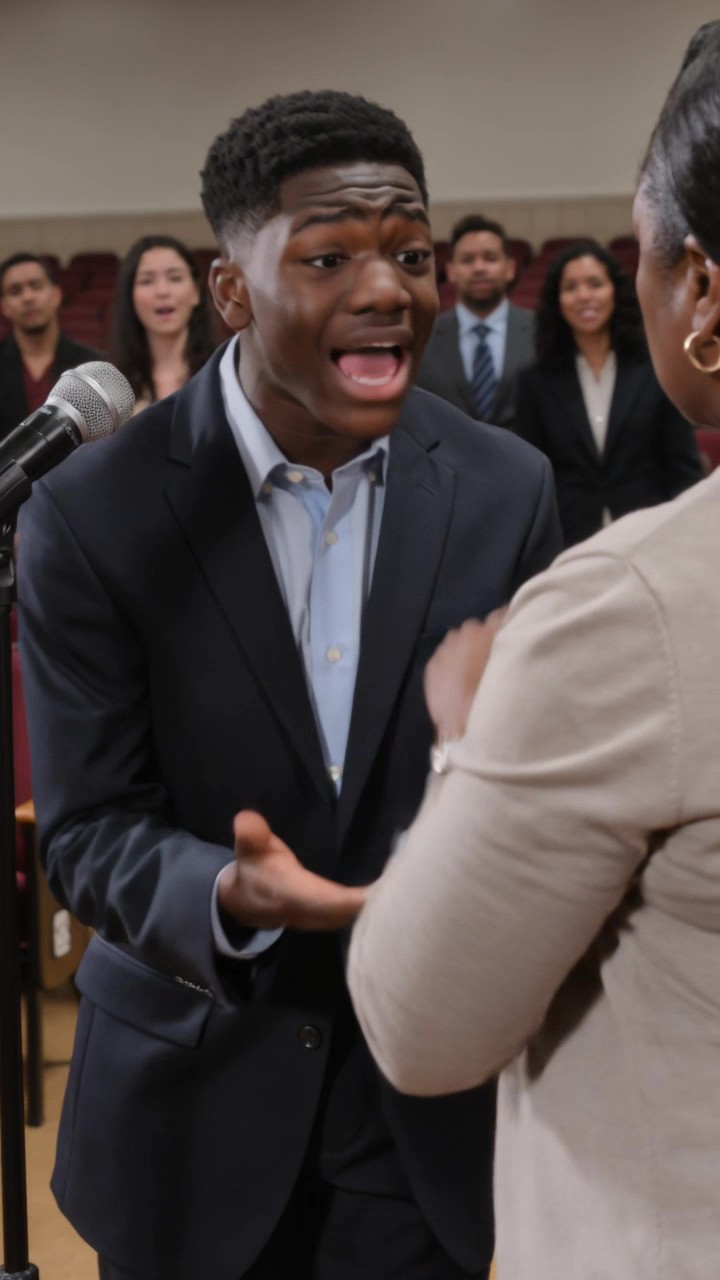
Jamal Carter stood in the center aisle holding a cracked library card in one hand and his mother’s paper dinner bag in the other.
Denise looked down at her cafeteria uniform.
For years she had taught him not to feel ashamed of work.
Now she was afraid her presence might cost him the future she had worked to build.
“Go finish,” she whispered.
Jamal shook his head.
“Not their version.”
He returned to the stage.
No pages waited on the podium.
Only the microphone.
Vivian Hart stood near the curtain, signaling for him to begin the prepared speech from memory.
Jamal looked at Mrs. Bell.
The librarian had not left.
She stood beside the exit without her badge, quiet and uncertain, as if she had just destroyed a boy’s chance and would accept his hatred if that was the cost of keeping his life honest.
Jamal placed the library card on the podium.
“My name is Jamal Carter,” he began. “I was told the strongest version of my story was that nobody stayed.”
Denise covered her mouth.
“That is not true.”
The room leaned toward him.
“My mother stayed through two jobs. She stayed while serving breakfast to children whose parents had more money than we did. She stayed on buses after midnight. She stayed even when I got angry that she could not come to school events because she was working.”
He looked toward the back row.
“I turned her staying into abandonment because someone told me pain sells better when the person who sacrificed is removed from the picture.”
Vivian’s face tightened.
The judges looked at one another.
Jamal continued.
“The library was my second home. But it was not my only home. Mrs. Bell kept me there safely until my mother’s shift ended. She repaired this card when it cracked.”
He lifted it.
“She said a damaged card still opens the same door.”
His voice shook.
“I think people are like that too.”
No one moved.
Jamal told the real story.
How Denise woke at four in the morning to prepare school breakfasts.
How he did homework at a cafeteria table while she counted meal trays.
How Evelyn let him practice speeches between bookshelves.
How shame had entered his life only when adults taught him that survival needed to be made more dramatic to deserve investment.
He did not beg for the scholarship.
He ended with a question.
“If your opportunity requires a student to erase the person who carried him to the door, what exactly are you rewarding?”
Then he stepped away from the microphone.
The applause did not begin immediately.
That mattered.
People had to decide whether they admired his honesty or resented being included in the accusation.
The first person to stand was not a donor.
It was Denise.
She was crying.
The second was a cafeteria coworker beside her.
Then students rose.
Teachers.
Finally, the judges.
Vivian did not.
After the ceremony, the scholarship panel asked Jamal, Denise, and Evelyn to remain.
Vivian tried to control the conversation.
“The speech was developed through standard narrative coaching.”
Evelyn looked at her.
“You instructed a child to describe a living mother as absent.”
“We shaped a concise story.”
“You sold poverty with the worker cropped out.”
One judge removed her glasses.
“Was the original application accurate?”
Jamal nodded.
“Yes. The abandonment story was added during coaching.”
The panel suspended Vivian from the program and reviewed every finalist’s materials.
Jamal was not handed the scholarship instantly.
That would have made the truth feel like a performance trick.
He was interviewed again.
Without a consultant.
Without staged grief.
The panel asked about grades, goals, community work, and the library tutoring program he had created for younger students.
Two weeks later, he received the Westbridge Promise Scholarship.
The official letter praised his academic record and his commitment to educational access.
It did not call him fatherless.
Self-raised.
Or rescued.
Denise opened the letter at their kitchen table.
Then she looked at Evelyn.
“You risked his scholarship.”
Evelyn nodded.
“I did.”
“You could have told me first.”
“Yes.”
“Why didn’t you?”
Evelyn looked at Jamal.
“Because he had to decide whether to say the lie. I could remove the pages. I could not make the choice for him.”
Denise considered that.
She was still angry.
Grateful too.
Both emotions were allowed to remain.
Jamal repaired Evelyn’s torn badge lanyard with black thread and returned it when the school reinstated her.
She placed his cracked library card inside a small frame near the checkout desk.
He protested.
“That is embarrassing.”
She smiled.
“Good. Important things usually are.”
The sign beneath it read:
NO FUTURE IS WORTH BUILDING BY ERASING WHO HELPED YOU REACH IT.
At college, Jamal studied public policy and education.
His first major project examined how scholarship campaigns turned poor students into simplified stories for donors.
He did not stop telling difficult truths.
He simply stopped allowing other people to decide which parts of his family made the story marketable.
And every time he entered a library, he carried the cracked card.
It still opened no electronic door.
But it reminded him who had kept the real ones open.





Leave a Reply