
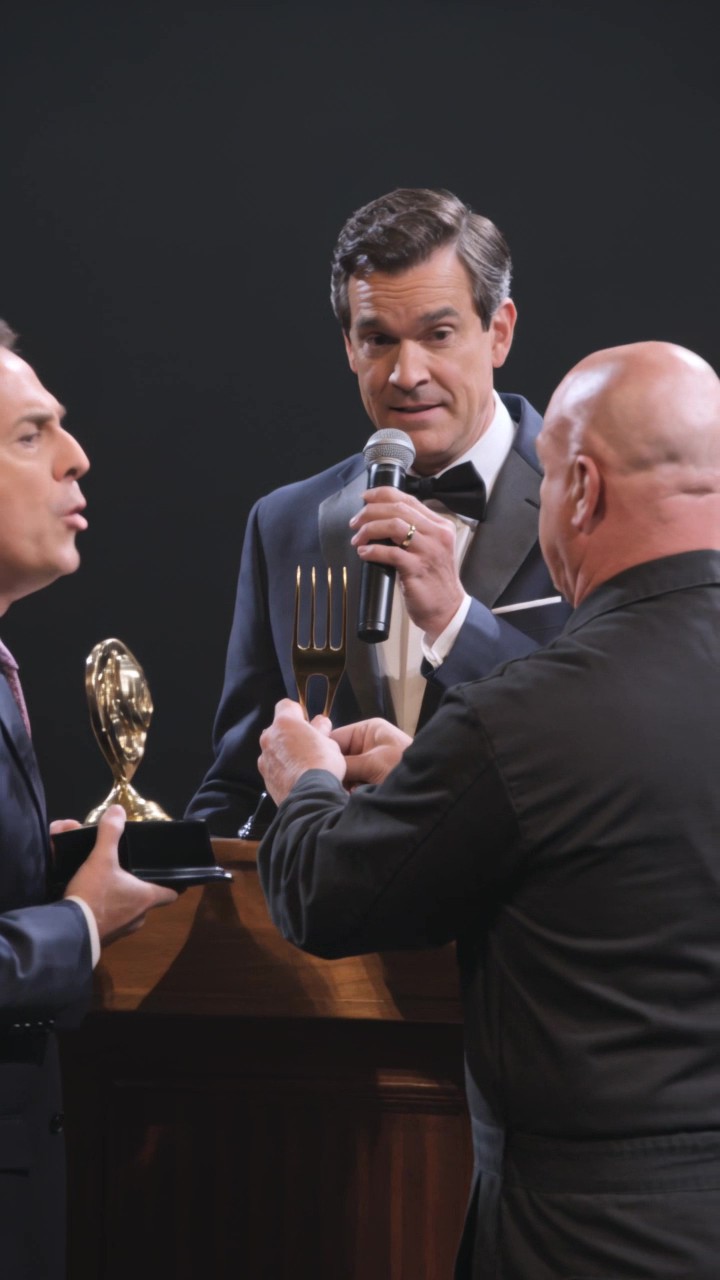
Caleb Reed stood beneath the theater lights without his stage badge.
For twelve years, he had worked in smaller venues under temporary contracts while the story of Adrian Vale’s rescue appeared in documentaries, anniversary interviews, and award speeches.
Each version became cleaner.
Producer Preston Hale noticed the rig.
Preston shouted a warning.
Preston pulled Adrian to safety.
The real event had been messier.
Caleb had been checking cable tension on the side catwalk during sound rehearsal. Because he could not rely on shouted cues, he kept a brass tuning fork in his tool pouch.
His father, a piano technician, had taught him to use vibration as information.
A healthy steel rail carried a clean response.
A shifting rig disturbed it.
When Caleb struck the fork that night, the vibration stuttered beneath his fingers.
He saw a support clamp moving.
The lighting truss was beginning to drop toward center stage.
Caleb hit the emergency power switch.
The theater went dark.
Adrian froze beneath the main spotlight, unable to see why the music had stopped.
Caleb ran through the curtain and pulled him by the jacket.
The truss fell behind them.
One lamp struck Caleb’s hand and bent the tuning fork beneath his palm.
Preston reached them after the impact.
He called the ambulance.
He controlled the press area.
He told reporters he had “recognized the danger and initiated evacuation.”
Caleb’s name appeared nowhere.
The drummer, Marcus Bell, climbed from the orchestra pit during the awards ceremony.
“I saw Caleb cross the stage,” he said. “Preston was at the sound desk.”
Preston’s face hardened.
“Memories change after traumatic events.”
A retired wardrobe supervisor stood next.
“I wrapped Caleb’s hand before the paramedics came.”
Then a former electrician raised his voice from the balcony.
“Caleb cut the main power. The emergency log recorded his station.”
Preston looked around the theater.
The people he had expected to remain background were standing one by one.
Adrian held the award against his side.
“Why did nobody tell me?”
Caleb signed slowly.
The interpreter spoke.
“People did.”
The answer hurt more than accusation.
After the accident, Caleb submitted a statement. The production company’s attorney said public discussion could interfere with liability negotiations.
Caleb was offered six months of technical work if he agreed not to speak independently.
He needed the health insurance.
His hand required surgery.
He signed.
Later, when the agreement ended, the rescue story was already attached to Preston’s career. Any correction from a deaf temporary worker sounded, to the company, like bitterness.
Caleb wrote Adrian twice.
The letters went through management.
Adrian never saw them.
Preston lowered his voice.
“I coordinated the emergency response after the collapse.”
Caleb nodded.
He did not deny it.
Preston had called medical teams.
Cleared the theater.
Helped protect the injured crew.
Those actions mattered.
They were not the same as detecting the failure and pulling Adrian away.
The problem was not that Preston had done nothing.
The problem was that he accepted everything.
Adrian faced the audience.
“This award was created around a false version of my own life.”
He placed it on the floor between himself and Caleb.
“I cannot simply hand it to another person and pretend that fixes twelve years.”
Caleb looked surprised.
Adrian continued.
“The theater industry removed a worker’s name because his contract, job title, and disability made him easier to edit out.”
The ceremony ended without a winner.
That frustrated the sponsors.
It also prevented the correction from becoming another hurried photo.
An independent review followed.
Former crew members gave statements.
The production company acknowledged that Caleb initiated the shutdown and performed the immediate rescue.
Preston’s role was corrected to post-impact emergency coordination.
The safety award was withdrawn.
Preston lost his position as head of the theater foundation, though he continued producing after several years away from public leadership.
Caleb was offered money.
He accepted compensation for lost employment and medical expenses.
He refused a ceremonial “hero consultant” title with no authority.
Instead, he proposed changes.
Temporary stage workers would be included in incident reports by name.
Safety testimony could not be filtered solely through production management.
Visual and vibration-based alerts would be standard backstage, improving communication for deaf and hearing crews alike.
And no confidentiality agreement could prevent a worker from accurately describing their role in a safety incident after immediate legal risk had passed.
The theater adopted the changes.
Caleb returned to the main stage one year later.
Not for an award.
To lead a rigging-safety workshop.
He placed the bent tuning fork on a steel rail and invited the technicians to touch the metal.
Some felt the clean vibration.
Others did not.
Caleb signed:
“You do not need to experience warning the same way to respect the person who detects it.”
Adrian attended from the front row.
Afterward, he apologized privately.
“I built gratitude around the wrong name.”
Caleb answered through the interpreter.
“You built it around the name they gave you.”
“That does not make it harmless.”
“No.”
Caleb did not absolve him.
Adrian had benefited from a simplified story, even unknowingly. Repair meant more than feeling guilty.
He funded accessible backstage apprenticeships but placed them under an independent technical board so the program did not become personal redemption branding.
The old award was melted down.
Part of the metal became small safety plates installed beside emergency power switches.
One plate was mounted at Caleb’s original station.
It read:
THE FIRST WARNING MAY COME FROM THE PERSON THE STORY FORGETS.
Caleb kept the tuning fork.
The bend remained.
During workshops, young stagehands often asked why he never replaced it.
He would place it in their hands, strike it gently, and wait.
The vibration was imperfect.
Still present.
A damaged tool could carry truth.
So could a person whose name had been removed





Leave a Reply