
The school-board room changed the moment Grace Miller spoke.
Evelyn Bell had prepared herself to lose her job.
She had not prepared to see the girl return.
Grace’s mother, Rachel, stood beside her with both hands wrapped around a folder she never opened.
The proof did not need to begin with paper.
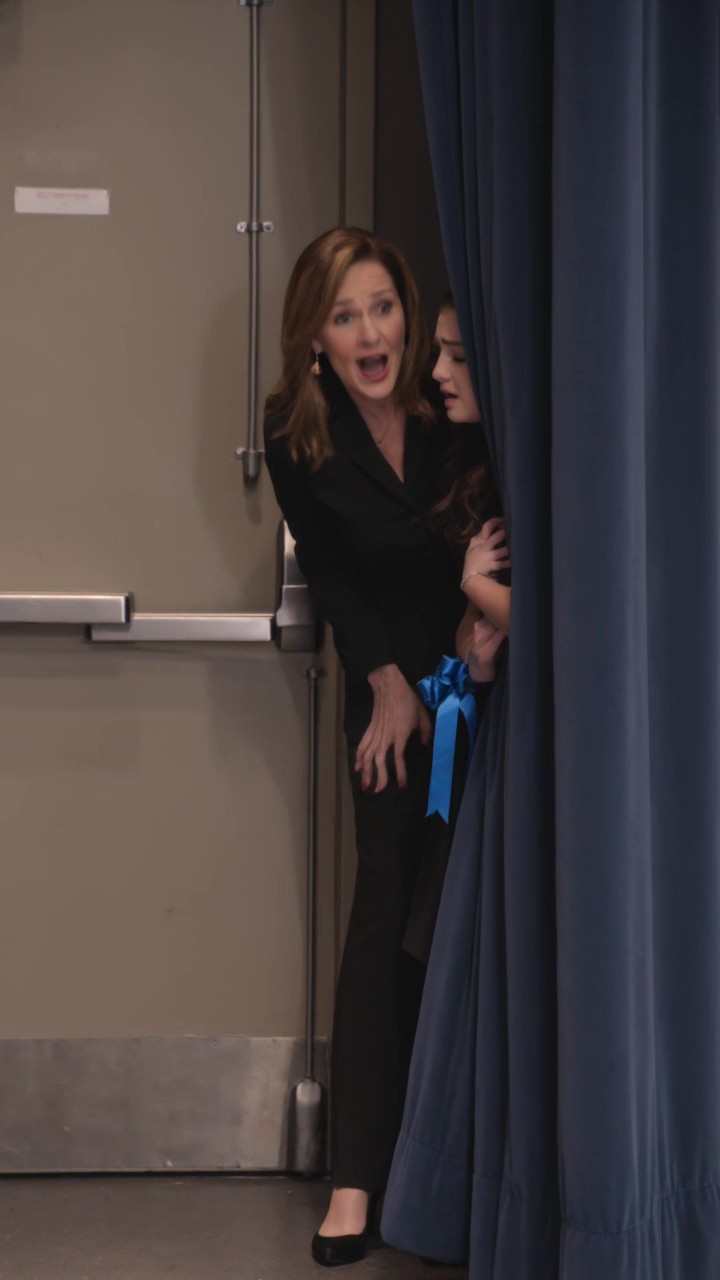
It began with the blue ribbon.
Rachel had tied one like it around Grace’s wrist on every court date after they left the old town. It was a quiet signal between them:
If someone dangerous appears, follow the blue marker and do not call out.
Evelyn learned the system when Grace enrolled under a protected identity.
The district safety officer showed her the father’s photograph and gave only the information she needed.
Do not confirm the student’s former name.
Do not announce the threat publicly.
Move the child through a preplanned exit.
Protect the location of the parent.
During the scholarship audition, Evelyn saw the father before security did.
He had changed his hair and wore glasses, but the scar beside his eyebrow matched the safety photograph.
Grace was singing beneath a livestream camera.
The program listed the school, performance time, and student name.
If Evelyn waited for a private conversation, the man could reach the stage or follow Rachel into the parking lot.
So she killed the sound.
Removed Grace.
Marked the safe route with the blue ribbon.
Then she told the room the failure was hers.
Principal Vivian looked at the officers.
“Was the man arrested?”
One officer nodded.
“He left the auditorium when the microphone stopped. Exterior cameras showed him following the costume-wing exit. Officers detained him near the service alley.”
Grace touched the ribbon.
“He thought I went that way.”
Evelyn had tied the marker to the visible stage door, but the costume hallway branched behind the curtain. Grace and Rachel exited through the laundry corridor while security watched the route the father expected.
Evelyn had not simply removed the girl.
She had used the performance confusion to direct the threat away from her.
The conservatory judge, seated near the board table, looked at Evelyn.
“Why did you not tell us afterward?”
Rachel answered.
“Because he had people contacting relatives and former neighbors. We did not know who had given him the audition information.”
The protected identity could not be explained safely while the network around the father remained under investigation.
Evelyn accepted suspension.
Accepted the social-media posts.
Accepted parents saying she had destroyed a poor student’s one chance.
Grace had hated her for the first two days.
“I thought you decided I was not good enough,” she said.
Evelyn looked at her.
“I know.”
“You let me believe that.”
“I needed you to leave without saying anything he could hear.”
Grace’s eyes filled.
“Did you know they would close my scholarship file?”
“Yes.”
The room grew quiet.
That was the cost.
Evelyn had protected Grace’s immediate safety but could not guarantee the conservatory would offer another audition.
The judge stood.
“Our panel was told the director had interrupted without cause. We were not told there was an active safety emergency.”
Vivian looked at her.
“Can Grace audition again?”
The judge paused.
The original scholarship had already been awarded.
She did not invent a happy answer.
“Not for that scholarship.”
Grace lowered her eyes.
Evelyn had saved her from being found, but the lost opportunity remained lost.
Then the judge continued.
“The conservatory has a spring assessment for institutional aid. I can guarantee a fair hearing, not an award.”
Grace nodded.
“That is enough.”
Evelyn turned to her.
“No. It is less than you earned that night.”
Grace looked at the blue ribbon.
“It is more than I would have had if he followed us home.”
The board reinstated Evelyn after the safety investigation cleared her actions.
She refused to return immediately.
The district had protected Grace’s location but left the teacher carrying all public blame without legal support, counseling, or a confidential review process.
Evelyn said:
“A protection plan that saves the child by destroying the adult who follows it is still incomplete.”
That sentence changed the district more than the dramatic reveal did.
New procedures created a confidential emergency panel that could verify protective actions without exposing a student’s identity.
Staff placed on leave during such incidents received legal representation and pay.
Public statements could say an event involved a verified safety intervention without naming the protected person.
Grace prepared for the spring audition.
She chose a different song.
Not the one interrupted that night.
The old song still tightened her chest whenever she reached the second verse.
Evelyn coached her privately in an empty music room.
At first, Grace could not sing past the note where the microphone had died.
Evelyn did not tell her to be brave.
She sat at the piano and waited.
One evening, Grace untied the blue ribbon from her wrist and wrapped it around the microphone stand.
“Ready?” Evelyn asked.
Grace nodded.
She sang the entire song.
Not perfectly.
Her breathing shook.
One note cracked.
She continued.
The conservatory later awarded her partial aid.
She still needed grants, work-study, and community fundraising to attend.
Safety did not restore the clean future that had existed before the auditorium.
It gave her time to build another one.
At the final school concert, Grace asked Evelyn to walk onstage.
The audience began to applaud.
Evelyn shook her head and stayed beside the curtain.
The moment belonged to the student.
Grace tied the blue ribbon to the microphone.
Then she spoke:
“The night the music stopped, I thought my future had ended. I did not know someone was protecting my right to have one.”
Evelyn watched from the dark wing.
That was where conductors often stood.
Visible enough for the singer to find.
Hidden enough not to become the song.




Leave a Reply