
The crowd changed when the white vapor appeared.
Complaints became movement.
Coaches guided children off the ice.
Parents lifted younger siblings from seats.
Security opened the east exits while Elias kept people away from the refrigeration corridor.
Nobody collapsed.
Nobody was injured.
That was the entire point.
The arena’s refrigeration system used ammonia to cool the ice surface. It was efficient, common, and safe when maintained correctly.
It was dangerous when a pressurized line failed in an enclosed mechanical room.
Elias knew the smell before most people noticed it.
Not because he was unusually brave.
Because before cleaning the arena, he had spent thirteen years servicing cold-storage warehouses.
A shoulder injury ended that work. Certification renewal cost more than he could afford while recovering, so he took a custodial position.
His job title changed.
His ears did not.
The knocking sound came from a pipe support vibrating against the wall.
The frost near the door showed cold vapor was escaping.
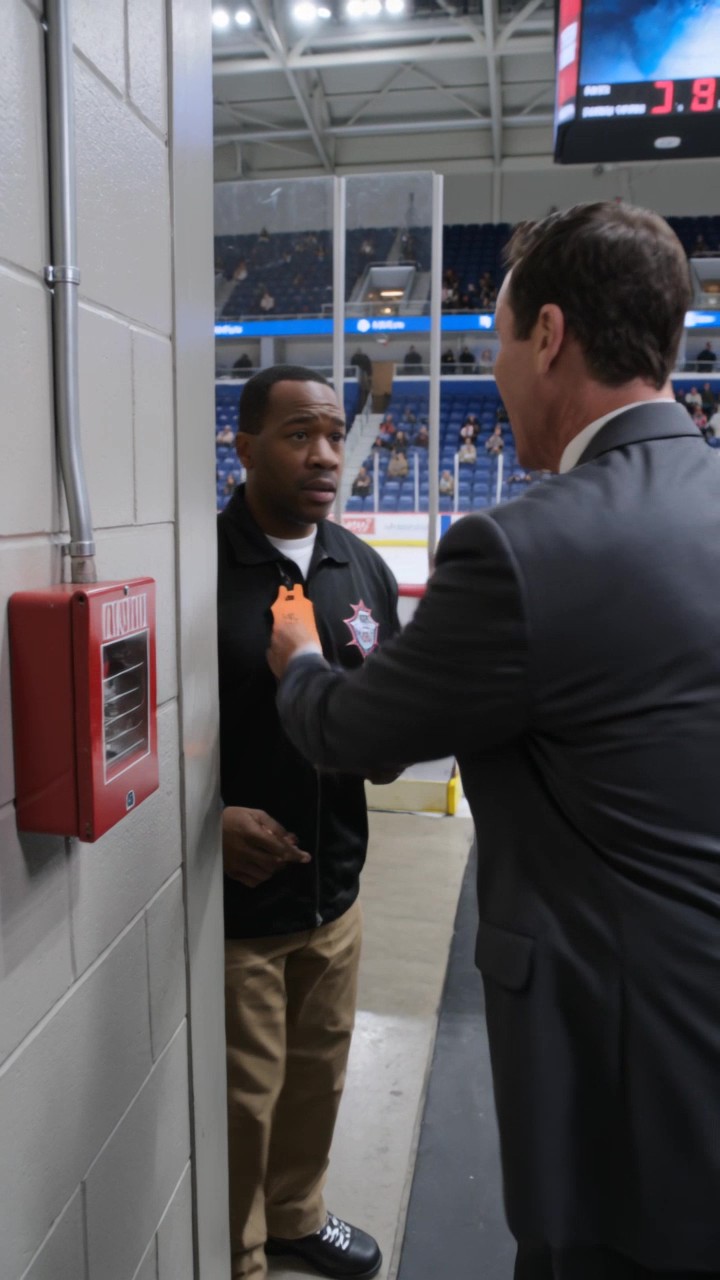
The orange tag confirmed someone had already identified a loose support.
Preston tried to explain that maintenance had cleared the problem.
The refrigeration contractor arrived wearing protective equipment and tested the room from outside.
The relief-line bracket had shifted again.
A flange was leaking.
The pressure system prevented a full rupture, but the room contained enough vapor to require evacuation and hazardous-material response.
The championship could not continue.
Several parents were furious until the fire department released the initial safety notice.
Then anger turned toward the arena.
The orange tag became the center of the investigation.
A maintenance technician admitted he placed it on the valve assembly three weeks earlier.
The repair was scheduled.
Then a televised tournament was booked.
Management wanted the system running continuously to preserve the ice.
The technician tightened the bracket temporarily and removed the equipment from service restriction, but the orange tag remained attached.
During later cleaning, it was knocked loose and never returned to the maintenance board.
Elias found it beside the door.
Preston had not personally loosened the pipe.
His failure came afterward.
He treated a warning as less credible because it came from a custodian during an expensive event.
At the emergency review, he said:
“I believed Mr. Grant did not understand the operational consequences of stopping the game.”
Elias answered:
“I understood them. I also understood the consequences of leaving the children beside that room.”
The distinction mattered.
Expertise is not only knowing what might happen.
It is knowing which cost must be accepted first.
The arena lost the broadcast contract.
Teams traveled home without a champion.
Families spent money on hotels and tickets for a game that never happened.
The incident was not converted into a perfect victory.
One team had seniors who would never replay that exact final.
Elias met with both teams.
He did not ask them to be grateful.
He showed them the orange tag, photographs of the frost, and the damaged bracket.
A player asked:
“Would the pipe definitely have burst?”
Elias answered honestly.
“No.”
“Then maybe we could have played.”
“Maybe.”
The room went quiet.
Elias continued.
“Safety decisions happen before certainty. After certainty, they are rescue decisions.”
The player looked at the tag.
“So you chose the chance that nothing happened over the chance that something did.”
“Yes.”
The arena board dismissed Preston after finding several delayed maintenance issues and incomplete incident records.
But Elias resisted turning one manager into the whole explanation.
The arena rewarded uninterrupted events.
Maintenance delays were treated as failures.
Custodians could report leaks but had no direct shutdown authority.
The system had trained people to keep the doors open until danger became visible.
That changed.
Any worker could trigger evacuation for suspected refrigeration leaks without prior managerial approval.
Mechanical-room tags were logged digitally and physically.
No warning tag could be removed without two signatures and a follow-up inspection.
Custodial staff received hazard-recognition training because they worked closest to vents, drains, doors, and changing smells.
Elias was offered the arena facilities supervisor role.
He accepted only after the board agreed to pay for his recertification.
On his first day, he mounted the orange valve tag beside the rink entrance.
Not as decoration.
It remained clipped to a sample bracket employees could handle during training.
The sign beneath it read:
IF THE WARNING ARRIVES BEFORE THE PROOF, THAT MEANS IT ARRIVED ON TIME.
The championship was rescheduled at a different arena one month later.
Both teams asked Elias to perform the ceremonial puck drop.
He declined.
“I did not earn a place in your game.”
The captains disagreed.
They invited him to stand near the bench instead.
Elias accepted that.
Before the faceoff, one player tapped the boards twice.
The sound carried through the rink.
A clean, solid vibration.
Elias smiled.
This time, the ice had nothing dangerous to say.







Leave a Reply