
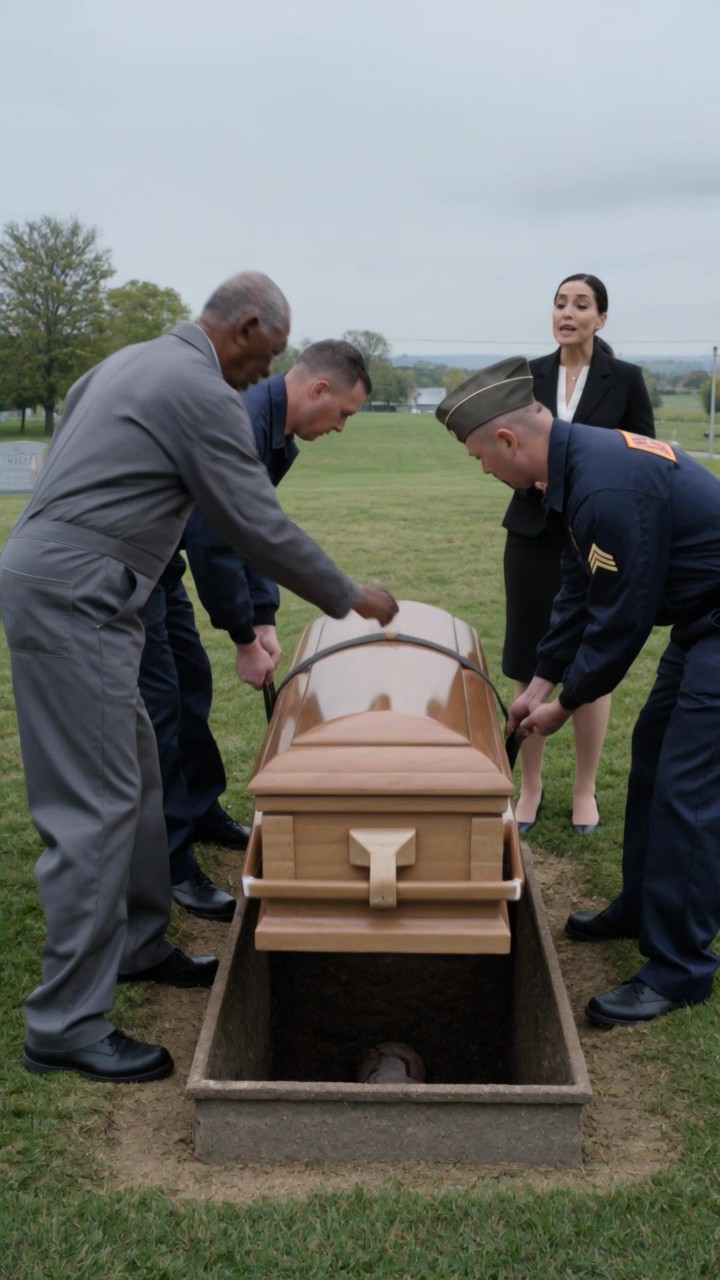
The burial did not continue that morning.
The county required more than memory before changing a legal record.
Samuel Bell understood that.
He was not asking the cemetery to replace evidence with emotion.
He was asking them not to close the ground before anyone followed the evidence they already had.
The bent harmonica.
The army jacket.
The scratched numbers.
The seven men who knew the call.
The elderly veteran who first approached was Colonel Marcus Reed, retired.
He held the harmonica beneath the light and pointed to a small solder mark near the corner.
“Thomas repaired this with field wire in Kandahar.”
Another veteran, Luis Ortiz, touched the dent along the side.
“He dropped it when our vehicle overturned.”
The men did not remember every day of deployment.
They remembered the sound Thomas Miller used when radios failed.
Four notes.
Pause.
Two.
It meant:
Medic coming.
Hold on.
Thomas had been the unit medic.
Not the decorated officer in most photographs.
Not the person interviewed at reunions.
The man who taped ankles, carried water, treated panic without mocking it, and played the harmonica when darkness made injured soldiers believe nobody was searching.
Samuel looked at the county case file.
“How did he become unknown?”
The answer took days.
Thomas returned from service with commendations and a family waiting.
Then his marriage ended.
A construction injury made steady work difficult.
He moved between temporary rooms, shelters, and veteran housing.
His identification expired.
His phone disappeared.
The last facility that knew him closed after a funding dispute.
Thomas became one of the people cities repeatedly recorded without truly seeing.
The coat still had a faded name strip, but the letters had been removed.
Not by the county.
By Thomas himself.
Marcus explained why.
Years earlier, Thomas told him:
“I am tired of people looking at the uniform before they look at the man wearing it.”
He did not want favors based on military service.
He also did not expect to die without anyone knowing his name.
A medical examiner reopened the personal-effects review.
Inside the harmonica case, beneath the lining, investigators found a folded repair receipt from a veteran-owned music shop.
The customer name read:
T. MILLER.
The shop owner remembered him.
Fingerprints were compared with military records.
The identification was confirmed.
Thomas James Miller.
Age sixty-eight.
Army medic.
Father of one daughter.
Grandfather of two children he had never met.
The daughter, Rachel Miller, lived three states away.
When the county contacted her, she did not react like the ending of a reunion story.
She cried.
Then she became angry.
Her father had disappeared from her life when she was fourteen.
He sent birthday cards for two years.
Then nothing.
She had spent decades deciding whether he abandoned her, became too ill to return, or simply chose another life.
Now strangers were calling him a hero.
Rachel arrived at the cemetery carrying one unopened birthday card.
Thomas had mailed it eighteen years earlier.
She had written RETURN TO SENDER across the envelope but never placed it in the mailbox.
She looked at the veterans around the casket.
“You knew how to find him in a war.”
No one answered.
She continued.
“But none of you knew where he slept here?”
The question was not entirely fair.
It was still necessary.
Marcus lowered his eyes.
“We met him at reunions until he stopped coming.”
“And then?”
“We assumed he wanted distance.”
Rachel looked at the plain county casket.
“Everyone respected his silence until it buried him.”
Samuel stood beside her.
He had seen that pattern before.
Institutions called it privacy.
Friends called it giving space.
Families called it self-protection.
Sometimes all were true.
Sometimes silence was simply the place where a struggling person disappeared.
Rachel asked to hear the harmonica signal.
Marcus played badly.
Samuel played worse.
For the first time that week, Rachel laughed.
Then she covered her face.
The burial was rescheduled.
Thomas received military honors, but Rachel refused a ceremony that made him only a soldier.
She brought a photograph of him cooking pancakes in a stained shirt.
One granddaughter sent a drawing of a harmonica.
The veterans brought unit coins.
Samuel placed the bus token beside the grave marker because it represented the life Thomas had actually been living when the county found him.
The final stone read:
THOMAS JAMES MILLER
MEDIC, FATHER, FRIEND
HE CAME WHEN PEOPLE CALLED.
WE SHOULD HAVE CALLED HIM TOO.
The county reviewed its unidentified-person burial process.
Personal effects linked to military service, unions, trade associations, schools, shelters, and transport programs now triggered additional outreach before burial.
Veterans’ groups created a rotating contact team for former service members who stopped attending meetings.
The program did not treat every absence as an emergency.
It created one human question before assumptions became years:
“Does anybody know where this person is sleeping?”
Samuel remained the cemetery groundskeeper.
He kept the bent harmonica in the office until Rachel decided what to do with it.
Months passed.
She returned on Thomas’s birthday.
“I don’t want to keep it,” she said.
Samuel nodded.
“I understand.”
“I don’t want it displayed like he was only brave.”
“I understand that too.”
She looked across the cemetery.
“Can it stay where people without family are prepared for burial?”
Samuel opened the drawer beside the county records desk.
The harmonica fit inside.
A small sign was placed above it:
BEFORE YOU CALL SOMEONE UNKNOWN, ASK WHAT THEIR THINGS ARE TRYING TO SAY.
Rachel never resolved every feeling about her father.
Learning he had saved soldiers did not repair the years he was absent.
Learning he struggled did not erase the hurt.
But he was no longer a blank marker.
His name returned.
His contradictions remained.
That was dignity.
Not turning a person into a hero after death.
Refusing to let poverty erase the full life that existed before it.



Leave a Reply