
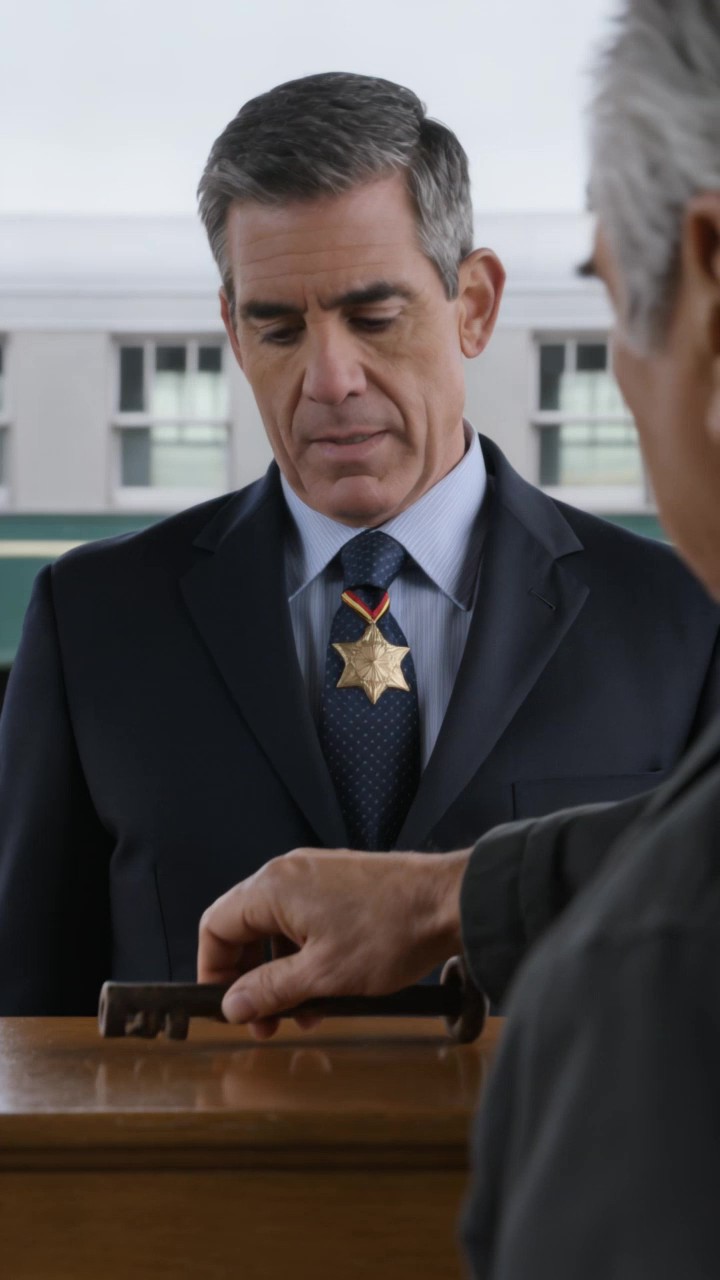
The ceremony stopped.
Thirty adults stood in the front row holding brass luggage tags that had spent twenty years in jewelry boxes, desk drawers, wallets, and one military footlocker.
Each tag carried the same stamped words:
JUNCTION 4.
Samuel Ortiz looked at them and remembered children’s faces behind fogged train windows.
He had never known their names.
The students knew his.
Their teacher, Mrs. Helen Bell, had made sure of that.
After the blizzard, she found Samuel’s ring of brass equipment tags on the floor of the final carriage. The ring had snapped when he climbed aboard to check that the train had stopped safely.
Helen asked the railroad for his contact information.
The company refused.
She wrote his name on thirty cards instead:
SAMUEL ORTIZ — SWITCHMAN.
Each child received one tag and one card.
The cards were eventually lost.
The tags remained.
Rail director Preston Hale stood near the medal podium.
“This event was investigated at the time,” he said.
Samuel answered:
“It was processed.”
The difference mattered.
The railroad’s electronic record showed Preston issued a route command from the central office at 8:42 p.m.
The train entered the freight siding at 8:42 p.m.
The system therefore concluded the command caused the switch.
What the record did not show was that the remote actuator at Junction 4 had lost power.
Preston’s command reached the network after emergency generators restored partial communication.
By then, Samuel had already thrown the switch manually.
A former engineer named Marcus Reed approached from the side aisle.
“I drove that train.”
The crowd turned.
Marcus faced Samuel.
“I saw your lantern at Junction 4.”
Preston’s expression tightened.
Marcus continued.
“The signal ahead showed red, but the points moved under us. When we entered the siding, Samuel was still holding the manual lever.”
“Why was that not in your report?” the mayor asked.
Marcus looked at the former students.
“Because the company attorney rewrote the final version.”
The railroad faced enormous liability.
The bridge inspection had been delayed.
The remote-control backup had failed.
A simple story protected confidence:
Central operations detected the hazard.
Central operations rerouted the train.
The system worked.
Samuel’s version proved the opposite.
A worker at an unheated rural junction had compensated for multiple system failures using a tool older than the computer network.
Marcus had objected.
He was told that including the manual failure would create panic and jeopardize his license during the inquiry.
He signed the report.
“I was afraid,” he said.
Samuel looked at him.
“I know.”
That answer did not absolve him.
It acknowledged the pressure without pretending he had no choice.
Preston held the medal box.
“At the time, I believed my command moved the train.”
Samuel nodded.
“At first.”
The crowd quieted.
The accusation was not that Preston knowingly invented the story from the first minute.
The deeper failure came later.
Maintenance logs showed the Junction 4 actuator had no power until 8:44.
The company privately informed Preston that the manual switch must have been moved.
He still accepted awards.
Still told interviews that technology and leadership saved the students.
He never asked who had been outside.
Preston looked at the rusted key.
“I should have corrected it.”
The woman in the red scarf answered:
“You built a career on not correcting it.”
Her name was Rachel Cole.
She had become a transit-safety researcher because of the blizzard.
For years, she tried to identify the switchman. The railroad said employment archives had been lost during a merger.
Then the city announced the twentieth-anniversary medal ceremony.
Rachel searched union retirement lists and found Samuel living two counties away.
He refused to attend at first.
“I did my job,” he said.
Rachel replied:
“Then why is someone else receiving your medal?”
Samuel did not come for the medal.
He came because the official exhibit praised a remote system that had actually failed.
If the false lesson remained, the next safety plan might trust a screen without preserving manual capability or staffing rural junctions.
That was why the rusted key mattered.
Not nostalgia.
Redundancy.
The mayor suspended the award and commissioned an independent historical and technical review.
The review confirmed:
The bridge was unsafe.
The remote controls were offline.
Samuel manually redirected the train.
Preston’s later command appeared in the system after the physical switch had already changed.
The railroad had simplified the report to protect the company.
Preston resigned as rail director before disciplinary proceedings ended.
Some people demanded criminal charges.
The review found no evidence he caused the original equipment failures or directly ordered the report alteration. His wrongdoing was knowingly preserving a false public story after learning the truth.
He lost the leadership role built around that story.
Marcus, the engineer, publicly corrected his statement.
The railroad union restored Samuel’s service record and compensated him for medical expenses connected to the shoulder injury the company had once classified as “weather-related strain.”
Samuel accepted the compensation.
He refused the medal.
Instead, he asked that the city use the money for three changes.
Manual switch training returned to every regional rail program.
Backup equipment could not be removed merely because a control center existed.
And incident reports had to include the accounts of field workers before software timelines were treated as complete truth.
The city agreed.
The rusted key was mounted in the new rail-safety classroom.
The thirty brass tags hung beneath it.
The plaque read:
THE SCREEN RECORDED THE COMMAND.
THE WORKER HAD ALREADY MOVED THE WORLD BENEATH THE TRAIN.
Rachel invited Samuel onto the restored school excursion route.
At Junction 4, the train slowed.
A new heated switch cabinet stood beside the track.
Samuel stepped down with the trainees and inserted a modern manual key into the mechanism.
It turned easily.
Too easily, he thought.
The instructor asked why he still carried the rusted one.
Samuel held it up.
“Because people trust tools that shine.”
He looked toward the students inside the train.
“This one reminds them to ask who used it.”
The former students later held their own private gathering.
No mayor.
No cameras.
They placed the brass tags back on one ring and gave it to Samuel.
He did not break them apart again.
He hung the ring beside his front door.
Whenever it moved, the tags struck one another with a small metallic sound.
Thirty lives.
One winter.
A rescue the official screen had almost erased.





Leave a Reply