
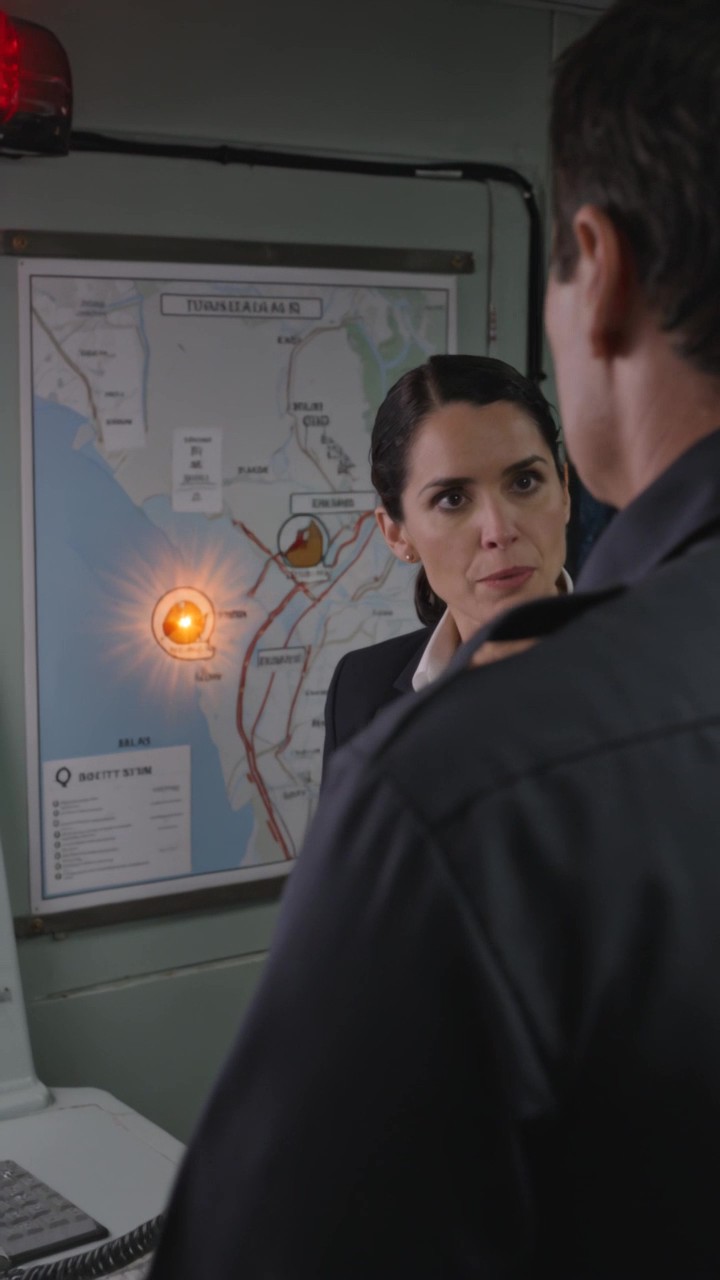
Every child on the Westbridge school ferry reached the dock safely.
The rescue crew attached a tow line seconds before the disabled ferry crossed into the rock-wall current. Two deckhands used the emergency rudder to stabilize it while children remained seated below.
News stations called the operation a successful storm response.
Jonah Bell did not feel successful.
At first light, he drove to the east mudflat.
Marcus’s fishing boat, the Clara B, leaned on one side where the retreating tide had left it against the stones.
The hull had split near the stern.
The nets were gone.
The cabin windows were broken.
Marcus stood in wet boots holding the orange buoy Jonah had told him to release.
The buoy had belonged to their father.
So had the boat.
Clara Bell had been their mother’s name.
Their father built the first cabin shelves by hand and taught both boys to read weather from the color beneath clouds.
When he died, Marcus inherited the vessel because he stayed in fishing.
Jonah took the cracked marine radio and a job at the harbor.
The brothers joked that one kept the family on water while the other kept it on maps.
Nobody had imagined the map would one day force Jonah to choose between them.
Marcus survived because he followed the instructions.
He cut the nets loose.
Used the orange buoy line to create drag.
Then grounded the boat deliberately on the mudflat before the storm pushed it toward deeper rocks.
The action saved his life.
It destroyed the vessel.
He looked at Jonah.
“Was the ferry really going to hit?”
“Yes.”
“You are sure?”
“No.”
Marcus turned sharply.
Jonah did not hide behind certainty.
“The steering was gone. The wind was driving them toward the wall. Rescue One could reach them in seven minutes and you in four.”
“So three minutes decided my boat?”
“Twenty-four children decided where the only rescue crew went.”
Marcus’s jaw tightened.
“And being your brother decided I could be told to save myself.”
Jonah had no defense against that.
Professional logic said the greater number and more vulnerable passengers received priority.
Family logic said his brother’s voice had called him by name through the storm.
Both truths remained.
The harbor investigation reviewed every recording.
Jonah had followed emergency triage protocol.
The ferry carried children, lacked steering, and was drifting toward immediate impact.
Marcus had a working radio, flotation gear, and a reachable mudflat option.
The rescue decision was judged correct.
That conclusion did not rebuild the Clara B.
Insurance denied full payment because Marcus intentionally grounded the boat and released insured equipment.
The company called those actions “voluntary damage mitigation.”
Marcus called them the reason he was alive.
The dispute lasted months.
Jonah testified that he ordered every damaging action.
The insurer still argued that harbor instructions did not change policy exclusions.
Fishermen across the county became angry.
If operators were punished for following emergency directions, future captains might delay lifesaving action to protect a claim.
A public fund was proposed.
Marcus refused at first.
“I do not want charity because my brother chose somebody else.”
The sentence hurt Jonah.
It also revealed what the boat had become.
Not merely income.
Proof of being the person left behind.
The parents of the ferry children organized a meeting.
They did not arrive with cameras or call Marcus a hero.
A mother named Rachel Cole placed twenty-four small orange ribbons on the table.
“One for each child,” she said. “Not payment. Evidence that the benefit of Jonah’s choice did not belong to nobody.”
Marcus looked at the ribbons.
“What do you want from me?”
“Nothing.”
She pointed toward the broken-insurance clause.
“We want the county to stop treating the cost as yours alone.”
That changed the conversation.
The harbor created an emergency-loss compensation policy funded by operators, insurers, and county reserves. When a dispatcher ordered property sacrifice to protect life, compensation review began immediately.
It did not guarantee full replacement.
It guaranteed the loss would not be dismissed as a private choice.
Marcus received enough to buy a used fishing vessel.
Not enough to recreate the Clara B.
He transferred the old cabin nameplate to the new boat.
The rest of the wreck was dismantled.
Jonah asked for the cracked radio.
Marcus handed it over without warmth.
“For training?”
“Yes.”
“Good. Let them hear what correct decisions sound like to the person not chosen.”
The sentence became the center of Jonah’s new dispatcher course.
He played both radio channels.
The children on the ferry.
Marcus at Marker Nine.
The seven-minute response time.
The four-minute distance.
The silence after the rescue order changed direction.
Trainees often asked:
“What would you do differently?”
Jonah answered:
“Improve the system before the storm so one boat is not all we have.”
The harbor added a mutual-aid agreement with a private tug operator.
Backup crews trained for school-ferry routes.
Emergency maps marked grounding areas for small vessels.
The lesson was not simply to make the same choice faster.
It was to reduce the chance that anyone would face it again.
Jonah and Marcus did not repair their relationship quickly.
They spent holidays at separate tables.
Jonah attended the launch of the replacement boat but stood near the parking lot until Marcus waved him closer.
The new vessel carried the Clara B nameplate.
Beside it, Marcus had tied the father’s orange buoy.
Damaged.
Still usable.
Jonah touched the cracked marine radio hanging from his belt.
“I am sorry.”
Marcus looked toward the water.
“I know.”
“That is not forgiveness.”
“No.”
“Will it ever be?”
Marcus considered the question.
“I am alive long enough to decide later.”
It was not a warm ending.
It was an honest one.
The ferry children grew older.
The fishing boat returned to sea.
The brothers remained separated by a choice that could be justified and still cause harm.
That is the burden of triage.
Saving the greater number does not make the smaller loss disappear.
It creates a responsibility to remember exactly who paid for the decision.




Leave a Reply