
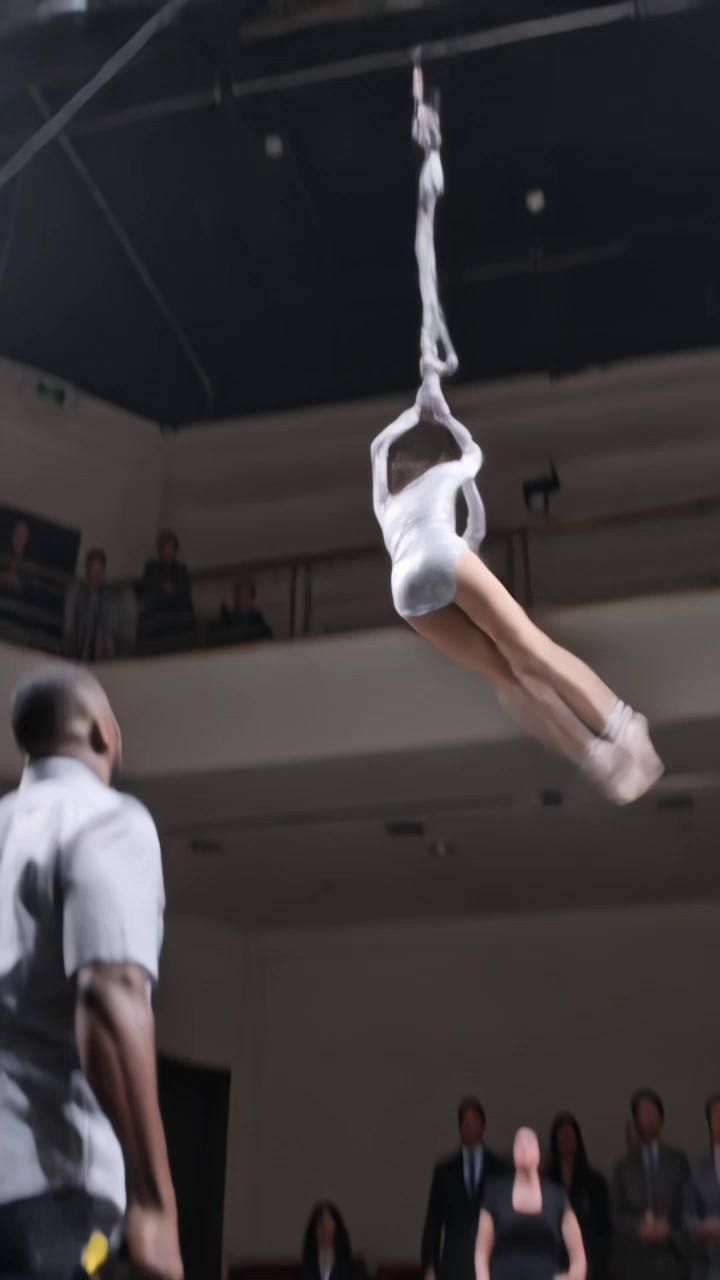
Claire Whitmore sat inside the safety net while the theater crew shut down power to the entire fly system.
Her mother knelt beside her.
Preston Hale stood near center stage with his scholarship clipboard hanging uselessly at his side.
The silver silk remained twisted inside the overhead winch.
Its empty harness had been pulled so hard that one steel connector bent against the rail.
Nobody had to guess what would have happened if Claire were still attached.
Elias closed the black rescue knife.
Yellow tape wrapped the handle.
The tool looked ordinary.
No polished award.
No family heirloom displayed in glass.
A cutting tool kept sharp because stage emergencies do not wait for permission.
Claire looked at it.
“How did you know?”
Elias pointed toward the red safety mark on the shredded silk.
Aerial fabric used in the theater had colored reference stitching near danger zones. The red mark should remain several feet below the guide wheel during Claire’s highest lift.
Elias saw it moving upward.
At first he thought the operator was changing the cue.
Then Claire’s body rotated the wrong direction.
The silk stopped sliding freely and began tightening like rope around the guide.
Elias called the booth.
No answer.
He hit the local emergency stop.
The motor continued.
The relay had fused during a power surge earlier that afternoon.
The winch was no longer obeying the stop circuit.
Claire’s mother, Vivian, looked toward Preston.
“Was there a power problem?”
Preston answered too quickly.
“A lighting fluctuation.”
Elias faced him.
“The rigging console reset twice during rehearsal.”
“The technician cleared it.”
“The technician recommended removing Motor Two from service.”
Preston’s jaw tightened.
“The backup test passed.”
Elias looked up.
“The stop relay did not.”
The scholarship showcase had been scheduled for months.
Conservatory judges had flown in.
Donors filled the front rows.
Claire’s aerial solo was the final performance and the emotional center of the event.
Canceling it would have embarrassed the school.
So Preston approved a limited operation after the motor restarted.
Elias had objected.
He was the theater’s senior rigger, but the outside production company controlled the showcase equipment.
His warning was logged as “excessive caution.”
That phrase almost became the official explanation for why he cut the silk.
Vivian turned toward him.
“Why didn’t you pull her into the platform?”
“No time.”
“Lower the rig?”
“The winch was pulling up.”
“Tell her to release?”
Claire answered.
“My wrist was locked in the wrap.”
Aerial performers secure themselves through controlled fabric loops. The same wrap that supports the body can become impossible to escape when machinery pulls in the wrong direction.
Elias saw the red mark disappear.
He checked the safety net.
It was fully tensioned.
Then he made the only remaining decision.
Cut the main silk above Claire’s support wrap.
Let gravity send her into the net.
Trade a predictable fall for an unpredictable machine.
The rescue looked violent because it was.
It was also controlled.
Preston looked toward the scholarship judges.
“The performance cannot be completed.”
Claire’s mother stood.
“My daughter was nearly pulled into the rig and you are discussing the performance?”
Preston lowered his voice.
“The judges have strict completion standards.”
One conservatory judge stepped onto the stage.
“Not when the equipment fails.”
Claire looked at the torn silk.
The scholarship had required a full technical performance.
Her final sequence had not happened.
She had trained for nine months.
The judge did not promise an award.
She said:
“We will review the recorded portion and permit a new assessment on safe equipment.”
That was fair.
It was not the same as getting the night back.
Claire began to cry.
Not only from fear.
From grief for a performance that had existed perfectly in rehearsal and would never exist again in that exact room.
Elias did not tell her being alive was all that mattered.
Of course it mattered most.
That did not make everything else meaningless.
He sat several feet away.
“I am sorry I had to cut it.”
Claire looked at him.
“Would you do it again?”
“Yes.”
She nodded.
“I know.”
The answer did not turn the ruined performance into gratitude.
It allowed both truths to remain.
The theater investigation found multiple failures.
Motor Two had produced intermittent stop errors during setup.
The outside technician recommended removing it from service.
The production manager asked whether a reduced-speed setting would be acceptable.
The technician said it could be tested but did not sign a full clearance.
Preston interpreted that ambiguity in favor of continuing.
The emergency-stop relay later fused.
The guide wheel had also been installed slightly off-center, causing the silk to climb toward one side and bind.
Elias’s cut prevented Claire from entering the pulley zone.
Investigators calculated that he acted less than three seconds before the harness connector reached the guide assembly.
The outside production company tried to blame “unauthorized intervention.”
Video ended that argument.
The local stop was visibly pressed.
The motor continued.
The red mark vanished.
The silk accelerated after Claire fell.
The theater suspended Preston for overriding the rigging concern and failing to document the technician’s restriction accurately.
He later resigned.
The school revised every aerial-performance rule.
A single rigger could stop a performance without approval.
Any intermittent failure removed equipment from service until the exact fault was identified.
Outside production managers could not override the venue’s senior safety worker.
And every aerial cue required a second independent stop system.
Elias was offered public recognition.
He declined a stage ceremony.
He agreed to teach the incident because performers and riggers needed to understand why cutting could be safer than releasing.
During the first workshop, he placed a length of silver silk over a training pulley.
A red safety line crossed the fabric.
He asked the students:
“What do you protect first?”
One answered:
“The performer.”
“Second?”
“The equipment.”
Elias shook his head.
“The performer again. Equipment is never second while someone is attached to it.”
Claire attended from the back row.
Her hair was tied up.
Her wrists still carried light bruising from the wrap, but she had resumed conditioning under medical supervision.
She did not immediately return to aerial performance.
The sound of the winch triggered panic.
Even a normal motor hum made her look upward.
Elias never told her to push through it.
He showed her how every stop worked.
Let her test the backup release.
Allowed her to cut practice silk with the black rescue knife.
The first time she held it, her hands shook.
“Why yellow tape?” she asked.
“So I can find it in blackout conditions.”
“Nothing symbolic?”
“No.”
She almost smiled.
“Good.”
Three months later, Claire completed a new scholarship assessment in a smaller studio using manual rigging.
No motor.
No spotlight audience.
Only two judges, her mother, a safety rigger, and Elias near the wall.
She changed the final sequence.
Instead of the dramatic powered lift planned for the showcase, she descended slowly through the silver silk and stopped with both feet on the floor.
The conservatory awarded her partial tuition support.
Not the full scholarship she had hoped for.
The incomplete showcase and recovery period affected the result.
Elias was angry on her behalf.
Claire was too.
Still, she accepted.
“I get to be disappointed because I am here,” she said.
Elias nodded.
“That is the point.”
The severed silk was not thrown away.
Claire cut one short strip containing the red safety mark.
She wrapped it around the handle of Elias’s rescue knife, covering part of the yellow tape.
He objected.
“That may make it harder to see.”
She left the yellow ends exposed.
“Now?”
He tested it beneath the work light.
“Acceptable.”
The remaining fabric became training samples for the theater.
A sign above them read:
IF THE MACHINE WILL NOT LET GO, CUT THE THING THAT CAN BE REPLACED.
Years later, Claire became an aerial instructor.
Before teaching any trick, she showed students the safety net.
Then the stop buttons.
Then the rescue knife.
Only after that did she show them how to climb.
New students sometimes asked whether falling into the net had been the most frightening moment.
Claire always answered:
“No.”
“The frightening moment was learning everyone thought the show mattered enough to keep the machine running.”
Then she pointed to the strip of silver fabric around Elias’s knife.
“That is why somebody backstage must be willing to ruin the performance.”





Leave a Reply