
Brian Price had returned because he noticed the deed folder was missing from Eleanor’s kitchen cabinet.
He expected to find his mother confused beside a bench.
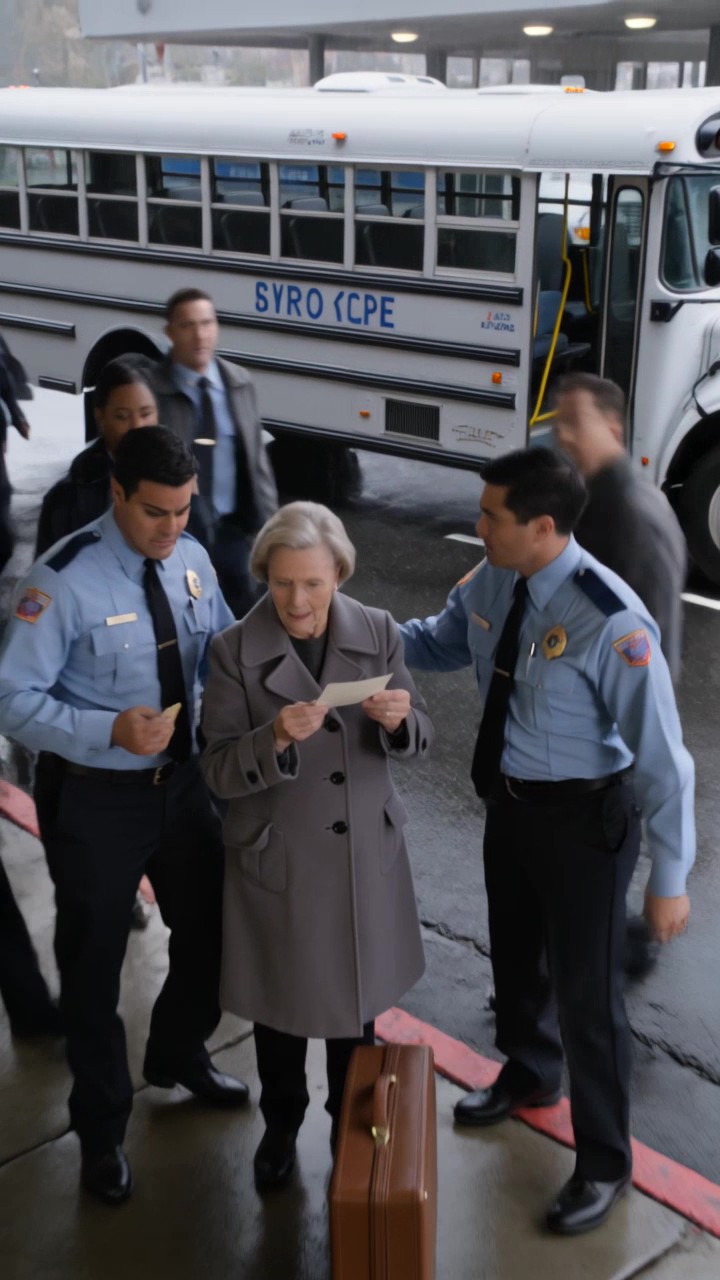
Instead, he found twelve bus drivers standing around her like a wall.
The terminal clerk had already called a senior-services advocate, not to remove Eleanor, but to make sure nobody pressured her into leaving with the person who had abandoned her.
Brian forced a smile.
“My mother has memory problems. This is a family matter.”
Eleanor looked at him carefully.
She did have memory problems.
She sometimes forgot why she entered a room.
She wrote appointments on three calendars.
She had once left soup on low heat until the pot burned.
But she remembered the fake ticket.
She remembered Brian telling her not to bring the deed.
She remembered his exact words that morning:
“Once you are checked in, I can handle the property without upsetting you.”
The senior advocate asked Eleanor where she wanted to go.
“Not with him.”
That answer was enough for the moment.
The drivers brought her into the employee lounge.
Hot coffee.
Dry chair.
No cameras.
No dramatic ceremony.
The yellow luggage tag passed from hand to hand.
Each driver remembered a different part of the blizzard.
Marcus Reed remembered Eleanor wrapping his feet in dish towels because his socks were soaked.
Rachel Cole remembered the tomato soup.
Luis Ortiz remembered Eleanor refusing to release him to a man who claimed to be his uncle but did not know his middle name.
That decision had seemed rude at the time.
It was also why Luis went home with the right person.
Eleanor listened.
She had not known what became of most of those children.
Her diner kept no photographs of the night.
Only a drawer of unused yellow tags and a rule she wrote afterward:
No child leaves because an adult is impatient.
Brian stood outside the lounge arguing with security.
He said the diner had become unsafe.
He said Eleanor could no longer manage money.
He said the developer’s offer would pay for excellent care.
Some of that might have been reasonable if he had told her the truth.
Instead, he tried to create confusion and use it as permission.
The advocate reviewed the deed folder.
Eleanor still owned the diner, the house, and the narrow strip of land beside the old Route 6 stop.
Brian had no power of attorney.
The assisted-living facility had no reservation in Eleanor’s name.
The “shuttle ticket” was a printed template with a false route number.
The police did not arrest Brian at the terminal. Abandoning an older parent inside a staffed building did not automatically create the simple crime people wanted.
But the evidence triggered an investigation into attempted financial exploitation.
A court issued a temporary order preventing the property from being sold or transferred.
Eleanor received an independent medical assessment.
The result was not a perfect reversal.
She had early cognitive decline.
She needed help with medication, bills, driving, and major contracts.
But needing support did not make every choice disappear.
The court appointed a professional fiduciary for property decisions and allowed Eleanor to select who would assist with daily care.
She did not select Brian.
That broke him more than losing control of the diner.
He had convinced himself he was solving a problem efficiently.
He did not understand that care without consent can become another form of taking.
The Route 6 drivers organized a rotating meal and transportation schedule.
Not because Eleanor had become a town celebrity.
Because she once stayed through a blizzard, and now they understood that waiting beside someone could be a form of returning home.
The diner did not reopen as a full restaurant.
Eleanor no longer had the strength.
Instead, the county rented the front room as a winter emergency rest stop for school routes and stranded families.
The kitchen served soup during storms.
The old counter remained.
So did the drawer of yellow luggage tags.
Above it hung a sign:
CHILDREN FIRST.
THEN ANYONE WHO HAS BEEN LEFT WAITING.
Brian eventually apologized.
Eleanor listened.
She did not move back in with him.
She allowed supervised visits and family counseling.
Forgiveness, like memory, arrived unevenly.
Some days she called him by his father’s name.
Some days she remembered the terminal clearly and refused to speak.
The story did not end with Brian publicly humiliated and Eleanor suddenly independent forever.
It ended with safeguards.
Shared decisions.
A woman allowed to need help without being erased.
One snowy afternoon, a bus arrived at the old diner with a heating problem.
Eight children stepped inside wearing bright winter coats.
Eleanor sat near the stove folding yellow tags.
A nervous girl asked:
“Do we have to leave when someone says they are family?”
Eleanor smiled.
“Not until they know your middle name.”
The drivers laughed.
Then they checked every pickup carefully.
Outside, the old Route 6 sign leaned beside the road.
The route was gone.
The promise remained.







Leave a Reply