
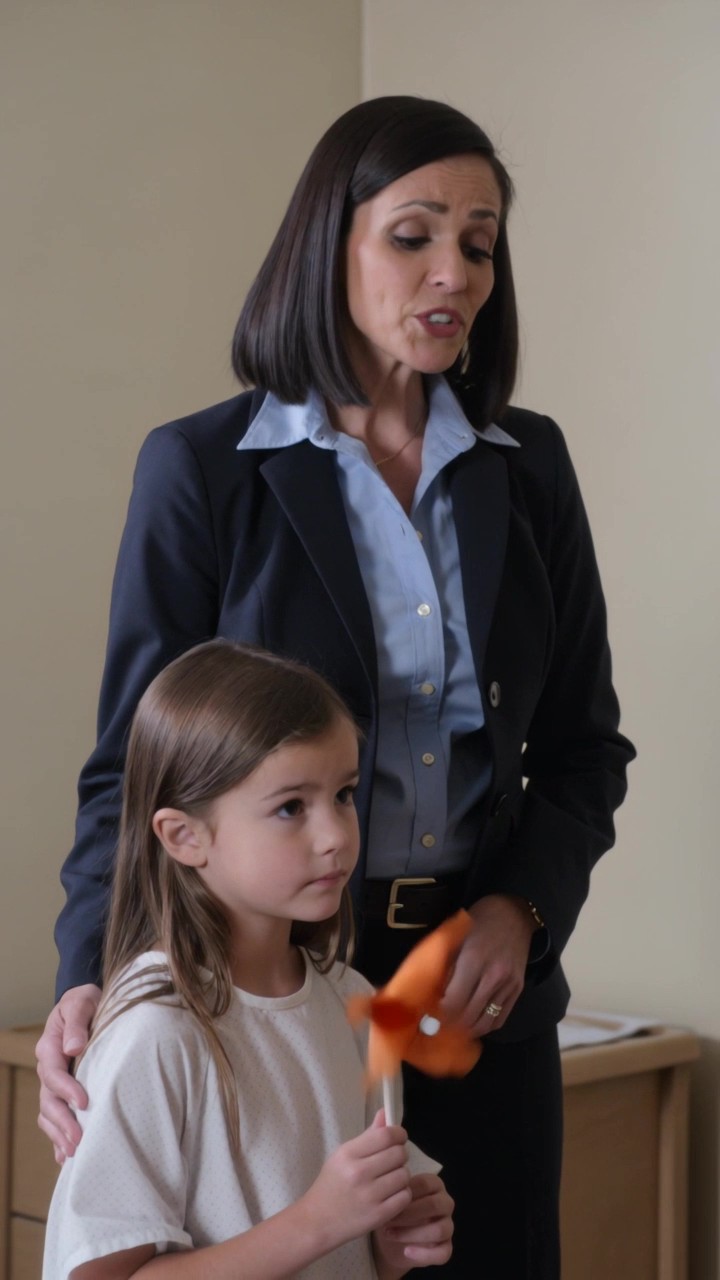
The hospital discharge room remained quiet.
Vivian Brooks looked at her granddaughter standing beside a woman in paint-stained work clothes.
The choice did not make Rosa Lily’s legal guardian.
It did something more immediate.
It revealed where the child’s body expected safety.
Social worker Dana Cole moved the photographs aside.
“This is an emergency placement discussion,” she said. “Not a final custody ruling.”
Vivian’s attorney began to speak.
Dana stopped him.
“We are not ignoring family rights. We are also not forcing a frightened child into an unfamiliar home tonight.”
Vivian looked wounded.
“My home is not unfamiliar. Lily has visited.”
Rosa answered gently.
“Twice.”
“That is because my daughter kept her away.”
Rosa did not argue.
Lily’s mother, Rachel, had a complicated relationship with Vivian.
After Rachel’s husband died, Vivian offered money, private school, and a room in her suburban house.
Rachel refused to move.
She believed the offer came with control over her job, friends, clothing, and parenting.
Vivian believed Rachel confused support with interference.
Both women collected evidence for their own version.
Lily lived between them.
Rosa entered the story by accident.
She managed the old brick apartment building where Rachel rented a second-floor unit.
The pipes failed often.
The elevator failed more.
Rosa fixed doors, painted halls, carried grocery bags, and learned which tenants needed time before rent day.
One night, Rachel suffered a severe breathing episode in the stairwell.
Lily watched emergency workers carry her mother away.
Afterward, every siren made the girl breathe too fast.
She would say:
“Mom is leaving again.”
Rosa bought an orange pinwheel from the pharmacy counter.
She sat in the hallway outside the apartment, not inside, because Lily would not open the door.
Rosa blew slowly.
The blades turned.
Lily watched through the mail slot.
Three breaths later, she opened the door.
From then on, the pinwheel became a shared language.
Three slow turns meant:
Your body can wait for the truth.
Rosa never told Lily her mother would definitely return.
She said:
“We know where she is. We know who is helping her. We will take the next breath while we wait.”
That honesty mattered.
Children remember broken reassurance.
At the hospital, Vivian looked at the grocery bag.
“You brought her things?”
“Rachel asked me to keep an emergency bag after the last admission.”
“You planned to take my granddaughter.”
“No.”
Rosa’s voice stayed level.
“I planned for the possibility that her mother might need help.”
Vivian looked at Lily.
“Do you not want to stay with me?”
Lily clutched Rosa’s sleeve.
The question placed too much responsibility on a seven-year-old.
Dana intervened.
“This is not a vote on whom she loves.”
Vivian lowered her eyes.
That sentence helped.
Lily did not choose Rosa because her grandmother was evil.
She chose the person whose presence required the least explanation during a crisis.
The temporary plan allowed Lily to remain in Rachel’s apartment with Rosa as an approved emergency caregiver for thirty days.
Vivian received daily contact and weekend visits while background checks, home inspections, and Rachel’s preferences were reviewed.
Rosa agreed to every condition.
She did not treat Lily’s gesture as ownership.
That first night, Vivian came to the apartment with two suitcases of new clothes.
Rosa accepted one set and asked her to take the rest back.
“She has no place to put them.”
“My house has four closets.”
“Tonight she needs the drawer she already knows.”
Vivian looked around the apartment.
Peeling paint near the window.
Radiator clicking.
A kitchen table with one uneven leg.
“This cannot be better.”
Rosa shook her head.
“Better and familiar are different questions.”
Vivian sat at the table.
For the first time, she saw the small systems Rachel had built.
The cereal bowl with blue stars.
The medicine schedule on the refrigerator.
The hallway night-light plugged into the lower socket.
The orange pinwheel beside the bed.
Lily woke at 2:11 a.m. after dreaming her mother had disappeared.
She began breathing rapidly.
Rosa entered but stayed near the doorway.
Vivian followed.
She reached for Lily.
Rosa lifted one hand.
“Watch first.”
Lily found the pinwheel.
Blew too hard.
The blades shook.
Rosa tapped the bedframe three times.
Slow.
Lily tried again.
One breath.
Second.
Third.
Vivian copied the rhythm with her own fingers.
Lily looked at her.
Then handed her the pinwheel.
Vivian blew once.
Too fast.
Lily shook her head.
“Like Rosa.”
The correction hurt.
Vivian accepted it.
She tried again.
Three slow turns.
Lily’s shoulders lowered.
That was the beginning.
Not of replacing Rosa.
Of Vivian learning the child who existed instead of the granddaughter she imagined welcoming into a perfect room.
Rachel’s rehabilitation lasted four months.
During that time, the family court reviewed caregiving options.
Rachel named Rosa as preferred temporary guardian but asked that Vivian remain involved.
Vivian objected to not being first.
Then she began attending Lily’s therapy sessions.
She learned the pinwheel routine.
Learned Lily slept with socks on.
Learned that sudden goodbyes frightened her more than loud voices.
Learned not to promise exact return times when traffic or hospital schedules could make them false.
Rosa learned too.
She learned that Vivian could help pay for repairs without demanding control if the boundaries were clear.
The apartment building received a new elevator motor after Vivian funded part of the work anonymously through a housing nonprofit.
Rosa discovered the donation anyway.
She thanked the nonprofit.
Not Vivian.
Vivian understood the message.
Help should not purchase emotional authority.
Rachel eventually returned home using a cane and a portable breathing device.
Lily met her at the apartment entrance holding the orange pinwheel.
Rachel cried when she saw Rosa and Vivian standing on opposite sides of the hallway.
“Did she choose?” Rachel asked.
Rosa answered:
“She showed us what she needed.”
That was more accurate.
The legal guardianship ended.
The relationships remained.
Lily began spending one weekend each month at Vivian’s house.
The private bedroom stayed.
But the expensive decorations were replaced with the same cheap night-light used at home.
An orange pinwheel sat on the bedside table.
Not a new one.
The original.
Lily allowed it to travel only after Vivian learned what it meant.
Years later, the paper blades tore.
Vivian offered to replace them.
Lily, now eleven, said:
“Rosa can fix it.”
Then paused.
“You can watch.”
The two women repaired the pinwheel together with orange paper and clear tape.
It did not spin perfectly afterward.
It still worked.
That was true of the family too.
No adult won Lily.
No one became the single hero.
The child chose the person who understood her panic.
The wise adults used that choice not to compete harder, but to learn the language that made safety shareable.




Leave a Reply