
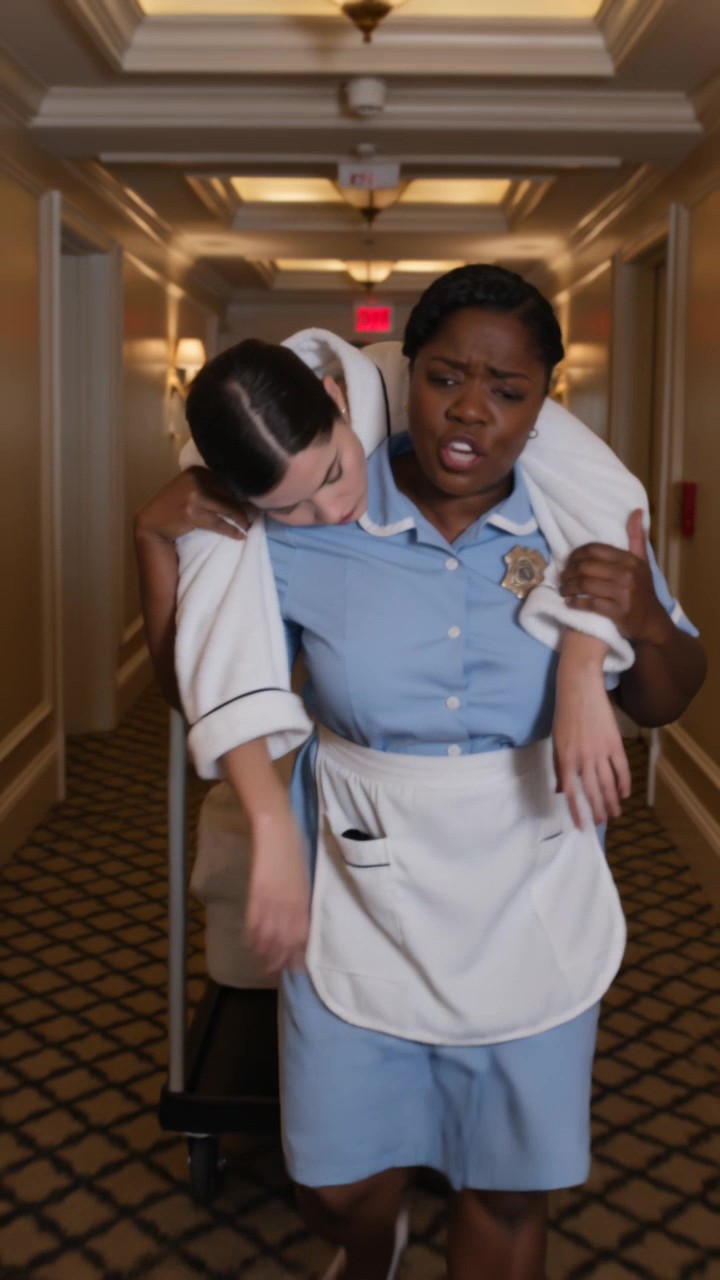
Julia Whitmore regained consciousness in the ambulance bay.
She remembered standing near the gas fireplace.
Then dizziness.
Then the floor moving beneath her.
She remembered one more sensation before everything disappeared:
Pressure at the back of her neck.
The diamond chain tightening.
Naomi Bell had entered Suite 804 for evening turndown service.
She carried a yellow portable carbon-monoxide detector clipped to her cart.
The hotel did not issue it.
Naomi bought it herself.
Nine years earlier, her husband Daniel died after a faulty heater leaked into the basement apartment they rented.
The building’s alarm had been removed during renovation.
Naomi survived because she had been working a night shift.
Afterward, she never entered a room with a gas appliance without carrying a detector.
Coworkers teased her.
Called it the yellow bird.
Management told her not to alarm guests by discussing it.
That evening, the device began sounding before Naomi reached Suite 804.
She knocked.
No answer.
The door had been left slightly open by room service.
Inside, Julia lay beside a decorative fireplace. The flames were low, but combustion gases were entering the room because a vent damper had failed.
The wall alarm showed a green power light.
It did not sound.
Naomi pulled Julia toward the hallway.
The guest’s necklace snagged on a curved brass hook used to hold fireplace tools.
Naomi felt Julia’s body stop moving.
The chain tightened against her neck.
Naomi could not lift the hook free while supporting an unconscious adult.
She grabbed the small safety shears from her uniform and cut the chain.
The pendant fell into the rug.
Naomi placed it in her apron pocket so it would not be lost.
Then she kept pulling.
That was the full explanation.
But in the hallway, Celeste saw three things:
A low-paid housekeeper.
An unconscious wealthy guest.
A diamond in the housekeeper’s pocket.
The conclusion arrived before the question.
Security took Naomi’s employee badge and asked her to remain in a service office.
They did not handcuff her.
They also did not let her accompany the emergency crew or explain the detector reading.
Naomi sat alone while guests uploaded videos with captions such as:
MAID CAUGHT WITH DIAMOND AFTER WOMAN COLLAPSES.
The hotel issued a statement saying an employee was “being investigated following a guest medical incident.”
It did not mention the gas alarm.
It did not close the other suites using the same fireplace system.
Naomi asked:
“Did you evacuate the floor?”
The security supervisor told her that facilities had found no visible fire.
Carbon monoxide is not visible.
That was why the yellow detector mattered.
Julia’s daughter, Lily, had been in the pool area when her mother collapsed. She returned through the stairwell because the elevator was held for emergency workers.
She saw the short chain hanging from the fireplace hook.
She also saw the green wall alarm.
Lily carried both the chain piece and Naomi’s yellow detector to the service office.
The detector still displayed a high reading stored from Suite 804.
Celeste told her not to touch hotel equipment.
Lily answered:
“This belongs to the person who saved my mother.”
The fire department tested the suite.
Carbon monoxide levels remained elevated.
The fireplace was shut down.
The entire eighth floor was evacuated.
Three additional rooms showed lower but unsafe readings near the same vent shaft.
The hotel’s decorative renovation had connected several fireplace exhaust channels to an older ventilation chase. A damper motor failed, allowing gases to backflow into occupied rooms.
Worse, Suite 804’s alarm had been disabled from audible mode after repeated false alerts during construction.
Facilities planned to replace it.
The room had been returned to service first.
Naomi had reported a faint exhaust smell on the floor two days earlier.
Her work order was closed as:
Housekeeping odor — likely cleaning solvent.
The investigation moved quickly after that.
Police returned the pendant to Julia.
No theft charge was filed.
The hotel reinstated Naomi.
She refused to return immediately.
“I was correct about the gas before anyone saw the necklace,” she said. “You believed me only after a rich guest’s daughter found proof.”
That sentence forced the hotel to examine more than one manager’s prejudice.
The system treated housekeepers as people who reported stains, not hazards.
Maintenance tickets from cleaning staff were frequently downgraded unless a supervisor confirmed them.
Guest complaints received faster responses than employee observations.
The hotel’s public apology initially called Naomi’s action “heroic.”
She rejected the draft.
“Do not praise me in a way that hides why I carried my own detector.”
The final statement admitted that the hotel failed to provide appropriate gas-monitoring tools, ignored a staff odor report, and publicly implied misconduct before completing basic safety checks.
Celeste was removed from guest-safety oversight.
She remained employed in event administration after disciplinary review.
Some workers believed she should have been fired.
Naomi said the decision mattered less than whether security would make the same assumption next time.
Policies changed.
Every housekeeping cart serving rooms with fuel-burning appliances received a calibrated detector.
Any alarm triggered immediate floor isolation.
Housekeepers could close a room without waiting for a manager.
Lost valuables found during emergencies were sealed in clear evidence bags with two witnesses, protecting both the guest and the employee.
Public statements could not imply theft before an investigation established cause.
Julia offered Naomi a reward equal to several months’ pay.
Naomi accepted only enough to replace the personal detector damaged during the rescue.
She asked Julia to donate the rest to a fund providing safety devices for low-income rental apartments.
Julia agreed.
Then she did something more difficult.
She attended a hotel staff meeting wearing the repaired diamond necklace.
The cut in the chain remained visible as a small silver joint.
She stood beside Naomi.
“This necklace did not prove she stole from me,” Julia said. “The cut proved she chose my breathing over my jewelry.”
Naomi looked at the repaired chain.
“I did not save the necklace.”
“No,” Julia answered. “You saved the person wearing it.”
Lily asked for the severed chain piece.
She attached it to the zipper of the yellow detector case.
Years later, Naomi still worked in hotels, though not at Harbor Crown.
She became a safety trainer for housekeeping teams across several properties.
At the beginning of each session, she placed three objects on a table:
A yellow detector.
A pair of safety shears.
A broken silver chain.
Then she asked:
“Which one looks like evidence of a crime?”
New employees usually pointed to the chain.
Naomi shook her head.
“Evidence needs context.”
She told them to look first at the person breathing.
The hotel guests who filmed the hallway never removed every video.
Some clips remained online without correction.
Naomi learned that public innocence is rarely restored as quickly as public accusation.
But inside the industry, the story changed.
Housekeepers began carrying detectors.
Managers began listening when cleaners reported an odor no one else noticed.
And in Julia’s home, the diamond pendant remained attached to a chain with one visible repair.
Not because the damage increased its value.
Because it marked the exact place where an object stopped mattering more than a life.







Leave a Reply