
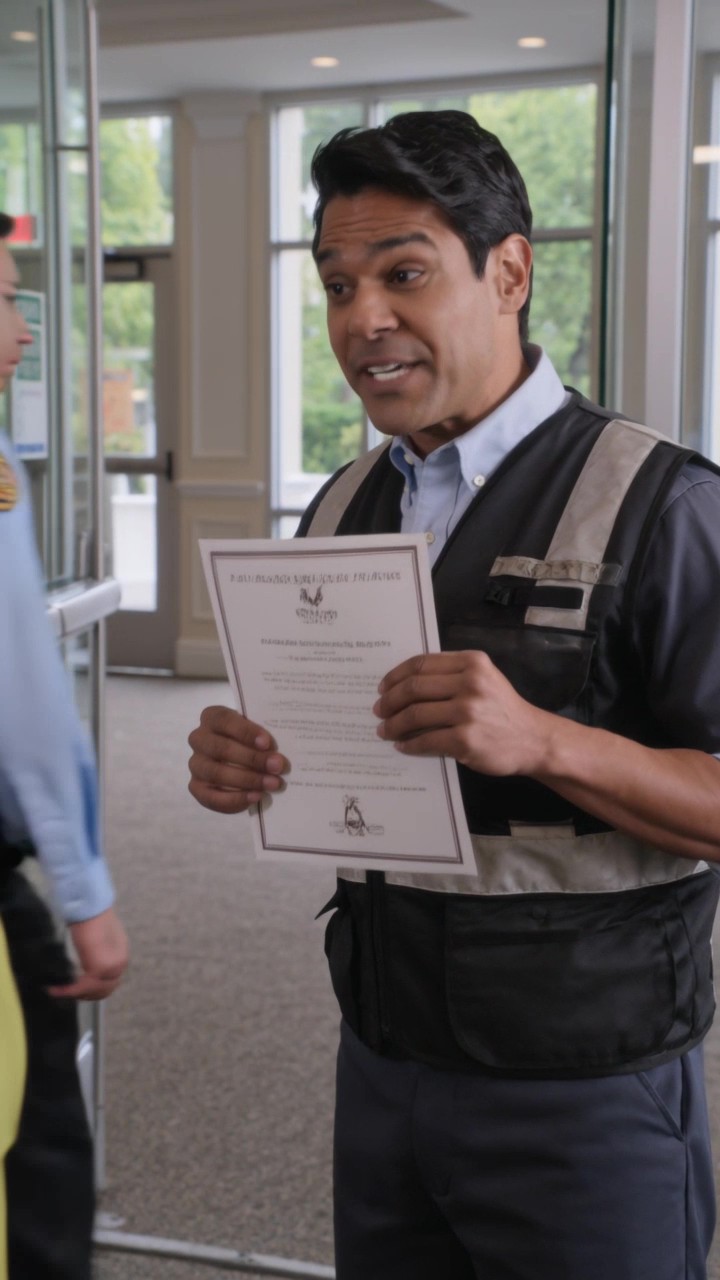
The ballroom doors opened.
Luis Rivera did not walk directly to the stage.
He stood at the entrance, uncomfortable beneath the attention.
The stain on his sleeve remained.
The reflective strips on his vest caught the chandelier light.
Every blue glove on the tables came from the same place:
The Westbridge Municipal Reuse Center.
Luis had worked sanitation for nineteen years.
He collected household waste, yard debris, recycling, and bulky items.
The job was physical.
Public.
Often invisible until something was missed.
People complained when bags remained at the curb.
Few noticed the workers who lifted broken furniture in rain, cleared storm debris before schools reopened, or identified dangerous items before they reached the compactor.
Luis took pride in the work.
He did not enjoy being treated as if the work had entered the room before he did.
Six years earlier, his daughter Elena came home crying over a college-preparation assignment.
The school required every junior to create a sample application and financial-aid plan.
Elena shared one old laptop with two cousins.
Their internet disconnected near the end of each month.
Luis knew nothing about application portals.
He knew the city reuse center had a small community room used for recycling workshops.
He asked the supervisor whether neighborhood students could use it on Saturdays.
The supervisor agreed if a city employee remained present and no operational areas were entered.
Luis began with one folding table.
Two donated laptops inspected by the city’s e-waste contractor.
A printer recovered from the approved reuse stream.
A box of blue nitrile-coated work gloves left over from a safety order in the wrong size.
He gave each student one glove.
Not to wear while studying.
To write deadlines across the fingers.
Thumb: recommendation.
Index: transcript.
Middle: essay.
Ring: aid form.
Little finger: submit.
The system was simple enough to remember when forms became overwhelming.
Luis could not teach advanced essays.
He could keep the room open.
He found people who knew more.
A librarian volunteered twice a month.
A retired counselor helped with financial-aid forms.
Sanitation coworkers donated application fees in five- and ten-dollar amounts.
A mechanic repaired student bicycles so they could reach weekend sessions.
A cafeteria worker brought soup.
The room became known as Blue Glove Saturdays.
No official program launched it.
No promotional banner.
Students arrived through cousins, bus drivers, coaches, and neighbors.
Luis checked the door at 8 a.m.
He made sure nobody left a form unfinished simply because a printer jammed or an adult became impatient.
He learned which questions he could answer.
Which required a counselor.
Which students needed quiet instead of encouragement.
When Elena submitted her first real college application, Luis wrote every deadline across his own blue glove.
Then kept it above the kitchen sink.
Over six years, more than one hundred students used the room.
Fifty of them received scholarships, apprenticeships, or training grants in the same graduating year.
The banquet invited those fifty students.
It did not invite the reuse-center volunteers as a group.
Elena invited her father personally.
The students decided beforehand to bring blue gloves.
Not for a planned confrontation.
For a photograph after the ceremony.
When Celeste sent Luis toward the loading dock, the symbol changed purpose.
Elena left the podium and opened the ballroom door herself.
“Dad.”
Luis looked past her at the tables.
“You were supposed to give a speech.”
“I am.”
He entered.
The donor who had covered her nose lowered her eyes.
Celeste attempted to recover the event.
“There was a misunderstanding. I believed Mr. Rivera was working.”
Luis looked at his vest.
“I was.”
A few guests laughed nervously.
He continued:
“I came from work.”
That distinction exposed the assumption.
A working sanitation uniform did not turn a parent into event staff.
A stain did not erase an invitation.
Celeste apologized and offered Luis a place at the sponsor table.
He declined.
“My seat is beside my daughter.”
The empty chair remained in the family section.
He sat there.
Elena returned to the podium.
Her speech was not about a father single-handedly creating fifty success stories.
She named the librarian.
The counselor.
The mechanic.
The sanitation coworkers.
The reuse-center supervisor.
Then she named Luis.
“My father did the thing institutions keep forgetting to count,” she said. “He kept the room open after everyone with a title went home.”
The scholarship foundation director asked to speak with him after the ceremony.
Luis expected praise.
Instead, he asked for permission to rebrand Blue Glove Saturdays as an official foundation initiative.
Luis said no.
Not permanently.
Not immediately.
He had seen small community programs become polished projects that excluded the same people who built them.
He gave conditions.
The reuse center remained the location because students already trusted it.
Volunteers received stipends when funding allowed.
No student photograph could be used without consent.
The program could not require applicants to write poverty stories for donors.
And sanitation workers would hold seats on the advisory board.
The foundation agreed to most of the terms.
Negotiated others.
The final program remained community-led.
It gained better laptops, stable printing, evening transportation, and professional application counselors.
Luis stayed as site coordinator for six paid hours each Saturday.
He did not quit sanitation.
People asked why.
“Because this is also useful work.”
That answer mattered.
The reversal did not require proving garbage collection had been beneath a hidden educator.
Luis was a sanitation worker and a mentor.
One role did not redeem the other.
Both carried dignity.
Celeste faced a formal complaint after several staff members described similar treatment of guests in uniforms.
The foundation found that registration volunteers had been informally instructed to redirect “service-looking individuals” away from sponsor areas.
No written rule used those words.
Bias rarely needs a written rule when everyone recognizes the expected image.
Celeste lost her event-chair role and completed corrective training before returning to another foundation position.
Some students wanted her removed entirely.
Luis did not defend her.
He also did not make punishment the center of the program.
“Change the door,” he said. “Then see who still tries to guard it.”
The next banquet used one entrance for families, donors, workers, and staff.
Invitations listed:
Work clothes welcome. Come as the day allows.
That sentence came from Luis.
Elena accepted a scholarship to study environmental engineering.
She did not choose the field to make her father’s occupation more respectable.
She had grown up asking what happened after trucks took things away.
At college, she studied waste systems, water protection, and material recovery.
Her first internship was at the same municipal department where Luis worked.
On orientation day, a supervisor handed her a new reflective vest.
Luis inspected it.
“Too clean.”
Elena laughed.
“Give me one shift.”
The original clean blue glove stayed inside a frame at the reuse-center study room.
Every student still received one at the start of application season.
The five-finger deadline system remained even after the program built an online portal.
Technology failed.
Hands were harder to lose.
Years later, Luis attended Elena’s university graduation.
He wore a dark suit.
Not because the uniform had embarrassed him.
Because he wanted to.
Under the jacket, one strip of reflective fabric was stitched into the lining.
Elena noticed.
“Still working?”
Luis smiled.
“Always.”
Near the stage, fifty former Blue Glove students gathered.
Teachers.
Electricians.
Nurses.
Mechanics.
Parents.
Some had degrees.
Some had certificates.
Some had changed plans entirely.
They raised blue gloves for one photograph.
Luis stood in the middle, still uncomfortable with being treated as the single reason.
He pointed toward the reuse-center volunteers.
“Get everyone in.”
The frame widened.
That was the dignity he wanted.
Not becoming important enough to sit among wealthy people.
Building a room large enough that nobody doing honest work had to enter through a door meant for things others preferred not to see.







Leave a Reply