
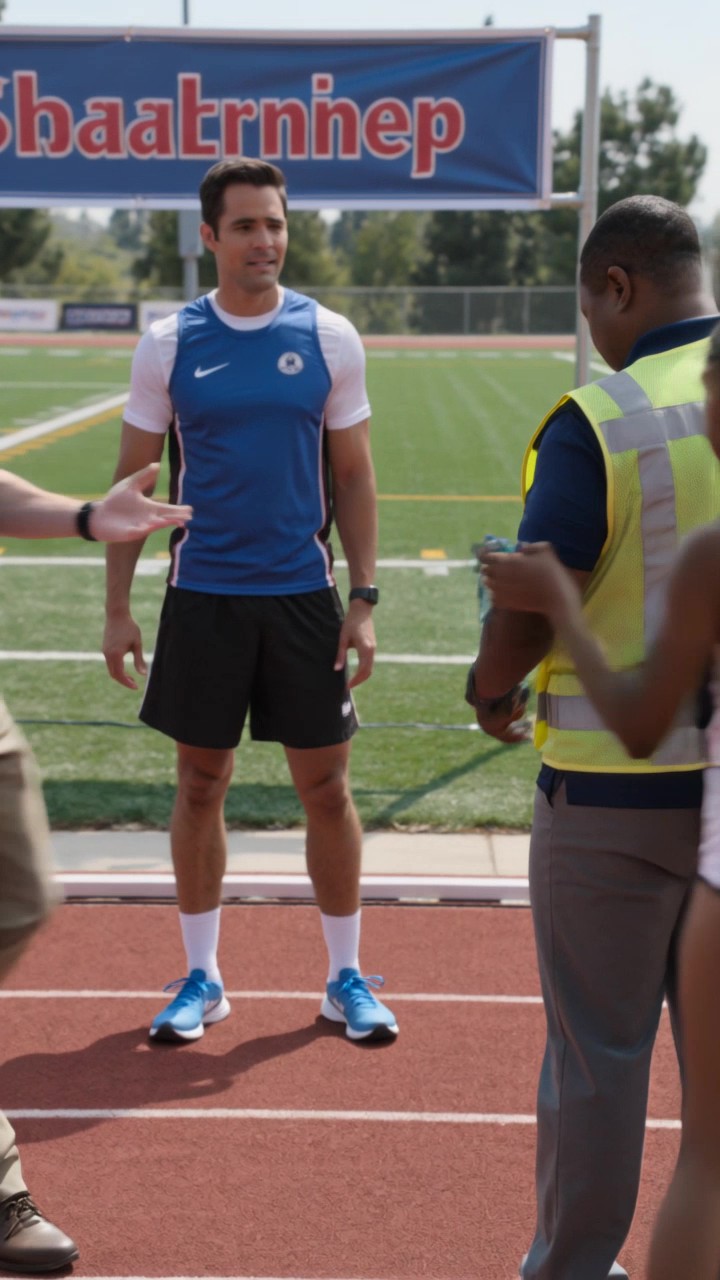
The blue tether was only sixteen inches long.
Two fabric loops connected by a narrow strap.
To the sponsor, it looked like equipment.
To Ava Brooks, it was a conversation.
A guide runner did not pull a blind athlete.
The guide matched movement.
Protected space.
Called turns before they arrived.
Adjusted without making the runner feel managed.
Trust traveled through the strap in tiny changes most spectators never noticed.
Marcus Reed had learned those changes slowly.
He was not a professional coach.
He worked mornings as a school crossing guard and afternoons maintaining city parks.
Two years earlier, Ava moved into the apartment building across from his intersection.
She had recently lost most of her vision after an illness.
Before that, she ran everywhere.
Down sidewalks.
Across playgrounds.
Around her mother’s small kitchen until neighbors complained about the floor.
After her vision changed, adults began saying:
“Careful.”
“Slow down.”
“Wait for someone.”
The warnings kept her safe.
They also made the world smaller.
One morning, Marcus heard Ava arguing with her mother at the crossing.
“I know how many steps to the gate.”
Her mother, Rachel, was late for a hospital laundry shift and terrified of letting go.
Marcus offered his arm.
Ava refused.
“I don’t want to be carried.”
He understood the difference.
The next week, he brought an old blue dog leash with both metal clips removed.
He made two soft loops.
“One for you,” he said. “One for me.”
Ava asked:
“Who leads?”
Marcus answered:
“The sidewalk.”
That was the first correct thing an adult said to her about running.
They began walking before school.
Then jogging.
Marcus learned guide-running techniques through free training offered by a local adaptive-sports group.
He practiced verbal cues, body position, turns, slopes, and emergency stops.
Ava created the tap system because morning traffic sometimes drowned out speech.
One tap:
Curb or surface change.
Two:
Narrow path.
Three:
I am still here.
The third signal mattered most during races.
Crowds, whistles, and amplified music could turn the track into a wall of noise.
Ava did not need louder instructions.
She needed one small confirmation traveling directly through the tether.
Marcus tapped three times.
The road returned.
Ava improved.
She entered a regional youth race and qualified for an adaptive-athletics scholarship program.
That was when Preston Hale entered the story.
Preston was an accomplished guide athlete and coach.
He had trained national competitors.
He could run faster than Marcus.
His technique was polished.
The scholarship sponsor wanted him beside Ava for the announcement video.
Their message was:
Elite potential deserves elite support.
That statement sounded reasonable.
The problem was that nobody asked Ava what support meant.
The program director planned to assign Preston as her guide for the exhibition lap and future publicity events.
Marcus would be thanked as “a community volunteer who encouraged her early journey.”
The wording reduced two years of trust to a warm beginning that professional people could now replace.
Marcus tried not to interfere.
He told Ava:
“Coach Hale can teach you things I can’t.”
Ava agreed.
“He can coach.”
“Then run with him.”
“No.”
“Why?”
“Because coaching and guiding are different.”
Marcus looked at the tether.
He had worried that wanting to remain beside her would become selfish.
A child’s growth often requires adults to step away.
But stepping away should serve the child, not the camera.
At the scholarship announcement, Ava chose publicly.
That did not automatically settle every future race.
The program required certified guides for sanctioned events.
Marcus had completed basic training but not the advanced qualification.
Ava could not simply insist that trust replace technical standards.
Instead, the program created a transition plan.
Preston coached her.
Marcus trained for certification.
During speed sessions, a second qualified guide worked with Ava.
She learned to run with more than one person.
That skill mattered.
Dependence on a single guide could limit her opportunities and create risk if Marcus became ill or injured.
Ava resisted at first.
She interpreted every new tether as someone trying to replace him.
Marcus tapped three times and said:
“More roads need more people.”
She answered:
“You said the sidewalk leads.”
“It does. That is why you learn every guide who can follow it with you.”
Preston also had to learn.
His first instinct was to call instructions constantly.
Ava became tense.
Her stride shortened.
Marcus watched from the infield.
Preston asked:
“What am I doing wrong?”
“Filling every quiet place.”
Preston looked annoyed.
“I am giving information.”
“She needs information before change, not commentary after every step.”
They tried again.
Fewer words.
Clearer timing.
Ava relaxed.
The famous coach was not exposed as a fraud.
He was required to recognize that expertise did not erase the knowledge held by the person already trusted.
Marcus passed the advanced guide assessment six months later.
He was not the fastest candidate.
His communication scores were among the highest.
At Ava’s first national youth event, the sponsor again requested Preston for the publicity heat.
Ava proposed something different.
Preston would coach from the track edge.
Marcus would guide the race.
A second certified guide would run warm-up.
The program accepted.
Before the starting signal, Ava tapped the tether three times.
Marcus answered.
The gun sounded.
They did not win.
Ava finished fourth.
She clipped the inside lane once and lost rhythm on the final turn.
Afterward, a reporter tried to create a sentimental story about the humble crossing guard leading a blind child to victory.
Ava corrected her.
“We did not win.”
The reporter smiled awkwardly.
“But getting here—”
“Getting here is not the same as pretending fourth place is first.”
Marcus laughed.
That was Ava.
She wanted access, not lowered standards.
She reviewed the race with Preston.
Worked on the turn.
Improved her final acceleration.
The next season, she placed second.
By then, she could run confidently with three certified guides.
Marcus remained the person she chose for difficult races.
Not because nobody else was good enough.
Because the tether between them carried history.
The scholarship program revised its guide-assignment policy.
Athletes participated in selecting guides.
Existing trusted partners received training pathways instead of being automatically replaced by professionals with more impressive résumés.
Sponsor materials named guide runners as skilled athletic partners—not inspirational helpers.
And no child was required to change a safety relationship solely for filming.
Marcus continued working the crossing.
Students saw his photograph from the national event and called him Coach.
He corrected them.
“Mr. Reed at the crosswalk.”
Ava corrected him too.
“And my guide on Saturdays.”
Both were true.
Years later, Ava received a new blue tether made from lighter competition fabric.
She kept the original leash conversion inside her track bag.
The loops were uneven.
One side had been sewn twice.
Preston once asked why she still carried it.
Ava held the worn strap between two fingers.
“This is how I learned a guide is not the person who tells me where to go.”
“What is a guide?”
“The person who makes enough room for me to keep choosing the direction.”
Before every major race, she tapped the tether three times.
Not because she was still afraid Marcus might vanish.
Because trust should never become so assumed that people stop answering.





Leave a Reply