
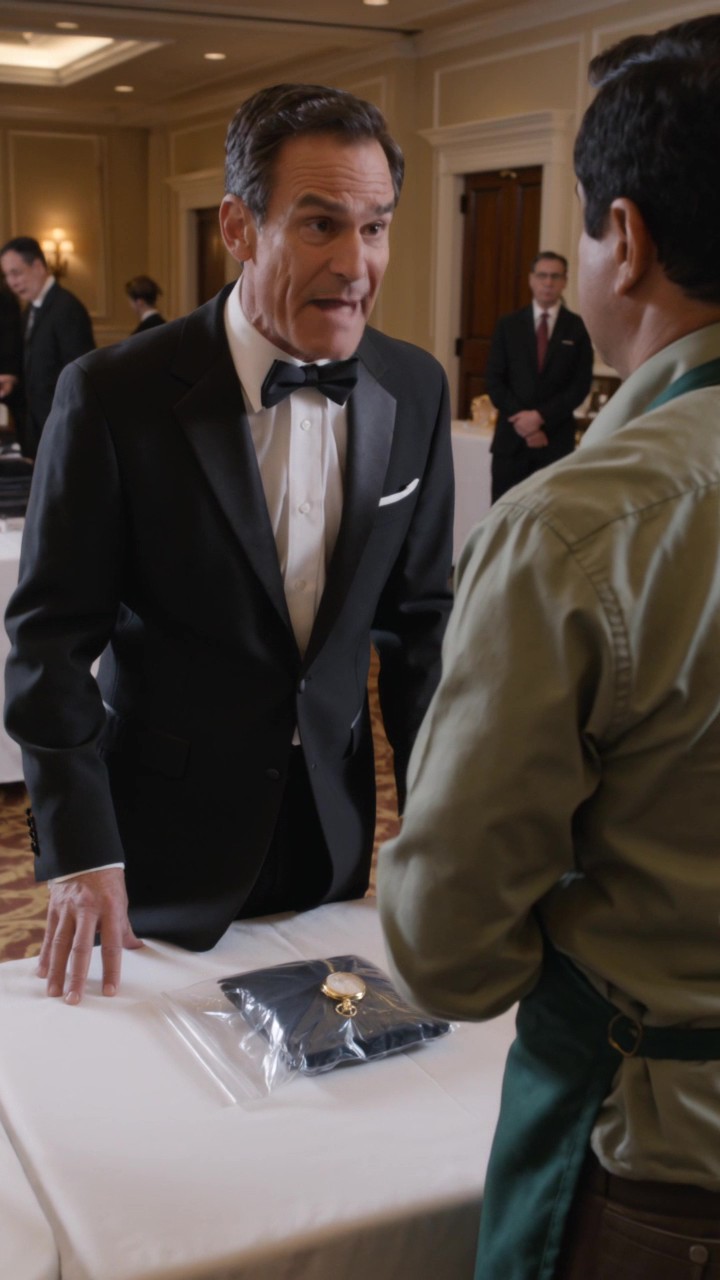
Security stepped back.
Luis Rivera remained beside the memorial table while the Whitmore family looked at the brown coat as if it had entered the room carrying an accusation.
Lily Whitmore walked toward it slowly.
She touched the white donation sticker.
The purple initials were hers.
Three weeks after her grandfather died, the family hired a company to clear clothing from the house.
Lily volunteered to help.
She was sixteen.
Grieving.
Angry that adults discussed property values while the rooms still smelled like her grandfather’s shaving soap.
She packed sweaters, shoes, old work shirts, and one heavy brown coat into clear donation bags.
Her grandfather had not worn the coat in years.
She remembered the worn elbow.
The missing top button.
She did not know about the hidden pocket inside the lining.
The bags went to Green Street Community Thrift.
Two days later, Charles realized the gold watch was missing.
The watch had belonged to the grandfather’s father.
It was engraved with three generations of initials and scheduled to appear in the memorial auction before being placed in a family trust.
The family searched drawers, safes, and jewelry boxes.
Nobody searched the donated clothing.
Instead, suspicion moved toward Nora Bell, the home health aide who had cared for the old man during his final year.
Nora had access to the bedroom.
She was working the afternoon Charles last remembered seeing the watch.
The agency removed her from the home while the family investigated.
Charles told relatives that “someone with opportunity” must have taken it.
No police charge was filed because there was no proof.
The accusation still followed Nora.
The agency stopped assigning her to private homes.
She took shifts in a rehabilitation facility at lower pay.
Luis knew none of that when the coat reached his sorting table.
Green Street Thrift trained workers to check pockets for medication, identification, cash, and personal documents.
Luis lifted the coat and noticed one side was heavier.
He felt a hard shape beneath the lining.
The hidden pocket had been sewn shut with brown thread.
He asked his supervisor to witness the opening.
Inside was the watch wrapped in an old handkerchief.
The thrift store could legally process ordinary forgotten property under its donation policy after a waiting period.
Luis refused to place the watch in the sales safe until the donor family was contacted.
The address on the bag matched the memorial notice printed in the local newspaper.
He called twice.
The family office assumed he was trying to sell an unrelated antique.
So Luis came to the auction himself.
He took two buses.
Missed four paid hours.
Carried the watch in a sealed bag with the coat and intake sticker.
The first thing the family saw was not the effort.
It was the apron.
The value of the watch.
And a man who looked easier to suspect than to thank.
Charles turned toward Luis.
“I apologize.”
Luis looked at Lily.
“Your granddaughter corrected it.”
Charles stiffened.
“I am correcting it now.”
“No.”
Luis’s voice remained calm.
“You are correcting what happened in this room.”
He pointed toward the empty chair reserved for family staff.
“What are you correcting for the woman you already called a thief?”
Vivian lowered her eyes.
The memorial guests began whispering.
Charles said the aide had never been formally accused.
Luis held the sealed watch bag.
“You removed her from work because you believed she took it.”
“That was the agency’s decision.”
“Based on whose complaint?”
Charles did not answer.
Lily began crying.
“This is my fault.”
Luis shook his head.
“You made a mistake with a donation bag.”
He looked at the adults.
“They made a decision about a person.”
The distinction mattered.
A grieving teenager overlooked a hidden pocket.
Adults with authority converted uncertainty into damage.
The family contacted Nora Bell that afternoon.
She did not come to the ballroom.
She did not want to stand before the same people and prove innocence through their recovered property.
Charles offered to send a car.
Nora declined.
He offered compensation.
She asked for a written correction to her agency, every family member who had been told, and the rehabilitation facility where she now worked.
“Not a private apology,” she said over the phone. “The suspicion was not private.”
The family issued the correction.
Charles personally met with the agency director.
Nora’s home-care eligibility was restored.
She chose not to return to the Whitmore family.
She remained at the rehabilitation center, where she had built relationships and later received a supervisory role.
The family compensated her for lost wages and the cost of legal advice.
The agreement did not purchase forgiveness.
It repaired measurable damage.
Lily visited Nora with her mother several weeks later.
She carried no flowers.
No camera.
Only the purple marker she had used on the donation sticker.
“I am sorry I packed the coat.”
Nora looked at her.
“You did not accuse me.”
“I stayed quiet when they did.”
“Did you know they were blaming me?”
“Not at first.”
“And after?”
Lily’s eyes filled.
“I thought adults knew more than I did.”
Nora nodded.
“That is something you can stop believing without stopping loving them.”
The pocket watch returned to the family.
Luis refused a cash reward equal to several months of his wages.
He accepted reimbursement for the bus fare and missed hours because returning the watch should not cost him income.
Then he asked the family to donate the rest of the proposed reward to Green Street Thrift’s document-return program.
The store often found photographs, military papers, immigration records, medication, and keepsakes inside donated furniture and clothing.
Finding owners required time.
Time required paid staff.
The Whitmore donation funded one part-time position for a year.
Luis helped create a two-person witnessing system for valuable discoveries.
Every recovered item was photographed, sealed, and logged before donor contact.
The process protected owners.
It also protected workers from the kind of accusation he faced.
Green Street placed no hero poster of Luis in the window.
He did not want customers staring at him as the honest poor man who returned a rich family’s treasure.
Honesty was not surprising because his apron was faded.
It was simply part of the work.
The memorial auction continued one month later.
The gold watch was not sold.
Lily asked that it remain with the brown coat.
The family agreed to display both at a small local-history exhibit about the grandfather’s textile work.
The hidden pocket became part of the story.
During difficult years, the grandfather’s own father had sewn valuables into coat linings when banks felt unsafe.
He passed down the habit but never explained which garments still contained something.
The family had preserved the watch while nearly discarding the person who returned it.
The exhibit label read:
FOUND INSIDE A DONATED COAT BY GREEN STREET THRIFT.
RETURNED BY LUIS RIVERA.
ITS RECOVERY ALSO CLEARED NORA BELL, WHO HAD BEEN WRONGLY SUSPECTED.
Charles initially objected to including the last line.
Lily insisted.
“Without it, we are displaying the watch and hiding the cost.”
The line stayed.
Months later, Luis found a wedding ring inside the pocket of a donated raincoat.
He followed the new process.
Witness.
Seal.
Log.
Contact.
The owner arrived in tears.
She looked at Luis’s apron and asked:
“Did you know how much it was worth?”
Luis smiled.
“Enough to know it was not ours.”
The true measure of dignity was not that he had resisted a valuable object.
It was that he had returned it even though the people receiving it were prepared to treat his goodness as less believable than their suspicion.







Leave a Reply