
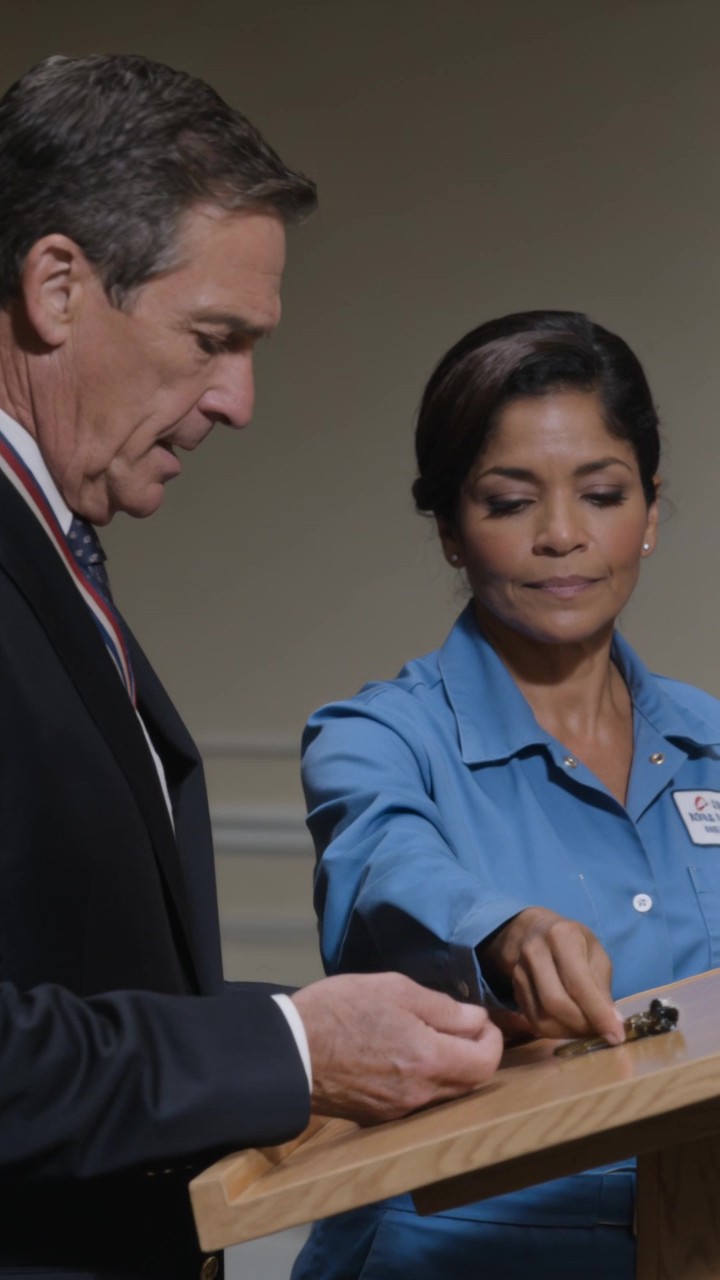
Ana Morales had not planned to interrupt the medal ceremony alone.
She expected the hotel board to correct the record after receiving the veterans’ written statements.
The board received twelve statements.
Then scheduled the ceremony anyway.
The official program described Preston Hale as the executive who “personally directed the evacuation of vulnerable guests through smoke and darkness.”
Ana’s name appeared nowhere.
The burned brass key forced the room to look at the part of the hotel its polished story had hidden.
Two years earlier, the Harbor Crown hosted a reunion for veterans and their families.
Many guests were older.
Several used canes, walkers, or oxygen equipment.
At 9:18 p.m., an electrical transformer failed beneath the loading area.
Smoke entered the ground-floor mechanical corridor.
The lobby lost power.
Emergency lighting activated unevenly.
The guest elevators stopped.
Preston was attending a private reception on the mezzanine.
He ordered staff to guide guests toward the grand staircase.
That was the written plan.
Then smoke pushed across the lower landing.
Fire doors closed automatically, separating several floors from the central stairs.
Ana worked in the basement laundry room.
She heard the electrical pop through the ductwork before the alarms began.
The laundry team lost overhead lights.
One machine continued turning on residual power, then stopped with wet sheets trapped inside.
Ana smelled burning insulation.
She shut off the laundry breakers and opened the service corridor.
A night porter shouted that guests on the third and fourth floors could not reach the main stairs.
Ana knew the hotel’s older infrastructure.
Before the building was renovated, a linen lift carried baskets between floors.
The motor had been disconnected years earlier, but the shaft remained.
Beside every service landing was a narrow mechanical gate.
The basement gate still had a manual release.
The brass key hung inside a locked maintenance box.
Ana had used it during a flood drill once.
Most managers had forgotten it existed.
She took the key.
Opened the basement gate.
Climbed the fixed service ladder to the second floor.
Then the third.
At each landing, she unlocked the gate and entered the service corridor behind guest rooms.
The corridors were narrow.
Uncarpeted.
Poorly lit.
But they connected to secondary stairwells that did not pass through the smoke-filled lobby.
Ana found three elderly guests sitting near an elevator door.
One held a portable oxygen unit.
Another could not read the small emergency map without glasses left in his room.
Ana tied a blue laundry towel to the safe stair door.
“Follow the towels,” she said.
The towels became the evacuation system.
One on each correct door.
Two on each landing where staff needed to turn.
A folded triangle beside guests who required assistance.
Housekeepers, dishwashers, and porters copied the pattern.
They moved thirty-seven people through service routes.
Twelve were veterans from the reunion.
The brass key grew hot after Ana used it near a smoke-filled fourth-floor utility door.
Part of the plastic grip melted.
She wrapped it in a towel and kept turning.
Preston’s real contribution began later.
When he reached the lower floors, he coordinated the fire department’s guest list, arranged buses, and kept frightened families from reentering the building.
He did not do nothing.
The lie began when the hotel communications office needed one public face.
A laundry worker leading guests through an unofficial service route raised uncomfortable questions.
Why had management failed to maintain the alternate lighting?
Why did only one hourly worker remember the manual key?
Why were several disabled guests placed on upper floors without individual evacuation plans?
The cleaner story was:
The manager led.
The hotel system worked.
The guests were saved.
Ana objected during the internal review.
Her supervisor told her:
“The board knows the team helped.”
Ana asked:
“Then why is one man in every photograph?”
No answer came.
Preston received media attention.
Then a regional hospitality award.
He used phrases carefully.
“My staff and I.”
“We directed guests.”
“I made the decision to use secondary routes.”
That last sentence was false.
Ana had already opened four floors before Preston knew the linen gates were being used.
One veteran, Thomas Bell, remembered the key.
During the blackout, Ana placed it in his hand while helping another guest transfer from a walker to the stair chair.
“Hold this,” she said.
The key was warm.
Heavy.
Real.
Thomas later asked who she was.
The hotel gave him Preston’s name.
He knew that was wrong.
The veterans found Ana through a housekeeper.
They wrote statements.
The hotel board thanked them and proceeded with the medal.
So they came to the ceremony carrying blue towels.
Not military flags.
Not dramatic evidence.
Laundry towels folded the way Ana had marked people needing assistance.
The board chair looked at Preston.
“Did Ms. Morales initiate the service-route evacuation?”
Preston answered slowly.
“She opened the first access points.”
“How many?”
“I do not know.”
Ana did.
“Six floors.”
The room changed.
Preston turned toward her.
“You violated the fire plan.”
“The main route had smoke.”
“You climbed an inactive lift shaft.”
“The ladder was the only way to unlock the floors from inside.”
“You could have been trapped.”
“Yes.”
Ana did not disguise the risk.
The proper investigation should ask whether her action was proportionate and whether another route existed.
It should not erase her because the correct answer made management look unprepared.
The hotel paused the ceremony.
An independent review compared fire-department timestamps, service-camera footage, staff radio logs, and guest statements.
It confirmed Ana opened the alternate corridors, created the towel-marking system, and directly assisted guests for twenty-three minutes before Preston entered the basement command area.
Preston’s post-evacuation coordination was also confirmed.
The individual medal was withdrawn.
Ana refused to accept it in his place.
“The key was mine,” she said. “The towels belonged to laundry. The people carrying guests came from five departments.”
The hotel created a team commendation naming every worker and guest who assisted.
Preston lost his role as emergency spokesperson and received formal discipline for claiming decisions he did not make.
He remained hotel manager under board supervision.
Some staff wanted him fired.
Others believed his genuine response work and public correction justified a chance to remain.
Ana did not decide his punishment.
She demanded better systems.
Every floor received maintained service-route lighting.
Old linen gates were replaced with accessible emergency doors.
Guests requesting mobility assistance received personal evacuation plans.
Housekeeping, laundry, kitchen, and maintenance workers joined emergency-command drills.
And no public rescue statement could be issued before frontline staff accounts were collected.
Ana was offered a promotion to guest-safety coordinator.
She accepted only if the role remained partly inside operations.
“I do not want to become another person who writes plans without walking the corridors.”
The burned key was mounted in the training room.
Beside it hung one blue towel.
The plaque read:
THE BUILDING HAD ANOTHER WAY OUT.
THE PERSON WORKING BEHIND THE WALLS REMEMBERED IT.
Thomas Bell returned one year later.
He brought the towel he had kept.
Ana told him hotel property should have been returned.
He laughed.
“You gave me a map.”
He placed the towel in a frame with the key.
Preston attended the anniversary drill.
This time, he followed Ana through every service corridor.
At the fourth-floor landing, he stopped beside the old gate.
“I thought leadership meant being the person who gave the order.”
Ana tested the new emergency light.
“Sometimes leadership is noticing the order is already coming from the person who understands the building.”
The next blackout was small.
A storm cut power for nine minutes.
Backup systems worked.
Staff opened alternate corridors before guests became frightened.
No medal ceremony followed.
No one needed one.
The truth had finally moved from a plaque into the plan.





Leave a Reply