
Every child left Riverside Daycare alive.
Every resident of Bellview Senior Living reached dry ground.
No ambulance carried anyone away with a flood injury.
The county called Ethan Cole’s decision a successful emergency diversion.
Families called him brave.
Riverside Cemetery families used different words.
Damage.
Violation.
Choice.
The cemetery held more than polished headstones.
Its oldest section contained immigrant families, mill workers, veterans, and people buried before the county kept reliable maps.
Some markers were hand-cut.
Some names survived only in family memory.
The flood did not erase the entire cemetery.
It damaged the lower rows.
Several stones toppled.
Fresh soil washed from planting beds.
Paper records stored in the maintenance shed became wet.
No graves were described publicly in graphic detail.
The damage was serious enough without turning grief into spectacle.
Ethan understood what had been lost.
His father, Daniel Cole, was buried in Row 11.
A city bus mechanic for thirty-four years.
The man who taught Ethan to check drainage grates before storms because:
“Water always takes the path somebody forgot to keep open.”
That sentence followed Ethan into county stormwater work.
On the day of the flood, water had nowhere safe left to go.
Three days of heavy rain filled the river.
A fallen tree blocked the downstream culvert.
The primary storm drain beneath Alder Road should have carried overflow toward an empty sports field.
It failed.
Later inspection found years of sediment, construction debris, and a partially collapsed pipe.
The county knew capacity was declining.
Replacement had been planned twice.
Budget shifted once to a courthouse roof.
Then to road resurfacing before an election season.
The pipe remained.
At 2:18 p.m., water crossed the road.
At 2:27, the daycare lost its front exit.
At 2:31, the senior center’s evacuation route flooded.
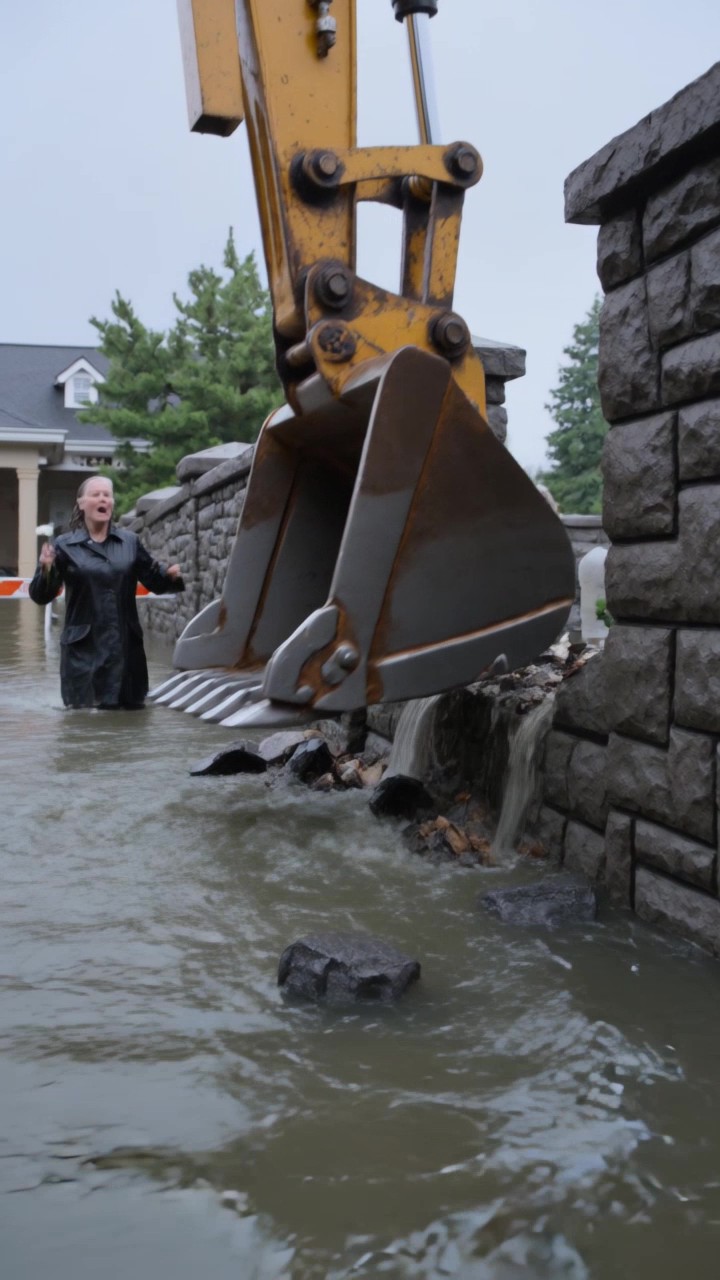
Ethan arrived with a maintenance excavator, two pumps, and a drainage map.
The pumps could not keep up.
The map showed one low corridor between the river and an undeveloped lot.
The corridor passed through Riverside Cemetery’s maintenance lane.
A stone perimeter wall blocked it.
If Ethan opened the wall, water would spread across the lower cemetery and into the empty lot.
If he did not, pressure would continue building against the occupied buildings.
Preston Hale, the county emergency director, asked Ethan to wait for the regional engineer.
Estimated arrival:
Twenty minutes.
The daycare window bowed inward.
Ethan believed they had less than five.
He made the decision.
He did not choose the cemetery because he thought the dead mattered less.
He chose it because no living person occupied the path.
That practical statement sounded cold to families whose loved ones were there.
Margaret Bell’s husband Thomas had been buried eighteen months earlier.
She visited every Sunday.
The white flower she threw at Ethan came from the arrangement she had placed that morning.
Water bent the stems and carried one ribbon into the maintenance ditch.
At the public review, Margaret faced Ethan.
“Would you have opened that wall if your father were buried there?”
Ethan answered:
“He was.”
The room became silent.
Some people expected that revelation to end the argument.
It did not.
Margaret said:
“Then you knew exactly what you were taking from us.”
“Yes.”
“Did that make it easier?”
“No.”
“Did it make you stop?”
“No.”
Both truths remained.
The county investigation concluded Ethan’s breach probably prevented rapid structural flooding at the daycare and senior center.
Probably.
The windows might have held longer.
Regional rescue boats might have reached the children before failure.
The senior center had an upper floor.
Alternative outcomes could not be proven.
Emergency decisions often become clearer only because the chosen path removes the worst possibility.
Ethan was cleared of misconduct under immediate life-safety authority.
The report also found the county created the crisis through delayed infrastructure work, incomplete cemetery drainage maps, and an evacuation plan that depended on a single road.
Preston had not caused the pipe collapse alone.
He had participated in budget recommendations that repeatedly postponed replacement.
His order to wait reflected procedure.
It also protected the organization from responsibility longer than it protected the people behind the windows.
He was removed from emergency operations while remaining in county administration.
Ethan received public praise.
He rejected an individual award.
“I acted because previous decisions left one destructive option,” he said. “Do not decorate the last person in the chain and forget the people who made the chain necessary.”
That sentence angered several county officials.
It also changed the repair process.
Cemetery families demanded restoration before road beautification or public ceremonies.
The county initially offered general landscaping funds.
Margaret refused.
“Grass is not a record.”
A professional cemetery conservator surveyed every stone.
Historical groups photographed inscriptions.
Families reviewed names and plot locations.
The maintenance records were freeze-dried and digitized.
Toppled markers were restored using preservation methods rather than replaced with uniform new stones.
The wall was rebuilt with a controlled flood gate and reinforced channel so future overflow could move along the maintenance boundary without crossing burial rows.
The county purchased the undeveloped lot as permanent flood storage.
A second evacuation road was added behind the senior center.
The daycare moved its youngest classrooms above ground level.
Most importantly, the collapsed storm drain was replaced.
Restoration took fourteen months.
Not everything returned perfectly.
One hand-carved marker had lost part of its inscription.
Several shrubs planted by families died.
Margaret’s husband’s white stone developed a faint water stain along the base.
She chose not to have it polished away.
“The flood happened,” she said. “Repair is not pretending it didn’t.”
Ethan’s father’s headstone tilted after the water receded.
Ethan was not permitted to repair it himself because preservation workers needed to document every shift.
He waited three months.
That delay taught him something.
Emergency authority had allowed him to act in seconds.
Grief required him to surrender control and let other people decide how the place should be restored.
Margaret joined the cemetery-repair committee.
So did Ethan.
Their meetings were tense.
She challenged every phrase that turned the cemetery into “available land.”
He challenged plans that rebuilt the old wall without creating a safer overflow route.
They did not become close friends.
They became necessary opponents.
The final memorial did not praise Ethan.
At the rebuilt wall, the county installed a small metal plate:
OPENED DURING THE ALDER FLOOD TO PROTECT OCCUPIED BUILDINGS.
REBUILT WITH THE FAMILIES WHO CARRIED THE LOSS.
Margaret approved the second line.
Ethan approved the absence of his name.
The daycare children returned one year later with paper flowers.
Teachers considered placing them on every affected grave.
Margaret suggested something different.
The children placed the flowers along the new flood channel.
“The graves are not a lesson prop,” she said. “The channel is the promise.”
Ethan stood beside the excavator path, now planted with low grass.
One child asked:
“Did you break the wall?”
“Yes.”
“Were you scared?”
“Yes.”
“Would you do it again?”
Ethan looked toward Row 11.
Then at the daycare across the road.
“If those were the only choices again, yes.”
Margaret heard him.
She did not smile.
She nodded once.
Understanding was not forgiveness.
Agreement was not celebration.
The cemetery had absorbed the water because the living needed time.
The living inherited responsibility for every name the water passed.
That was the only honest ending.







Leave a Reply