
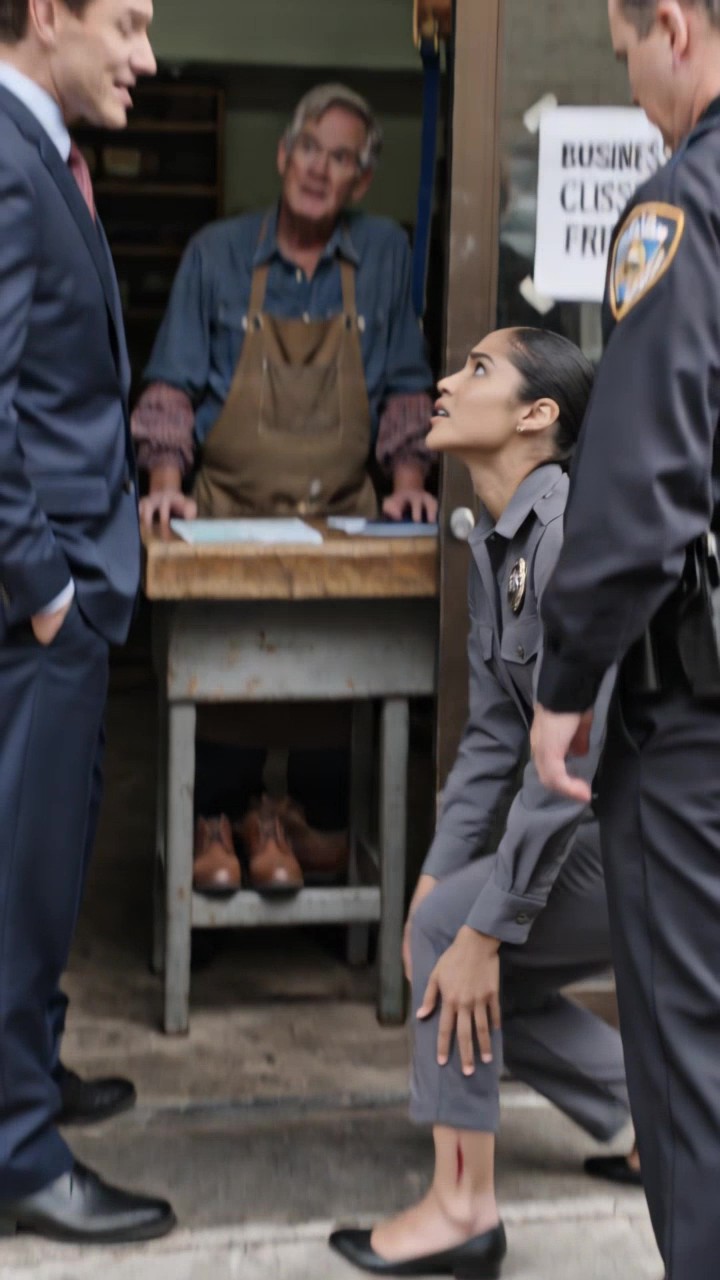
Lena Morales did not cancel the closure notice because Henry Bell had once helped her.
She suspended it because the evidence supporting the closure was incomplete.
That distinction protected both of them.
Gratitude could make an official careless.
Professional verification made the result trustworthy.
Henry’s shop occupied the ground floor of a narrow brick building on Alder Street.
The entrance had three concrete steps and no automatic door.
For years, customers using wheelchairs or walkers called from outside.
Henry carried small repairs to the sidewalk.
He believed that was enough because nobody had filed a formal complaint.
It was not enough.
A business open to the public needed an accessible route where feasible.
The problem became urgent after the city launched a corridor inspection.
Henry asked the landlord, Preston Hale, for permission to build a side ramp across a strip of unused pavement.
Preston refused.
He said underground electrical and water infrastructure made construction impossible.
He submitted an engineering sketch showing a utility vault beneath the proposed route.
The city accepted the sketch.
Henry received the closure notice.
What the paperwork did not show was that the utility vault had been abandoned and removed during a street reconstruction project fifteen years earlier.
The landlord knew.
The empty side strip had become more valuable because a neighboring café wanted to expand its patio.
If Henry’s shop closed, Preston could terminate the old low-rent lease and combine both storefronts under a new commercial agreement.
The accessibility violation was real.
The claimed impossibility was not.
Lena noticed the problem because she had become an accessibility and building-compliance inspector.
Her work required separating three questions:
What barrier exists?
What correction is technically possible?
Who benefits from saying nothing can be done?
The blue leather strap did not answer those questions.
It reminded her to look carefully.
At ten years old, Lena wore a leg brace after surgery.
The brace was heavy.
Her school shoe tore where the metal joint pressed against the leather.
The medical supplier said the custom replacement would take weeks.
The school told her mother Lena could remain home until proper footwear arrived.
Her mother cleaned offices at night and could not miss more work.
They entered Bell’s Shoe Repair hoping Henry could glue the split for one day.
Henry examined the brace.
He did not pretend to be an orthopedic specialist.
He called the rehabilitation clinic.
Asked what movements had to remain free.
Then cut a blue leather strip from a display shoe and built a temporary external strap that held the shoe closed without pressing against the healing area.
He told Lena’s mother to return to the clinic as soon as the proper shoe arrived.
He charged one quarter.
Lena asked why.
“Because this is a repair, not a favor you have to remember forever.”
He wrote a receipt:
BLUE STRAP — TEMPORARY — 25¢.
The strap lasted three weeks.
Long enough for Lena to attend school.
Long enough for her mother to keep working.
Long enough for a child who already felt different not to be told that one broken shoe had removed her from the classroom.
Lena kept the receipt.
Henry kept the pattern strap because he later used the shape to explain modifications to other customers.
Neither expected to meet again.
At the shop inspection, Lena ordered a new site survey.
The survey confirmed no active vault beneath the side pavement.
A modular ramp with one turning platform could reach the entrance without blocking the alley, drainage, or neighboring property.
The cost was significant but manageable.
Preston argued the lease required Henry to fund all business improvements.
Henry had little savings.
The closure was still possible if no one paid.
Lena did not solve that problem by writing a personal check.
She connected Henry with the city’s small-business accessibility grant.
The program covered part of construction.
A neighborhood development fund offered a low-interest loan for the remainder.
The landlord was legally responsible for approving changes to the common exterior and correcting false property information.
He tried to delay.
The city issued an order preventing lease termination while the accessibility modification was under approved construction.
Preston accused Lena of favoritism.
She disclosed the childhood connection in writing and requested a second inspector review every technical decision.
The second inspector reached the same conclusion.
The ramp was feasible.
The shop could remain open during part of construction through a temporary side platform.
That transparency mattered.
Returning a kindness should not require bending rules.
Sometimes it means finally applying the rules to the person who assumed nobody would look closely.
Henry struggled with the loan paperwork.
He was seventy-two.
His bookkeeping system consisted of envelopes, handwritten tickets, and a calculator with one faded button.
His niece Rachel helped organize the application.
The neighborhood raised a smaller amount for a new automatic door.
Henry resisted the fundraiser.
“I did not ask people to save the shop.”
Rachel answered:
“They are paying for a door they can use.”
Customers contributed because the shop had repaired work boots, school shoes, dance slippers, leather bags, and one child’s blue brace strap across four decades.
The money was not repayment for a single saintly act.
It was investment in a place people still needed.
Construction exposed another problem.
The front threshold had rotted beneath the metal plate.
Henry wanted to cover it and continue.
The contractor refused.
The repair added cost and delayed reopening.
Lena supported the contractor.
Henry became angry.
“You found a way to keep the shop open, then every new rule makes it harder.”
Lena sat beside the workbench.
“The blue strap was temporary because the clinic needed to replace the real shoe.”
Henry looked at her.
“A temporary fix is not permission to leave the dangerous part forever.”
The lesson returned in the opposite direction.
Henry had helped a child move until proper care arrived.
Now Lena helped him accept that dignity did not mean resisting every form of assistance or regulation.
The shop reopened after seven weeks.
The new ramp turned once along the brick wall.
A low handrail followed both sides.
The automatic door opened slowly enough for walkers and wheelchairs.
Henry complained that the motor sounded like a tired refrigerator.
Then learned how many customers had stopped visiting because the steps had become too difficult.
An older tailor returned after three years.
A wheelchair user brought in a leather backpack Henry repaired without asking her companion questions meant for her.
A delivery driver with a knee injury could enter without lifting himself along the rail.
The shop gained business.
Preston faced a city penalty for submitting outdated site information as current.
Investigators found emails showing his property consultant had warned that the vault no longer existed.
He had chosen not to correct the file.
The city required new verification for “technical impossibility” claims involving accessibility upgrades.
Property owners could no longer rely solely on old private drawings when denying a feasible route.
Lena did not become Henry’s daughter or business partner.
She returned occasionally for shoe repairs.
Paid full price.
Henry framed the old quarter receipt near the blue strap.
Beneath it, he added a new note:
TEMPORARY HELP SHOULD MOVE SOMEONE TOWARD THE NEXT DOOR, NOT MAKE THEM OWE YOU FOR THE FIRST ONE.
At the reopening, reporters asked Lena whether Henry’s kindness inspired her career.
She answered honestly.
“Partly.”
She had also grown up encountering buildings that treated access as an inconvenience.
A school without a working lift.
A clinic entrance blocked by delivery boxes.
A city office where the accessible door required ringing a bell no one answered.
Henry’s strap showed her one person could adapt an object.
Her career taught her systems should not depend on finding one unusually kind person.
Months later, a teenager entered the shop with a torn work boot and an ankle support.
Henry examined it.
Then called the teenager’s clinic before changing anything.
He cut a temporary strap from blue leather.
The teenager looked at the framed receipt.
“Is this free?”
Henry shook his head.
“Twenty-five cents.”
Lena happened to be inside collecting her shoes.
She smiled.
The quarter had returned.
Not as payment of an old debt.
As a method of helping someone keep moving without taking their dignity as collateral.







Leave a Reply