
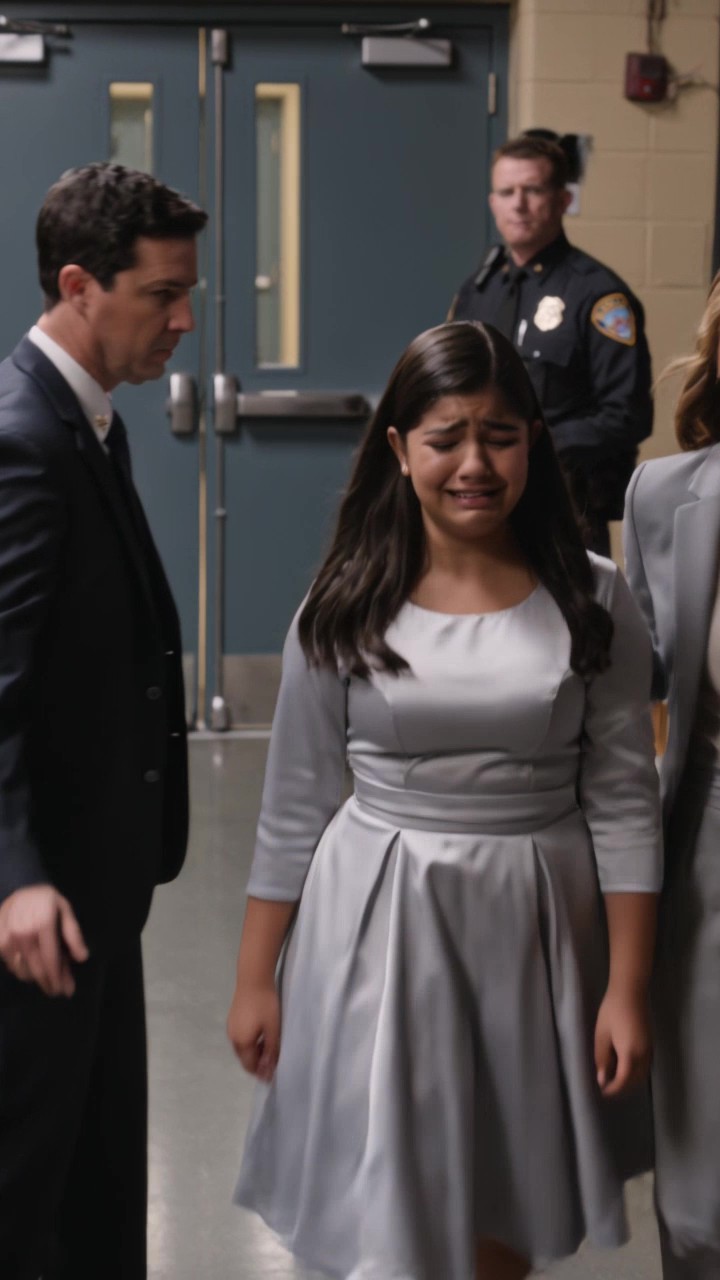
Maya Carter did not forgive Rachel Cole when the man was removed from the concert center.
She understood the reason.
That was not the same thing.
For eleven months, Maya had trained for the state youth-choir solo.
She learned every breath mark.
Practiced after school.
Worked weekend shifts at a grocery store to help pay for the trip.
The scholarship attached to the performance could cover summer conservatory tuition.
Rachel removed her less than two minutes before the livestream began.
Understanding danger did not restore the moment.
The safety plan began after Maya’s mother, Elena, left a controlling relationship.
The man, Aaron Vale, was not Maya’s biological father.
He had lived with the family for six years.
At first, he was attentive.
Then he began monitoring phones, controlling travel, and appearing at school events after being told not to.
When Elena left, a court issued restrictions on contact while allegations and custody-related matters were reviewed.
The family moved to another district.
Maya began using her mother’s family name, Carter, instead of Vale.
The school received a confidential safety file.
Only the principal, counselor, front-office lead, and Rachel knew the complete details.
Maya wanted music to remain the part of her life that did not feel like escape.
She asked to join the state choir under her new name.
The program accepted her.
The problem was the livestream.
Public schedules listed the concert center, school district, performer names, and broadcast time.
The district requested that Maya’s image not be used in promotional clips.
The state program agreed.
Her solo itself would still be live because Maya and her mother believed the risk had become manageable.
Aaron had not appeared for months.
Police had no evidence he knew the new district.
Then, on concert afternoon, a parking attendant noticed a vehicle circling the venue.
The license plate resembled the one in Maya’s safety file.
A school security officer checked the driver from a distance and recognized Aaron.
He called police.
The officer faced a tactical problem.
If staff suddenly announced a security threat, Aaron might leave, follow another family, or move toward an unguarded side entrance.
He advised the school to move Maya into the interior rehearsal suite without identifying her publicly or revealing that he had been recognized.
Rachel had less than three minutes.
She could tell Maya privately that Aaron was outside.
But Maya was standing beside other students at the curtain.
Any visible panic could draw attention.
The rehearsal suite required passing the livestream camera and public lobby unless staff used the disqualification route through the instrument corridor.
Rachel chose the fastest believable explanation:
Maya could not perform because of a participation violation.
The statement moved her away from the stage without naming the threat.
It also damaged her.
Rachel understood that immediately.
Maya’s classmates believed she had broken rules.
The scholarship judge recorded a disqualification.
Her aunt, who knew only part of the safety plan, thought Rachel was punishing the family for keeping details private.
Rachel allowed the anger to remain.
She handed Maya to the counselor.
Closed the corridor door.
Then stood at the lobby desk when Aaron entered asking for “Maya Vale.”
That name exposed his purpose.
The state program listed no performer by that surname.
Security delayed him with registration questions until police arrived.
No physical confrontation occurred.
Maya remained inside the rehearsal room.
Aaron was removed and later faced legal consequences for violating court restrictions and approaching a protected school event.
The immediate danger ended.
The institutional damage did not.
The scholarship committee initially said Maya could not be reconsidered because the concert had already begun.
Rules treated every last-minute removal as a performer issue.
Rachel refused to let the false explanation become the permanent record.
Once police confirmed Aaron was secured and the family’s location no longer depended on secrecy, Rachel submitted a correction.
She wrote:
Maya Carter did not violate any participation rule. I removed her under an emergency confidential safety direction and used disciplinary language to prevent disclosure of the protected student.
The state director asked why she had not used the phrase “medical emergency.”
Rachel answered:
“Because a medical emergency would have brought staff, cameras, and questions toward her.”
“Why not technical difficulty?”
“Because they would have expected her to remain backstage and perform later.”
The disciplinary explanation was the only one guaranteed to move Maya immediately through the interior corridor.
It worked.
That did not make it harmless.
Maya met Rachel the next morning with her mother and an advocate.
“You let them think I cheated.”
“Yes.”
“You heard me say I hated you.”
“Yes.”
“Did you believe I would understand later?”
Rachel looked at her.
“I believed you needed to be alive and unreachable first.”
Maya’s mother began crying.
Maya did not.
“What if he had never entered the lobby?”
Rachel understood the question.
If Aaron had driven away, Maya might have remained disqualified while evidence stayed confidential.
Rachel had been prepared to carry that outcome until authorities cleared disclosure.
“I would have corrected it as soon as the safety team allowed.”
“That might have been after the scholarship.”
“Yes.”
Maya looked down.
Protection sometimes transfers the cost of danger onto the person being protected.
That cost needs to be named, not hidden beneath gratitude.
The state program created a private re-evaluation.
Maya performed the solo two weeks later in a closed auditorium with judges, her accompanist, her mother, and an independent student advocate.
No livestream.
No audience.
She sang well.
Not perfectly.
The final sustained note shook.
She completed it.
The committee restored her eligibility and awarded partial summer tuition based on the full audition score.
She did not receive the separate live-performance prize because she had not appeared in the concert.
That felt unfair.
It was also the limit of what the rules allowed after other students had already performed.
Maya appealed.
The appeal failed.
The story did not return every lost opportunity.
It changed future ones.
The state choir created confidential-performance protocols.
Protected students could appear under limited public listings.
Livestreams could use delayed broadcast instead of real time.
Venues established interior safe rooms that did not require disciplinary pretexts.
A safety coordinator could remove a student using neutral language already approved with the family.
Scholarship committees could pause eligibility when an emergency removal was verified.
Most importantly, the student participated in planning the words staff would use.
Maya chose:
The performer is temporarily unavailable under an approved safety protocol.
No shame.
No diagnosis.
No clue about location.
Rachel received a formal review for using false disciplinary language.
The review found the emergency decision reasonable but identified that the program had left her without a safe alternative.
She was not punished.
She did not ask to be praised.
“I protected Maya by borrowing her reputation,” she said. “The system has to make sure nobody needs to do that again.”
The phrase spread through training sessions.
Maya returned to choir.
For several months, she would not take a solo from Rachel.
Trust did not repair because adults held a meeting.
Rachel respected the distance.
She coached the full group.
Answered questions.
Never used the danger to demand closeness.
At the spring concert, Maya volunteered for a small duet.
Before going onstage, she handed Rachel the original blue performer ribbon.
Rachel had kept it sealed in an envelope.
Maya tied it around her own wrist.
“This does not mean I am done being angry.”
“I know.”
“It means I am singing.”
Rachel nodded.
“That is enough.”
The performance was recorded with a two-hour delay.
No public location appeared until the venue had emptied.
Maya’s mother watched from the front row.
The song ended.
No one rushed the stage.
No secret door opened.
No man entered the lobby.
The quiet ending mattered.
Rachel had once allowed a student to hate her because explaining the truth in that moment might have revealed where the student was.
The better system did not ask another teacher to become the villain.
It protected both the child and the name she had worked to build.





Leave a Reply