
Fire Captain Preston Hale had earned recognition.
His crew entered moving floodwater.
Secured the school bus.
Opened the roof hatch.
Moved eleven children and a driver to higher ground.
Nothing about Noah’s choice erased that.
The error came from treating the final visible rescue as the entire event.
The school bus stalled at 3:16 p.m. during an intense rainstorm.
A clogged storm channel sent water across the low road beneath the railway bridge.
The driver, Rachel Cole, entered before the depth became obvious.
Halfway through, the engine stopped.
Water rose around the wheels.
The rear of the bus shifted toward the curb.
Rachel called dispatch and tried to restart.
Samuel Ortiz worked as the bus aide.
His job was to help younger children buckle in, monitor behavior, and assist two students with medical plans.
He had never performed a flood rescue.
He did know the children.
Noah became silent when frightened.
Lily’s blood sugar could fall quickly under stress.
Another child removed his hearing aids when alarms became too loud.
A first grader would unbuckle and run whenever adults shouted.
Samuel’s first task was not heroic.
It was specific.
He moved every child from the lower seats to the highest side of the bus.
He counted.
Eleven.
Counted again.
Eleven.
He told Rachel to stop restarting the engine after water reached the lower electrical area.
He took the red emergency whistle from the driver’s pouch because his voice disappeared beneath rain striking the roof.
One whistle blast meant:
Quiet enough to hear instructions.
Two meant:
Answer so I can count you.
Three meant:
Help has confirmed our location.
At first, there had been no confirmed help.
Samuel did not use three blasts.
He refused to promise what dispatch had not told him.
Water entered through the folding-door seal.
Children began crying.
Noah watched a lunchbox float beneath a seat and asked:
“Are we sinking?”
Samuel answered:
“The bus is still on the road. We are moving higher while help comes.”
Not:
Everything is fine.
Not:
Nothing bad will happen.
Children remember false reassurance.
Lily’s medical pouch slid from the front shelf when the bus tilted.
It disappeared beneath two seats on the lower side.
Rachel told Samuel to leave it.
Lily had a backup snack in her backpack.
The backpack was already wet.
Her glucose monitor began alarming.
Samuel clipped himself to an interior handrail using the bus’s evacuation strap and moved across the seat backs.
He did not enter deep current outside the bus.
He remained inside the vehicle.
He reached beneath the seat with a broken broom handle, hooked the pouch strap, and pulled it upward.
The supplies stayed dry inside the sealed bag.
He gave Lily the treatment specified in her school plan while speaking to the nurse by phone.
Then dispatch confirmed fire crews had reached the road.
Samuel blew three times.
Every child answered by tapping the seat frame.
Three taps.
Help knows where we are.
That signal changed panic into a task.
The children repeated it whenever sirens became audible.
Captain Preston’s crew arrived nine minutes later.
The rescue required speed and training.
Firefighters stabilized the bus with lines, broke the roof ventilation panel, enlarged the opening, and removed children in life jackets.
Preston entered last to help Rachel after every child was counted outside.
The news cameras captured that part.
They did not capture the minutes inside before the crew arrived.
City communications interviewed Preston.
The school district provided Rachel’s name.
Samuel appeared in one sentence:
A bus aide assisted students while awaiting rescue.
The wording was not completely false.
It was too small.
The city-hall ceremony was planned around emergency responders.
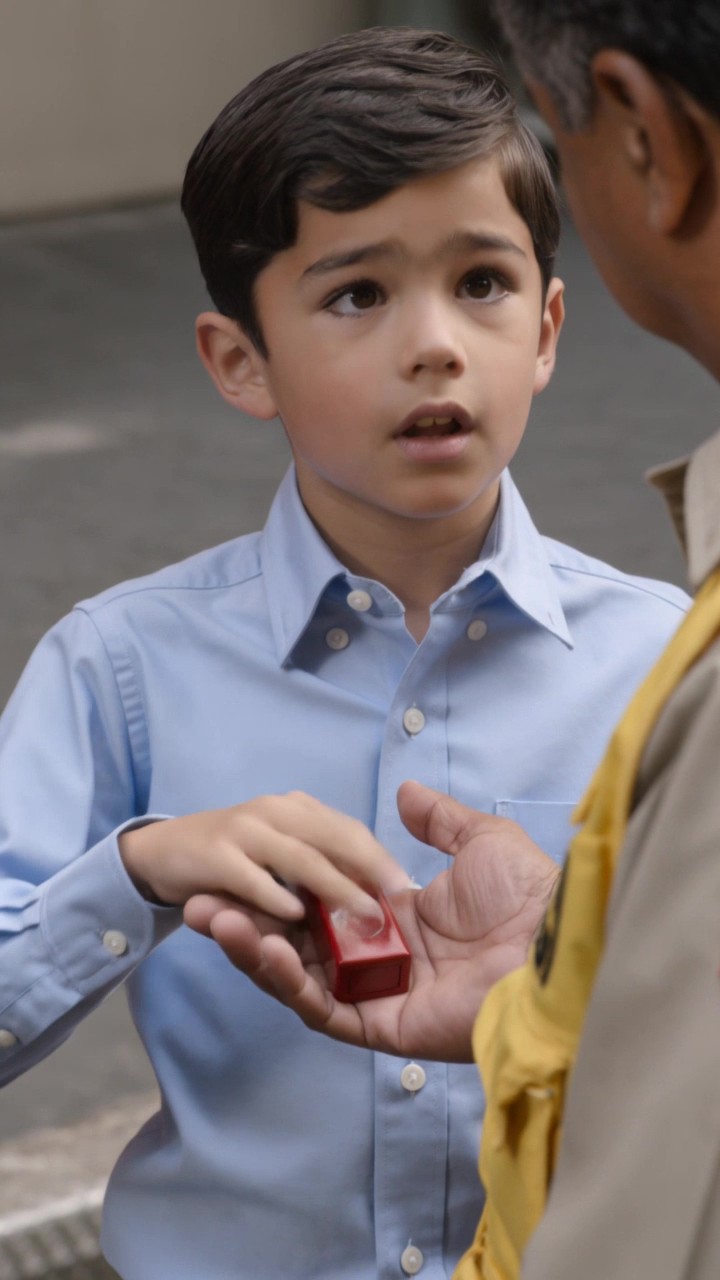
Noah and Lily were invited to present a red whistle as a symbolic gift to Preston.
Nobody asked Noah whether the whistle symbolized the firefighter.
To him, it belonged to the person inside the bus.
At the ceremony, Preston did not argue when Noah chose Samuel.
The sponsor representative did.
The event had printed programs.
A medal.
Photographers positioned for a captain and a grateful child.
Samuel’s yellow vest disrupted the image.
The mayor tried to call his role “assistance.”
Noah corrected the word because children often understand emotional labor more accurately than institutions.
Samuel had not physically removed them from the bus.
He had kept the group organized, medically stable, and reachable until trained rescue arrived.
That was not everything.
It was necessary.
After the ceremony stopped, Preston walked toward Samuel.
He looked at the red whistle.
“I didn’t know about the signal.”
Samuel answered:
“Nobody asked the children what happened before the hatch opened.”
Preston nodded.
Then did something the sponsor did not expect.
He removed the rescue medal from its box and placed it back on the podium.
“This award is for the fire crew,” he said. “The whistle belongs where Noah put it.”
The audience applauded.
Samuel did not want the moment turned into another individual hero transfer.
He pointed toward Rachel, the driver, seated in the second row.
“She called our location and held the wheel while the road moved.”
Then toward Lily’s school nurse.
“She stayed on the phone.”
Then toward the children.
“They answered every count.”
The city revised the ceremony.
The fire crew accepted the public-safety award as a team.
Samuel and Rachel received separate school-transport recognition describing their exact actions.
Noah kept the whistle after the photographs.
He had only placed it in Samuel’s hand temporarily.
That detail made Samuel smile.
The object did not need to become an adult’s trophy.
The school district reviewed the incident.
The route should have been closed earlier.
Weather alerts had reached transportation dispatch, but the detour order came after the bus entered the low road.
The bus carried an evacuation strap but no clearly accessible roof-hatch tool.
Medical pouches were stored on an open shelf instead of secured above the flood line.
Aides received behavior training but almost no emergency leadership instruction.
The district corrected all four problems.
Low-water crossings closed automatically under county warnings.
Medical supplies moved into secured waterproof compartments.
Drivers and aides trained together.
Every bus developed simple communication signals for noise, smoke, or other conditions where voices might fail.
The red whistle system was adapted carefully.
One blast:
Listen.
Two:
Respond to count.
Three:
Emergency services have confirmed contact.
Staff were warned not to use the third signal before confirmation.
Trust depends on words and signals meaning what they claim.
Noah struggled after the flood.
He hated buses during heavy rain.
For several weeks, his mother drove him.
The district offered a different route.
Samuel visited the family with the new emergency map.
He did not tell Noah to be brave.
He asked:
“What part do you need to see first?”
Noah wanted to inspect the roof hatch.
They visited an empty bus in the maintenance yard.
A technician opened it.
Closed it.
Let Noah touch the release cover without operating it.
Samuel showed where medical pouches would now be stored.
Noah asked:
“Where do you stand?”
Samuel pointed to the aisle.
“Where I can count everyone.”
Noah boarded again the following Monday.
The forecast was clear.
He carried the red whistle in his backpack.
Not because he expected another flood.
Because choosing to carry it returned some control.
Lily placed a tiny three-mark sticker on her medical pouch.
Years later, the city wanted to place the whistle in a transportation museum exhibit.
Noah refused.
“It’s still useful.”
He became a junior lifeguard in high school.
Samuel remained a bus aide until retirement.
Preston invited him to speak during fire-department school training.
Samuel accepted only when Rachel and a student representative were included.
At the training, Preston explained the external rescue.
Samuel explained the internal count.
Noah explained what three taps felt like when the bus windows showed only brown water.
“The firefighters gave us a way out,” he said.
“Mr. Ortiz gave us something to do until the way out arrived.”
That was why the child had walked past the medal.
He was not choosing one rescuer over another.
He was choosing the person whose part everyone else had failed to see.



Leave a Reply