
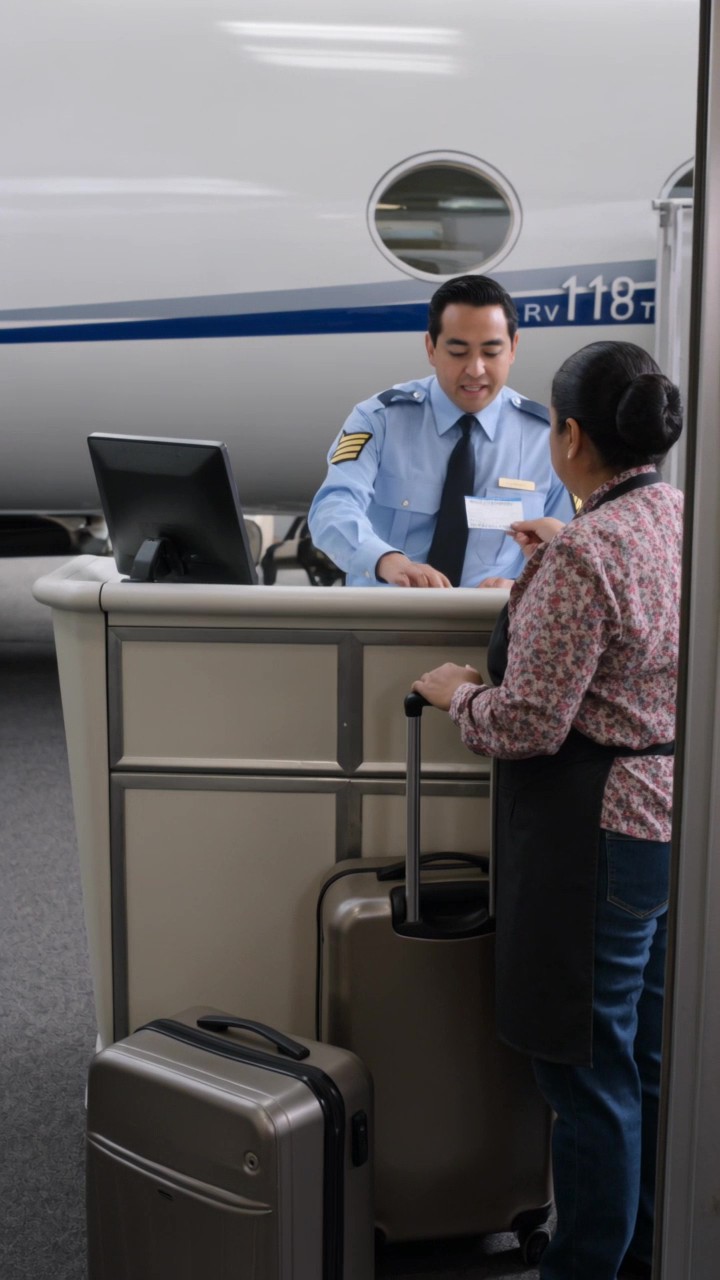
The aircraft door remained open for four more minutes.
That was not enough time to restore Maria’s canceled seat.
The reservation had been released and assigned to a standby passenger.
The airline had followed the group organizer’s instruction.
The gate agent could not remove another traveler simply because the family conflict had become visible.
Emma faced a choice.
Board the flight without her mother.
Or leave the jet bridge and accept the consequences.
She stepped back into the terminal.
Lily followed.
Emma’s fiancé, Daniel Hart, came after them.
Several relatives remained on the aircraft.
Celeste stood between the gate and the jet bridge.
“This wedding has two hundred guests waiting.”
Emma answered:
“My mother is one of them.”
The aircraft departed with half the wedding party.
Emma, Daniel, Lily, Maria, and three close relatives stayed behind.
They missed their connection.
The destination wedding did not begin the next morning as planned.
That inconvenience was real.
Vendors charged change fees.
Guests waited.
Flowers arrived before the bride.
The family spent money it had not budgeted.
The decision to correct an abandonment did not erase the cost of making it late.
The story began months earlier when Emma and Daniel planned a wedding in Charleston.
Daniel’s family had more money.
They hired a coordinator.
Reserved a group flight.
Scheduled photographs from airport arrival through the rehearsal dinner.
Emma wanted her mother included.
She also felt anxious about how Maria would fit into the polished plan.
Maria worked at a grocery-store bakery.
She did not own formal luggage.
She preferred speaking Spanish when nervous.
She had never flown.
She asked practical questions the coordinator considered obvious.
Could scissors for emergency dress repair go in checked luggage?
Would the plane provide water?
What happened if her ears hurt?
Emma answered impatiently more than once.
Then apologized.
Her embarrassment never became a direct request for Maria to stay home.
It became silence whenever Celeste made the request indirectly.
Celeste offered to buy Maria a new formal outfit.
Maria declined because she had already sewn one.
Celeste suggested Maria travel separately with hotel staff because “family arrival images were crowded.”
Emma said nothing.
Celeste moved Maria from the main rehearsal table to a side table for vendors and caregivers.
Emma corrected that.
But she did it privately.
The pattern continued.
Every correction protected the event without confronting the belief beneath it:
Maria belonged because Emma loved her, but she did not look like the family image Celeste wanted.
The yellow dress bag carried more history than Celeste knew.
Emma’s father, Luis Alvarez, drove a city bus.
When Emma was fourteen, he bought six yards of blue fabric from a closing textile shop.
He told Maria:
“Make the dress you’ll wear when she becomes someone important.”
Maria laughed.
“She is already important.”
Luis died before Emma finished college.
The fabric remained folded inside a cedar box.
When the wedding was announced, Maria used it.
She chose a simple pattern.
No beads.
No expensive trim.
Inside the hem, she stitched a narrow piece of Luis’s old bus-uniform lining.
Emma knew about the dress.
She did not know the yellow bag held it at Gate 18.
Celeste canceled Seat 14C the previous afternoon using the group organizer access code.
She then sent Maria a printed message saying her seat had been moved to a later connection because of overbooking.
Celeste told Emma that Maria felt unwell and might travel the following day.
Neither statement was entirely believable.
Both women accepted the version that required less confrontation.
Maria arrived at the original gate because the grocery bakery supervisor drove her and checked the airport board.
She had no smartphone capable of loading a new boarding pass.
At the counter, the truth appeared in plain language:
Canceled by group organizer.
Celeste later said she believed Maria would be more comfortable traveling quietly after the wedding party.
That explanation failed.
A next-day flight would arrive after the ceremony began.
The separate ticket had never been purchased.
Celeste had not rearranged Maria’s travel.
She had removed it and expected pressure, confusion, and shame to keep her away.
Daniel looked at his mother.
“Why?”
Celeste began with logistics.
Then photographs.
Then Maria’s anxiety about flying.
Finally, the real answer emerged.
“I did not want the first image of the weekend to look disorganized.”
Maria held the yellow bag.
“You mean poor.”
Celeste did not answer.
Emma did.
“Yes.”
Everyone turned.
Emma’s face had changed.
“She means poor. And I kept letting her say it with nicer words.”
That admission mattered more than Celeste becoming the only villain.
Emma had not canceled the ticket.
She had allowed her mother to become negotiable.
Maria looked at her daughter.
“I taught you not to be ashamed of where you came from.”
Emma began crying.
“I was ashamed of how they would look at you.”
“No.”
Maria’s voice stayed calm.
“You were ashamed of what their look would say about you.”
The gate became quiet.
Maria did not board another flight immediately.
She asked to sit.
The family moved to a row of terminal chairs.
For the first time in months, nobody discussed schedules.
Maria told Emma she did not want to attend a wedding where her presence required a public rescue.
Emma asked:
“What would make it possible?”
“Not a better seat.”
Maria looked at Celeste.
“The truth told to everyone who was told I chose not to come.”
Celeste resisted.
A public correction would expose what she had done to relatives, vendors, and guests.
Maria did not negotiate.
The false story had already traveled.
The correction needed to travel at least as far.
Celeste sent a group message under the coordinator’s name:
Maria Alvarez did not cancel or delay her travel. I canceled her seat without her consent because I prioritized the planned family image over her place in the family. The wedding schedule is changing because Emma and Daniel refused to continue without her.
The message did not fix the harm.
It stopped hiding it.
The airline found five seats on an evening flight to a nearby city.
The family rented a van for the remaining trip.
Maria’s fear of flying became worse after the confrontation.
She considered returning home.
A gate employee who spoke Spanish walked her through boarding, pressure changes, and where the call button would be.
The employee did not know the family story.
Professional kindness did not need to.
Maria boarded beside Lily.
The child held the yellow dress bag on her lap until a flight attendant stored it safely.
The wedding began fourteen hours late.
Some guests left.
The outdoor flowers had wilted at the edges.
The photographer lost the planned arrival sequence.
Emma did not replace it.
She asked for one photograph before the ceremony.
Maria in the blue dress.
The yellow bag open beside her.
A narrow strip of bus-uniform fabric visible inside the hem.
Emma told the photographer:
“This is the arrival image.”
Celeste did not stand in it.
That was her choice.
She attended the ceremony but sat away from the family aisle after apologizing to Maria.
Maria did not forgive her that weekend.
She accepted the apology as information about what Celeste now understood.
Trust would require behavior later.
Emma changed the ceremony processional.
Originally, Daniel’s father would escort his mother while Emma walked alone.
Instead, Emma asked Maria to walk beside her.
Maria refused the first wording.
“I am not replacing your father.”
Emma nodded.
“Walk with me because you are here.”
That she accepted.
Lily carried one small piece of blue fabric tied around her flower basket.
The wedding did not become perfect because the abandoned mother arrived.
The conflict remained beneath the music.
Daniel argued with Celeste after the reception.
Emma and Maria spent part of the morning in silence.
Several relatives believed leaving the flight had been dramatic and wasteful.
The family paid the cost.
That was appropriate.
People often call boundaries excessive when somebody else has always absorbed the inconvenience.
After the wedding, Emma made slower changes.
She stopped allowing gifts from Daniel’s family to become authority over holidays, childcare, and appearances.
She visited Maria’s apartment without suggesting upgrades.
She learned to ask before solving.
Celeste attended counseling with Daniel.
Her relationship with Maria remained formal.
At the first family gathering after the wedding, Maria arrived in her grocery bakery uniform because her shift ended late.
Celeste opened the front door.
For one second, both remembered Gate 18.
Celeste said:
“Come in.”
No comment about changing.
No side entrance.
A small correction practiced privately after a large failure.
Maria kept the voided boarding pass inside the yellow dress bag.
Emma once asked why.
“Because I want to remember I was not late,” Maria said. “I was removed.”
Years later, Lily used the blue dress fabric for a school family-history project.
She wrote:
My grandma was left at an airport because someone thought family should look expensive. My aunt Emma got off the plane. Grandma still decided for herself whether to get on the next one.
That final sentence pleased Maria most.
The story was not about a daughter dramatically retrieving an abandoned mother.
It was about a mother whose dignity did not depend on whether the family finally turned around.
Seat 14C had been canceled.
Maria’s place was not.





Leave a Reply