
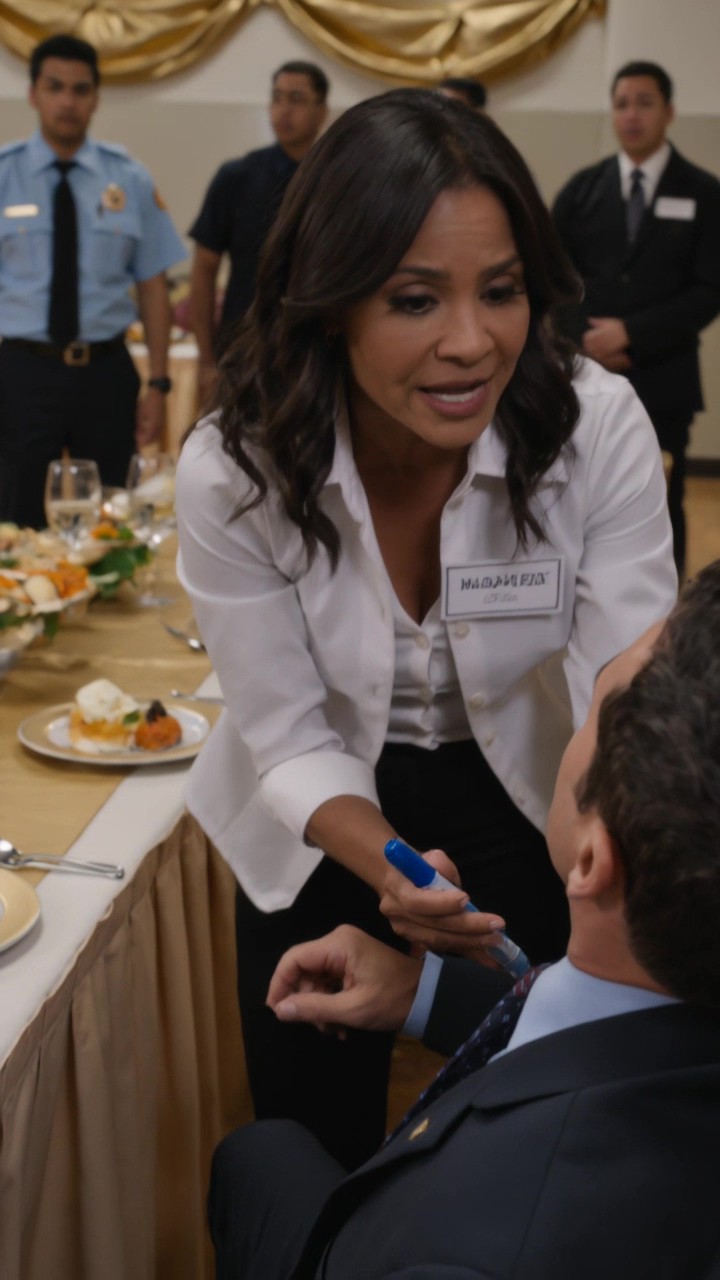
Charles Whitmore survived the allergic reaction.
The emergency medication bought time.
Paramedics continued treatment and transported him to the hospital.
The school board’s first instinct was gratitude.
Its second was control.
Before the ambulance left, board chair Preston Hale asked Nina to wait in a private office.
He said the district wanted to thank her properly.
Nina looked at the dessert label in Maya’s hand.
“Then preserve the catering trays and vendor records.”
Preston’s expression changed.
“This incident has nothing to do with your old employment dispute.”
“It involves the same supplier.”
“That does not mean the same problem.”
“No.”
Nina nodded.
“It means you check before deciding it is unrelated.”
Three years earlier, Nina managed the cafeteria at Westbridge Middle School.
She supervised nine workers and served breakfast and lunch to nearly six hundred students.
She knew which children arrived early because their homes were loud.
Which students asked for extra fruit on Fridays because weekends were uncertain.
Which families needed help completing meal-assistance forms.
Nina followed the district’s nutrition rules.
She also kept a small approved emergency-meal log for students whose accounts or applications were unresolved.
The district had a policy allowing one temporary meal while adults corrected paperwork.
Nina documented every one.
The real problem began after Westbridge changed food distributors.
The new company, Harbor Student Nutrition, promised lower prices and centralized delivery.
Invoices listed full cases.
Deliveries arrived with missing cartons, substituted sizes, and damaged produce.
At first, shortages looked like cafeteria waste.
Nina counted every package for three weeks.
The numbers did not match the invoices.
Milk cases billed as forty-eight units contained forty.
Fruit cups arrived twelve short.
Protein portions used labels corresponding to larger weights than the actual cartons.
Nina reported the pattern to Charles.
He asked the district business office to review it.
Then Preston Hale intervened.
Preston chaired the school board finance committee.
Harbor Student Nutrition was partly owned by his brother-in-law.
The relationship had been disclosed in a board document but presented as indirect and non-controlling.
Preston said the cafeteria’s handwritten inventory system was unreliable.
He ordered a surprise audit.
The audit found food distributed without full payment records.
Those were Nina’s emergency meals.
It also found product leaving through the side kitchen door.
Those were unopened leftovers transferred to the county food pantry under a written donation agreement.
The agreement had expired administratively two months earlier even though the pantry pickups continued with the principal’s verbal approval.
The vendor shortage disappeared inside a simpler accusation:
The cafeteria manager was giving away food and could not account for inventory.
Charles knew more than the public report showed.
He had signed several pantry transfer sheets.
He had read Nina’s delivery counts.
He also knew the district’s grant renewal depended on presenting stable food-service finances.
Preston warned that a vendor scandal could delay the grant and expose the school to repayment claims.
Charles chose the institution.
That was how he described it later.
In practice, he chose the explanation that cost him less power.
He fired Nina for failure to follow inventory and distribution controls.
The district statement avoided the word theft.
Parents and local news did not.
Someone told a reporter that “large quantities of food were missing.”
Nina became the cafeteria worker accused of stealing children’s meals.
No criminal charge was filed.
That did not restore her name.
Two school districts declined her applications.
A private senior residence withdrew an offer after checking references.
She found work in a hospital kitchen at lower pay.
Her marriage became strained under the lost income.
Maya stopped eating school lunch because other students whispered that her mother had taken it.
Nina appealed.
The district denied the appeal based on expired pantry authorization and incomplete emergency-meal documentation.
Her delivery-count evidence was called inconclusive.
Harbor Student Nutrition continued its contract.
At the fundraiser three years later, Maya received a community scholarship.
Nina attended for her daughter.
She did not want to see Charles.
She also did not plan to rescue him.
Medical emergencies do not ask whether the person deserves the nearest trained hands.
School cafeteria managers received annual response training because reactions and choking could occur during meals.
Nina recognized Charles’s symptoms.
She knew he carried a severe nut allergy.
His information had once been included in staff-event meal planning.
The fundraiser tart was labeled nut-free.
The catering kitchen had used a shared tray containing walnut garnish.
A worker changed the visible label but did not replace the tray liner or serving utensil.
Trace contamination entered Charles’s dessert.
The vendor responsible was Harbor Student Nutrition’s events division.
That fact did not prove the old shortages automatically.
It proved the company’s control systems deserved investigation.
The district tried to separate the emergency from the history.
Nina refused to allow gratitude to become a substitute for evidence.
Charles called her from the hospital the next morning.
“Thank you.”
“You are welcome.”
“I owe you my life.”
“No.”
Nina’s answer surprised him.
“You owe the emergency staff your continued care. I used the tool available.”
“I owe you something.”
“Yes.”
She looked at her old dismissal file on the kitchen table.
“You owe the truth.”
Charles asked to meet privately.
Nina agreed only if Maya, her union representative, and an independent district investigator attended.
At the meeting, Charles admitted he had approved pantry transfers after the written agreement expired.
He admitted Nina reported vendor shortages before the audit.
He admitted he allowed the district statement to imply she caused the entire inventory gap.
Preston interrupted.
“Those facts do not prove Harbor under-delivered.”
Nina placed copies of her count sheets on the table.
“Then audit the warehouse, invoices, and receiving records.”
The district had never done that.
The dessert incident created political pressure it could no longer avoid.
A state procurement auditor reviewed three years of records.
The findings were broader than Nina expected.
Harbor did not simply remove food from boxes.
Its warehouse software billed schools using standard case quantities even when substitute products contained fewer units.
Credits were inconsistently issued.
Some delivery drivers marked full receipt before cafeterias counted.
Damaged goods were charged until schools filed separate claims many staff did not know existed.
At several schools, the pattern created shortages appearing as kitchen waste.
The auditor also found the company’s event division had weak allergen controls and misleading “nut-free” labeling practices.
There was no evidence Preston personally stole food money.
There was evidence he used his board position to discourage scrutiny of a related vendor and failed to recuse himself fully.
The district terminated the contract.
Harbor entered civil settlement negotiations and regulatory review.
Preston resigned from the board.
Charles faced a separate employment review.
He had not created the vendor system.
He had sacrificed Nina’s record to contain it.
The review removed him as principal.
He remained employed temporarily in a non-supervisory curriculum role while the board determined final status.
Several parents wanted immediate dismissal.
Nina did not defend him.
She also refused to let his allergic reaction become part of the punishment discussion.
“Being saved does not make him innocent,” she said.
“Being guilty does not mean he should have been left without help.”
That distinction became the moral center of the case.
The district publicly corrected Nina’s record.
The statement used direct language:
Nina Alvarez did not steal school food. She accurately reported delivery shortages and operated emergency meals and pantry transfers with administrative knowledge. The district’s previous process wrongly assigned vendor-related inventory discrepancies to her management.
Nina insisted the correction be sent to every employer that had received the old reference.
The district paid lost-wage compensation and legal costs through a settlement.
It offered her the cafeteria-manager position back.
She declined.
Returning to the same kitchen was not the only proof of restored dignity.
Nina had advanced inside the hospital system.
She completed food-safety and allergen-control credentials.
She accepted a new role training kitchen teams across several medical facilities.
The work paid more than her old school job.
It also allowed her to change the systems that failed in both stories:
Inventory evidence.
Donation authorization.
Allergen labeling.
And the tendency to treat low-ranking food workers as convenient explanations.
Maya asked why her mother saved Charles.
Not at the fundraiser.
Weeks later.
After the public correction.
“If you had waited for someone else, would anyone blame you?”
Nina answered carefully.
“Maybe not.”
“Then why didn’t you?”
“Because waiting would have made his past decision part of my decision.”
Maya looked confused.
Nina continued:
“I did not want him choosing what kind of person I became twice.”
That answer stayed with her daughter.
Charles requested one final meeting after leaving the principal’s office.
He brought no flowers.
No award.
Only the expired pantry agreement bearing his signature.
“I signed this,” he said.
“Yes.”
“I told myself I had forgotten.”
“You did not.”
“No.”
He looked at Nina.
“When the board asked, I remembered the grant, the vendor, and the risk. I made your memory less convenient than mine.”
Nina accepted the sentence.
Not as forgiveness.
As accurate language.
Charles later testified during the procurement hearing.
His testimony helped establish how Preston pressured administrators.
It also exposed his own decisions.
He lost the professional reputation he had tried to protect.
He began working for an adult-literacy nonprofit after a period away from education administration.
Nina heard about it.
She did not visit.
Their lives did not need reunion to prove the rescue mattered.
The school district created a meal-service oversight committee including cafeteria workers, parents, finance staff, and students.
Emergency meals received a permanent, simple authorization process.
Food-pantry transfers used current digital agreements.
Cafeteria staff counted deliveries before drivers closed receipts.
Vendor relationships required stronger conflict disclosures.
Every catered event used documented allergen separation and label verification.
At the first training, Nina placed two objects on the table:
A red emergency epinephrine case.
Her old delivery-count notebook.
“One responded to danger in seconds,” she said.
“The other warned about danger for weeks.”
She looked at the administrators.
“Do not praise the first kind of evidence because an ambulance arrived and ignore the second because the person carrying it wears an apron.”
Years later, Maya became a school social worker.
At a student meal meeting, a cafeteria worker reported that breakfast cartons were arriving short.
An administrator called it likely counting error.
Maya opened the delivery log.
“Let’s count before we explain.”
The cartons were short.
The issue was corrected that day.
No firing.
No news story.
No emergency.
That was the future Nina wanted.
She had saved the man who betrayed her because a human life did not become disposable when accountability was deserved.
Then she saved herself from the second betrayal:
The idea that one merciful act required her to abandon the truth.







Leave a Reply