
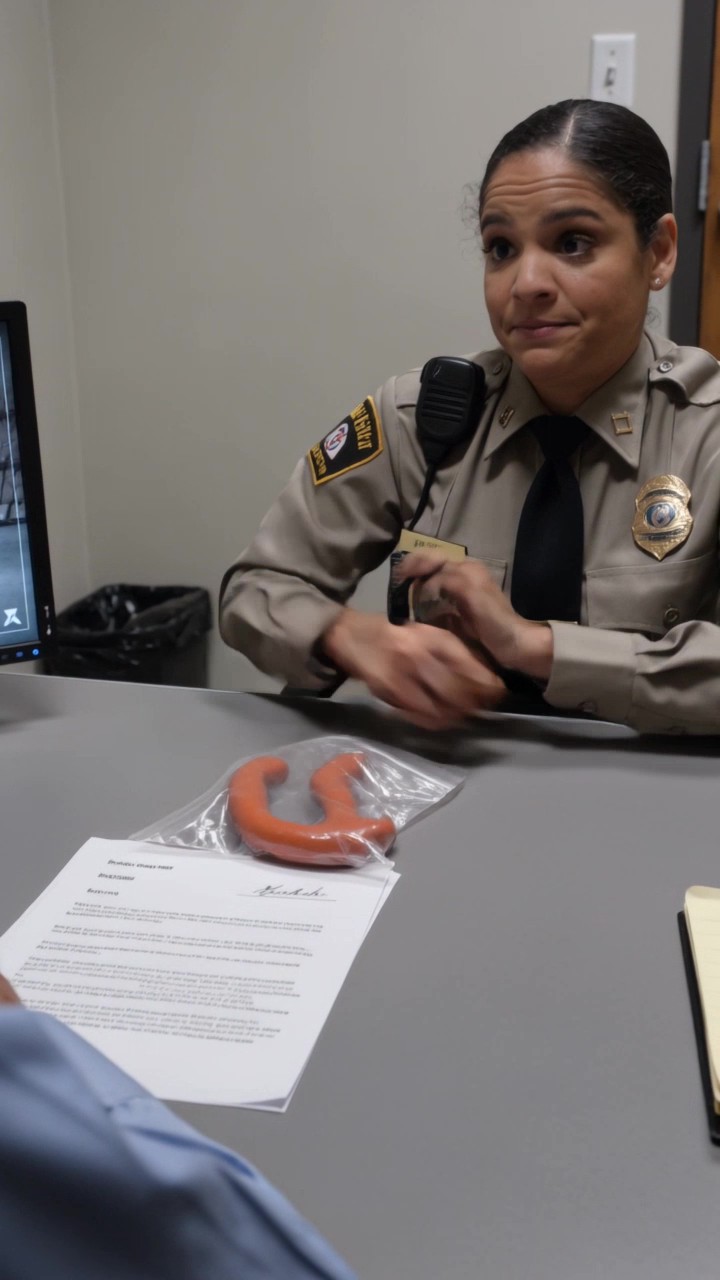
Malik Reed did not sign the termination letter.
The hearing stopped.
His forklift certification remained suspended while an independent investigation reviewed the collapse.
That was appropriate.
A new piece of evidence did not automatically prove every action safe.
The company needed to understand the rack failure, the forklift contact, the loading pattern, and Malik’s response.
What changed was the presumption.
Before Elena entered, management treated Malik’s guilt as complete.
After the orange anchor appeared, the four seconds before the visible scrape became important.
Malik had worked at Westbridge Distribution for eighteen years.
He began loading trailers on the night shift.
Then earned forklift certification.
He knew Rack 14 carried boxed medical equipment and paper products.
The materials were not individually dangerous.
The upper levels were heavy.
Two weeks before the collapse, the warehouse changed the aisle layout to increase holiday inventory.
The new plan placed taller pallets on the top level.
A rack-inspection contractor approved the arrangement based on the system’s rated capacity.
The calculation assumed every frame remained fully anchored to the concrete.
Rack 14 did not.
One rear anchor had loosened.
Another had corroded near a floor crack where cleaning water collected.
The protective orange paint hid much of the damage.
Elena first noticed orange powder during her midnight rounds.
The powder appeared beneath the rear foot of the rack.
She photographed it because the color matched the anchor paint.
Her security app included maintenance reporting.
She submitted:
Orange metal debris and movement mark at rear base, Rack 14.
The facility office converted the request into a housekeeping ticket:
Sweep colored debris behind storage rack.
A cleaner removed the powder.
Elena reported it again two nights later.
This time, she placed a small pencil mark beside the rack foot.
The next night, the foot had shifted beyond the line.
She photographed that too.
Preston Hale, the facility supervisor, reviewed the second report.
He believed the movement came from normal forklift vibration.
The annual rack inspection was six weeks away.
Closing Rack 14 would require relocating inventory and delaying orders.
He wrote:
Monitor until scheduled inspection.
No temporary barrier was installed.
Nobody told forklift operators.
On the afternoon of the collapse, Malik approached the aisle carrying an empty pallet.
He saw two warehouse workers walking toward Rack 14.
At the same time, he heard a hard metallic pop.
The top beam shifted.
One pallet leaned toward the aisle.
Malik sounded the horn.
The workers did not immediately understand.
He reversed and turned the empty pallet sideways across the aisle entrance to block them.
During the turn, the forklift’s rear footguard scraped the rack’s front protector.
That contact appeared clearly on Camera 6.
The top beam leaned farther.
Cartons fell.
Malik drove out of the aisle.
The rack settled against the adjacent frame without completely collapsing.
The company’s first review focused on the visible contact.
The forklift left a fresh scrape.
Malik admitted touching the protector.
The camera angle did not show the rear anchors or the top shelf’s first movement clearly at normal speed.
Management classified the event as operator-caused impact.
That explanation protected several assumptions.
The rack inspections were adequate.
The loading plan was safe.
Maintenance reports had been handled.
One worker violated distance rules.
The company could terminate him, repair one frame, and resume operations.
Malik’s union requested the full camera archive.
Management provided the thirty seconds beginning with the forklift turn.
Elena knew the rack had moved before that.
She had watched live monitors from the security desk.
She asked the system administrator to preserve the preceding minute.
The administrator said incident clips were managed by operations.
Elena filed a written preservation request through the security contractor.
That action prevented automatic deletion.
After the collapse area was secured, a maintenance worker found the bent anchor several feet behind the rack.
He placed it in a debris tray.
Elena saw it during her incident patrol.
She photographed its location.
Then asked the worker to seal it in an evidence bag.
She did not hide it or take it home.
The facility supervisor ordered routine disposal after photographs.
Elena refused to authorize removal from the security chain until the investigation closed.
That decision almost cost her contract position.
Preston accused her of exceeding her role.
At Malik’s hearing, Elena brought the sealed bag only after the union requested it formally.
The independent rack engineer examined the anchor.
The fracture surface carried corrosion across most of its depth.
A small bright section indicated the final break.
The anchor hole in the concrete had elongated over time.
The rear rack foot showed repeated movement.
Frame measurements confirmed the rack had begun leaning before the forklift scrape.
The full video, slowed frame by frame, showed a top carton shift and dust fall from the rear base before Malik turned.
The forklift contact contributed vibration.
It did not initiate the structural failure.
More importantly, Malik’s turn blocked the aisle.
The two workers stopped behind the empty pallet.
Had he continued forward or abandoned the vehicle without blocking access, they might have entered beneath the leaning load.
The investigation did not label his response perfect.
The safest action in training was to stop, sound the horn continuously, lower the forks, and evacuate the area.
Malik turned while the rack was moving.
That created another contact.
The review classified it as an emergency judgment under developing danger—not gross misconduct.
His certification was restored after a refresher course.
His termination was withdrawn.
He received back pay for the suspension period.
The company corrected the incident record so future employers and insurers would not see “reckless rack collision.”
Malik returned to work.
He did not return unchanged.
For weeks, he avoided Rack 14 even after replacement.
Loud metal sounds made him tense.
The company offered counseling after the union demanded it.
No one had been physically hurt.
Near-miss events can still leave people replaying what almost happened.
Malik’s wife had already begun calculating how long their savings would cover the mortgage.
His oldest daughter delayed submitting a college housing deposit because she believed the family might need the money.
Restoring a job did not erase those weeks.
The company reimbursed documented late fees and contributed to the counseling program.
Elena’s evidence saved more than Malik’s paycheck.
It exposed how low-status warnings were being translated out of meaning.
Her report said metal debris and movement.
The maintenance system reduced it to sweeping.
Her photograph showed a shifted foot.
A supervisor called it normal vibration.
The rack held until it did not.
Westbridge Distribution changed the process.
Any report involving rack movement, anchor debris, beam damage, repeated impact, or floor cracking triggered immediate restricted access.
Security photos could not be reclassified as housekeeping without review by facilities engineering.
Incident video preservation began sixty seconds before the first visible impact.
Unions and safety representatives received the same footage as management.
Rack inspections included anchor torque, concrete condition, and post-layout verification.
And no manager could close a repeated structural report based only on production inconvenience.
Preston was removed from facility-safety authority.
The investigation found he had not intentionally concealed a known collapse.
He had repeatedly interpreted ambiguous evidence in the direction that kept inventory moving.
He remained employed in logistics planning after discipline.
Some workers wanted him fired.
Elena did not argue either way.
She asked one question at the safety committee:
“Who gets rewarded when a rack stays open, and who pays when the warning is called an overreaction?”
The company revised management bonuses.
Inventory throughput no longer outweighed verified safety holds.
Elena’s security contractor offered her a supervisor title.
She declined the first version because it added scheduling duties without pay recognition for safety work.
After negotiation, she became a site safety-observation coordinator with a wage increase and direct reporting access to the warehouse engineer.
She remained on night patrol.
“I see things after the people writing the reports go home,” she said.
Malik thanked her privately.
“You saved my pension.”
Elena shook her head.
“The bolt saved the argument.”
“You saved the bolt.”
She accepted that wording.
Evidence does not preserve itself when the system benefits from calling it debris.
At the next annual training, Malik stood beside the replacement rack.
He showed operators the fresh scrape his forklift had left on the old protector.
Then Elena held up the bent anchor.
One mark was visible.
One failure had been beneath the floor line.
“Cameras catch action,” Malik told the room.
“They do not always catch cause.”
The warehouse placed the orange anchor inside a clear case near the incident-report station.
The label did not call Elena a hero.
It read:
REPORTED AS METAL MOVEMENT.
RECLASSIFIED AS DEBRIS.
FOUND AFTER FAILURE.
Months later, a cleaner noticed red flakes beneath another rack.
She reported them.
Operations closed the aisle.
An engineer found only chipped protective paint, no anchor damage.
The aisle reopened after inspection.
The shutdown delayed twenty orders.
No manager complained to the cleaner.
Malik passed her in the break room and said:
“Good report.”
That ordinary response was the real reform.
Elena had entered a termination hearing with one bent bolt because the company was prepared to destroy a worker’s future using the most convenient four seconds of video.
The full truth began four seconds earlier.
It survived because someone whose job was to watch refused to let management decide that watching did not include understanding what she saw.







Leave a Reply