
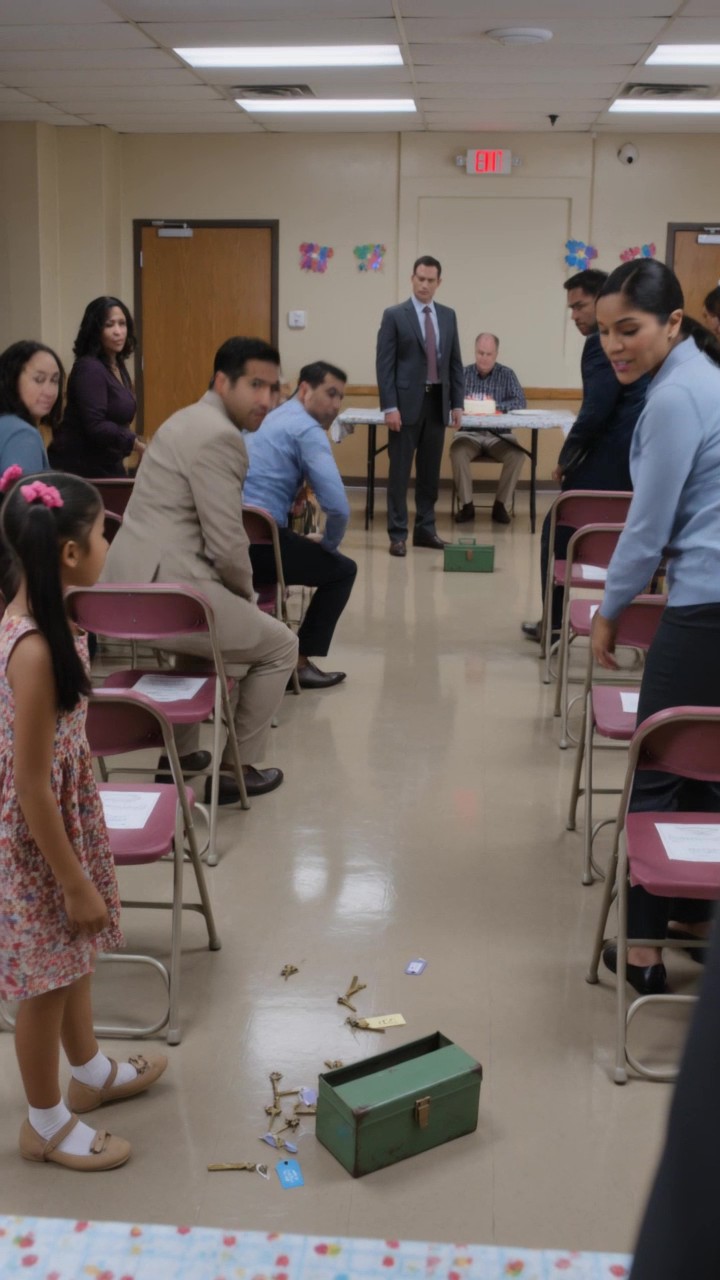
The church hall became quiet.
Henry Bell remained seated while people gathered the brass keys from the floor.
The keys no longer opened anything.
They came from locks Henry had replaced over twelve years.
He kept one old key from every emergency job inside the hidden compartment of the green toolbox.
Not as trophies.
As a private count.
One home stayed usable.
Then another.
Then another.
Charles had known none of it.
Neither had his sister Vivian.
They knew Bell Hardware closed after a national home-improvement chain opened near the highway.
They knew their father sold the building for less than they expected.
They knew his retirement savings were modest.
They knew he continued driving an old repair van long after he said he had stopped working.
They created the simplest explanation:
Henry could not say no.
Customers used his kindness.
He had sacrificed family security for strangers who would never repay him.
That explanation was not completely invented.
Henry did have trouble saying no.
Some people did fail to pay.
He also made a deliberate choice his children never understood because he refused to explain it.
Bell Hardware had served the Alder Street neighborhood for thirty-five years.
Henry sold nails by the handful.
Cut spare keys.
Repaired window screens.
Told customers which pipe fitting they needed after they brought him blurry photographs.
The store did not survive changing retail patterns.
The chain store offered lower prices and weekend hours.
The building needed a roof.
Henry’s wife, Margaret, had died two years earlier.
Without her bookkeeping and pension, he could not keep absorbing losses.
He sold the property.
After paying the mortgage, taxes, suppliers, and closing costs, the amount remaining was far smaller than his children imagined.
Henry planned to place it into retirement savings.
Then a woman named Lena entered the empty store.
At the time, she coordinated emergency housing repairs for a neighborhood nonprofit.
A single mother had received a city notice because her apartment’s exterior door no longer latched.
The landlord stopped answering.
The family risked temporary displacement until the door met safety requirements.
Every contractor Lena called required a minimum fee the nonprofit could not immediately cover.
She asked whether Henry had one lockset left.
He had seventeen.
He installed one that afternoon.
The apartment was 3C.
The little girl at the birthday party had been five then.
Henry charged the nonprofit for the lock.
He did not charge labor.
A week later, Lena called about an older man whose furnace access panel had broken during winter.
Henry repaired it.
Then a wheelchair user needed a safer threshold ramp while waiting for a formal accessibility grant.
Then a grandmother needed smoke alarms installed before foster-care inspectors could allow her grandchildren to stay overnight.
The requests shared one feature:
A small repair stood between a person and safe housing.
Existing programs often approved large projects slowly.
Families needed something by Friday.
Henry used the unsold inventory from Bell Hardware.
Door hardware.
Weather stripping.
Grab bars.
Smoke alarms.
Basic plumbing parts.
He also used the repair van, tools, and years of knowledge customers once received across the counter.
The nonprofit named the informal work:
Home Until Friday.
Henry disliked the name.
“Repairs should last longer than Friday.”
Lena answered:
“Friday is when the inspector comes.”
The name stayed.
At first, Henry expected the remaining inventory to support a few months of work.
It lasted two years because suppliers donated discontinued stock and local tradespeople contributed labor.
The proceeds from the building sale remained mostly in Henry’s account.
Then the nonprofit lost a grant.
A dozen approved repairs faced cancellation.
Henry transferred part of his savings into a restricted repair fund.
He did not tell Charles or Vivian.
Both had young families.
Henry did not want them to feel responsible.
He also did not want an argument.
Silence allowed him to keep choosing without defending the choice.
It also allowed his children to misunderstand every consequence.
Over twelve years, Henry completed or coordinated repairs at forty-three homes.
Not full renovations.
Practical interventions.
Locks.
Heat.
Safe railings.
Broken windows.
Small ramps.
Electrical work performed by licensed partners.
Emergency water shutoffs.
He did not personally perform tasks outside his training.
The nonprofit paid contractors when certification was required.
Henry’s contribution included triage:
What had to happen now?
What could wait?
Which repair would keep the family inside until the larger program approved funding?
The green toolbox traveled in the van.
Beneath the removable tray was the hidden key compartment.
Every replaced lock contributed one retired key.
Henry carved the unit number into a scrap wooden tag.
Margaret had once used colored paint to organize store orders.
Henry continued the colors.
Blue for lock or window.
Red for heat.
Green for access.
Yellow for electrical work handled by licensed partners.
The keys inside the birthday gift told a story his children had reduced to financial irresponsibility.
Charles looked at Henry.
“You used retirement money.”
Henry nodded.
“How much?”
Henry gave the amount.
It was significant.
Not everything.
Enough to explain years of tight budgets.
Vivian began crying.
“We were paying your rent while you were paying for strangers’ houses.”
Henry corrected her.
“You helped me twice when the van transmission failed and when the medical bill came.”
“That is still help.”
“Yes.”
“Why didn’t you tell us?”
Henry looked at the green toolbox.
“Because every conversation about money became a trial about whether I was allowed to make my own choices.”
Charles stood.
“You were allowed to choose. We were allowed to know you might need us later.”
That was also true.
The birthday revelation did not make Henry automatically right.
Generosity can become another form of secrecy.
A person may give freely and still leave family members unprepared for care, debt, or emergencies.
Lena did not defend every decision.
She addressed the room.
“Home Until Friday should never have depended this heavily on one retired man.”
Henry looked at her.
“You told me that?”
“Many times.”
“What did I say?”
“That forms take too long.”
“They do.”
“And then you paid the gap yourself.”
Henry nodded.
The program had saved homes.
Its design remained unsustainable.
That was why Lena returned the toolbox on his seventieth birthday.
The hidden keys were not only a tribute.
They were the closing record of the informal version.
The nonprofit had merged with a community housing cooperative.
A new repair fund received city support, foundation money, landlord penalties, and small member contributions.
Licensed contractors were paid.
Emergency triage no longer depended on Henry’s savings.
The cooperative offered Henry a part-time paid advisory role.
Not as repayment for every past favor.
As compensation for current knowledge.
He would train younger repair coordinators, review emergency requests, and help residents understand whether a repair required a carpenter, plumber, electrician, accessibility specialist, or code officer.
Henry had refused the first offer because he said volunteers should not take money from families.
Lena brought the formal contract inside the toolbox lid.
Charles expected a hidden deed or pension.
There was none.
The salary was modest.
The hours were limited.
The program included retirement contributions and transportation reimbursement.
A sustainable future, not a miracle.
Henry looked at the contract.
“I thought this was a birthday gift.”
“It is,” Lena said. “The gift is that you stop pretending free labor is the only honest kind.”
Several guests laughed.
Henry did not.
The sentence hit too close.
He had spent years measuring his usefulness by what he could give without asking anyone to carry him back.
The birthday party resumed only after a long conversation.
Some residents shared what the repairs changed.
The mother from Apartment 3C said the new lock allowed the city inspector to close the case without moving her daughter into temporary care.
The widower said Henry found a licensed heating contractor before a winter storm.
A nursing aide said one grab bar allowed her mother to return home from rehabilitation.
Nobody said Henry single-handedly saved forty-three families.
Housing stability depended on tenants, advocates, inspectors, tradespeople, neighbors, and money.
The keys represented doors where Henry’s skill filled a specific gap.
Charles apologized for calling the toolbox junk.
He did not apologize for worrying.
“I am still angry you hid the money.”
Henry nodded.
“I am still angry you talk about my life like an estate that failed to mature.”
Vivian interrupted.
“Both of you can be angry after cake.”
That became the most realistic family reconciliation available.
They did not solve twelve years in one evening.
They agreed to review Henry’s finances together with an independent advisor he chose.
Charles would not control his accounts.
Henry would maintain an emergency plan and stop presenting preventable crises as surprises.
Vivian became the contact for medical paperwork because she asked questions without turning every answer into a verdict.
Henry accepted the cooperative position.
His first task was training a twenty-four-year-old apprentice named Malik.
Malik wanted to repair everything immediately.
Henry stopped him at a damaged apartment step.
“What is the emergency?”
“The board is loose.”
“That is the damage. What is the emergency?”
Malik watched an older resident approach with a walker.
“She cannot enter safely.”
“Good. Now what requires a licensed contractor, and what can we secure until then?”
The work was not charity theater.
It was judgment.
The cooperative paid Henry for it.
Home Until Friday continued under a new name:
Open Door Repair Network.
Henry disliked that name too.
The board approved it anyway.
The forty-three brass keys were mounted inside a clear shadow box at the cooperative office.
Henry allowed the display under three conditions.
No family names.
No before-and-after poverty photographs.
No language calling recipients helpless.
The label read:
RETIRED KEYS FROM EARLY EMERGENCY REPAIRS.
EACH JOB KEPT A HOME USABLE WHILE A LONGER SOLUTION WAS BUILT.
The green toolbox returned to Henry.
The hidden compartment was empty.
On his seventy-first birthday, Charles gave him a set of new insulated screwdrivers.
Henry inspected the brand.
“Too expensive.”
Charles smiled.
“Use them on paid hours.”
Their relationship improved through ordinary boundaries.
Henry still offered help too quickly.
Charles still asked financial questions too sharply.
Vivian still mediated when both men pretended not to need her.
The residents did not become a replacement family used to shame the biological one.
They belonged to a community Henry helped.
His children belonged to the private consequences of the choices he hid.
Both truths remained.
Years later, the little girl from Apartment 3C became a housing inspector.
At an Open Door training, she brought the old brass key tag her mother had kept.
The lock itself was long gone.
She placed the tag in Henry’s hand.
“Your repair kept us there.”
Henry shook his head.
“Your mother kept you there. Lena handled the notice. I changed one lock.”
She smiled.
“That one lock was the thing due Friday.”
Henry accepted that.
The secret inside the birthday toolbox was not that he had hidden wealth.
It was that the years his children called a failed retirement had been full of work they never learned to count.
The keys covered the floor for only a few minutes.
The doors they represented had remained closed against cold, danger, and displacement for years.







Leave a Reply