
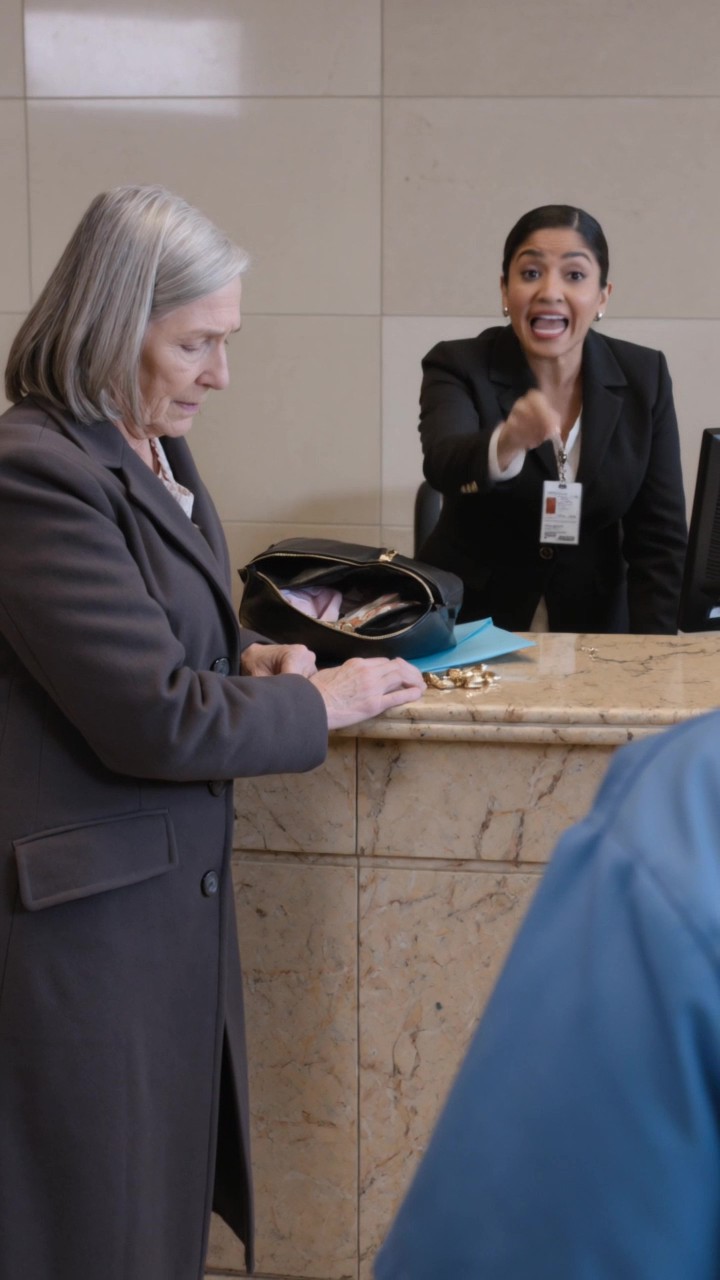
The police did not allow anyone to leave immediately.
The blue envelope remained on the desk inside a clear evidence sleeve.
The bills inside were counted.
$1,840.
The exact amount of Evelyn Brooks’s withdrawal.
The cash straps and serial-number sample matched the teller drawer used that morning.
Maria Alvarez was no longer treated as the person most likely to have taken it.
She was still a witness.
So was Evelyn.
So was Charles.
So was every bank employee who had accepted the first explanation before looking at the full camera record.
Evelyn visited Harbor Trust on the third business day of every month.
Her pension and survivor benefit entered by direct deposit.
She withdrew a set amount in cash because several parts of her life still operated that way.
Her landlord accepted checks, but Evelyn paid the home aide in cash after each week.
A neighborhood pharmacy offered a discount for one medication when paid at pickup.
She placed grocery money into labeled envelopes so she would not spend the rent portion accidentally.
Her children encouraged online banking.
Evelyn tried.
Small screens, passwords, security codes, and changing interfaces made her anxious.
Cash felt visible.
That did not make her careless or confused.
It made her routine different from the one the bank preferred.
Celeste Hart knew the routine.
She had served Evelyn many times.
She greeted her by name.
Printed larger receipts.
Counted the bills twice.
On the morning of the theft, Celeste had a problem inside her teller drawer.
The previous afternoon, a local restaurant deposited a large amount of cash near closing.
Celeste processed the deposit without the second employee count required for amounts above the branch threshold.
The restaurant owner was in a hurry.
The branch was short-staffed.
Celeste entered the amount stated on the deposit slip.
During end-of-day balancing, the drawer appeared short by $1,800.
Celeste believed she had over-credited the restaurant.
She reported a smaller discrepancy and told the operations lead she needed to recheck one batch in the morning.
An ordinary review would have examined the deposit, camera footage, straps, and count records.
Celeste panicked.
A serious drawer shortage could remove her from cash duties.
She had already received a warning for bypassing dual verification during busy periods.
She decided to make the drawer balance before the review.
That decision became theft.
Evelyn withdrew $1,840.
Celeste counted the money and placed it in the blue envelope.
The extra forty dollars made the amount slightly different from the missing balance.
Celeste believed she could return forty later and use the remainder to correct the drawer.
She expected Evelyn to place the envelope deep inside her purse and leave.
Then Evelyn’s bus card slipped from the desk.
When she bent to catch it, her purse fell from the chair.
The contents scattered.
Maria was cleaning the seating area.
She immediately knelt to help.
Celeste saw the gray cart beside the desk.
She also saw an unused blue envelope near the receipt printer.
While Evelyn and Maria faced the floor, Celeste opened the purse, removed the full envelope, and placed the empty one inside.
Then she slipped the full envelope beneath the trash liners in Maria’s cart.
Her plan relied on several assumptions.
Evelyn might not notice until home.
If she noticed inside the bank, she might believe the envelope had fallen.
If staff searched, the cash would appear in the cleaner’s cart.
Maria’s access would become the explanation.
Celeste told herself she was not permanently taking the money.
She would recover the envelope from the cart before Maria left, balance the drawer, and later find a way to repay Evelyn.
That internal story did not reduce the act.
It added another layer.
She was willing to let a cleaner become suspicious long enough to solve her own problem.
The main lobby camera failed to capture the exchange clearly because the customer-service desk blocked Celeste’s hands.
At first, the footage seemed to support her account.
Maria approached.
Evelyn’s purse fell.
Maria handled items.
The cash later appeared in her cart.
Preston Hale stopped there.
He ordered the doors closed.
He told security to inspect the cart.
He allowed Charles to stand beside Maria while she was questioned.
He asked Maria whether financial trouble had influenced her.
Maria had worked for the bank’s cleaning contractor for four years.
She was paid hourly.
Her husband’s construction work had become irregular.
Those facts entered the questioning before anyone asked whether Celeste’s drawer balanced.
The compliance officer, Leah Brooks, happened to be at another branch reviewing a large deposit.
The automated monitoring system flagged Evelyn’s transaction because a teller had reopened the same cash batch from the prior day shortly after the withdrawal.
Leah called Harbor Trust.
When she heard a customer’s money had been found in a contractor’s cart, she instructed staff to preserve every camera angle.
The ATM vestibule camera pointed outward.
At night, its glass reflected lobby lights.
During the day, the reflection was faint but visible when contrast was increased.
Leah saw Celeste’s hands in the reflection.
The teller removed one thick envelope.
Placed one flat envelope.
Then reached toward the cart.
The image was not perfect.
The timing aligned with transaction records.
The cash matched.
Celeste’s drawer, examined before any adjustment, remained short by approximately the amount she tried to replace.
Police arrested her after further interview.
The legal case continued beyond the bank incident.
Celeste eventually pleaded guilty to charges connected to theft, evidence planting, and falsifying internal records.
The court considered that the act arose from panic rather than a long-running scheme.
It also considered that she intentionally redirected suspicion toward another worker.
She lost her banking job and received financial penalties, supervision, and restitution obligations.
Evelyn’s money never left bank control.
The funds were returned immediately.
That did not mean there was no harm.
Evelyn stopped visiting the branch.
For weeks, she checked her purse repeatedly in public.
She worried people would think she had imagined the withdrawal.
She asked Rachel to accompany her to a different bank.
Maria’s harm was different.
Security had opened her work cart in front of customers.
Charles had grabbed her wrist.
Preston had suggested an apology before reviewing all evidence.
Two people had recorded part of the confrontation.
A short clip circulated locally:
BANK CLEANER CAUGHT WITH WIDOW’S CASH.
The correction received fewer views.
Maria’s cleaning contractor suspended her automatically after police contact.
Even after charges were dropped, the company asked her to wait while “client trust” was reviewed.
Maria refused to return under an uncorrected record.
She contacted a worker advocate.
Harbor Trust and the contractor eventually issued written statements confirming Maria had not stolen the money and that the envelope had been placed in her cart without her knowledge.
The contractor paid back wages and removed the suspension.
Maria chose to transfer to a hospital office building rather than return to the branch.
Some people described that as the bank losing a loyal cleaner.
Maria described it differently.
“I did not lose the floor. I chose another building.”
Charles apologized to her.
First by phone.
Maria declined the call.
Then in writing.
He admitted grabbing her wrist and deciding the uniform, the cart, and the location of the envelope were enough.
Maria answered once:
“You were afraid for your mother. Fear explains speed. It does not excuse where you aimed it.”
Charles kept the letter.
Evelyn asked to meet Maria at a café.
She brought a new blue envelope containing no money.
Inside was a bus card and a note:
THANK YOU FOR PICKING UP WHAT FELL. I AM SORRY THEY USED THAT KINDNESS AGAINST YOU.
Maria accepted the note.
Not the envelope.
The color still carried too much.
Harbor Trust’s internal review examined more than Celeste’s crime.
A teller could create harm because the branch had weak controls.
Celeste bypassed dual counts repeatedly without immediate restriction.
A discrepancy remained partially unresolved overnight.
Contract cleaners’ carts were accessible inside customer areas.
Preston treated finding money in a low-wage worker’s equipment as proof rather than one piece of evidence.
And staff emptied an elderly customer’s purse publicly before offering a private room or asking consent.
The bank changed procedures.
Unresolved teller shortages triggered immediate cash-duty suspension until review—not informal next-day correction.
High-value cash counts required two employees without exception for customer impatience.
Cleaning carts in customer areas used sealed compartments.
When property went missing, staff preserved evidence before searching workers.
Customers could request a private space for bag or document review.
No employee, contractor, or customer could be pressured to apologize before investigation.
And security training included a rule written after Maria’s case:
PROXIMITY IS NOT PROOF. ACCESS IS NOT INTENT. CHECK THE RECORD BEFORE CHOOSING THE PERSON.
Preston received formal discipline and lost branch-management authority.
He remained with Harbor Trust in operations after retraining.
Some employees believed he should have been dismissed for the public accusation.
Maria did not ask to decide.
She requested one specific repair:
The bank’s public correction had to remain posted in the branch for the same number of days as the viral accusation circulated before correction.
Harbor Trust agreed to thirty days.
The notice did not name Celeste before the legal process concluded.
It named Maria.
MARIA ALVAREZ DID NOT TAKE CUSTOMER FUNDS. VIDEO AND TRANSACTION EVIDENCE CONFIRMED THE CASH WAS PLACED IN HER CART WITHOUT HER KNOWLEDGE.
The statement appeared beside the marble clock.
Evelyn saw it once.
Then chose the other bank permanently.
Institutions do not retain trust simply because they finally tell the truth.
Months later, Leah used the vestibule footage in compliance training.
Faces were blurred.
The reflection remained.
She paused the video before the swap.
“What do you see?” she asked managers.
“A customer dropping a purse.”
“A cleaner approaching.”
“A teller behind the desk.”
Leah played four more seconds.
The meaning changed.
“The most dangerous evidence,” she said, “is often the clip that begins after someone has already decided what the scene is.”
Maria never watched the training.
She worked evenings at the hospital offices.
Her cart had a sealed supply drawer.
Nobody treated that feature as proof she was untrusted.
It was simply better equipment.
Evelyn began using smaller cash withdrawals and cashier’s checks for rent.
Not because cash had caused the crime.
Because the experience changed what felt safe.
Her family helped without taking control of every transaction.
At the café, she and Maria met twice more.
They did not become inseparable.
They became two women connected by four seconds in a reflection.
One had been chosen as an easy victim.
The other had been chosen as an easy suspect.
The camera did not create justice by itself.
A person had to look beyond the angle that confirmed what everyone was already willing to believe.







Leave a Reply