
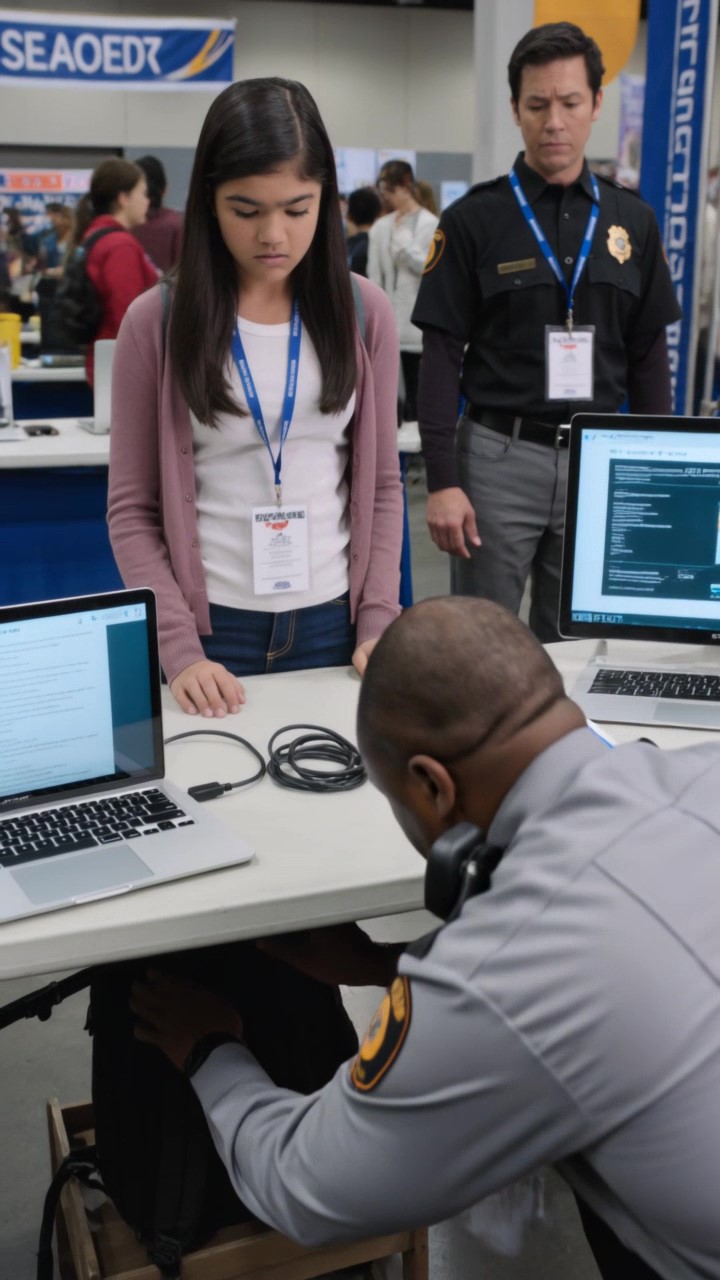
The convention hall was evacuated for twenty-seven minutes.
Fire personnel isolated the damaged battery and confirmed the area was safe before anyone returned.
No student was injured.
No neighboring exhibit was damaged.
Lily Brooks’s backpack, several notebooks, one borrowed sensor kit, and the refurbished laptop were unusable afterward.
Her project survived only partly.
The code existed in an online school account.
The physical model inside the bag did not.
A rescue can be correct and still destroy something the person cannot easily replace.
That was why Lily did not thank Marcus immediately.
The Westbridge Youth Technology Fair brought students from twelve public schools into a downtown convention center.
Lily attended on a need-based scholarship funded by Digisphere Learning, a company that donated refurbished laptops and electronics kits.
Her project measured classroom noise and used simple lights to help students recognize when group work became too loud for classmates with sensory needs.
She built the device with a school teacher.
Tested it in two classrooms.
And carried every component in the same black backpack she used for school.
Her family did not own a second computer.
The refurbished laptop mattered beyond the competition.
Her mother, Rachel, used it for online work scheduling.
Lily’s younger brother completed homework on it.
Losing the device meant more than losing a presentation.
The laptop had arrived six months earlier through Digisphere’s school-equipment program.
A certified refurbishment partner replaced the original battery.
The replacement passed an initial diagnostic.
The casing showed no damage.
The computer worked normally until fair week.
Lily noticed the bottom panel no longer sat perfectly flat.
She assumed one screw had loosened.
The night before the event, the laptop became unusually warm while charging.
She unplugged it and continued preparing on battery power.
She did not know those changes could indicate a serious battery problem.
Nobody had taught the scholarship recipients what physical warning signs to report.
The program emphasized logging software issues through an online form.
The form did not include a category for a bulging case or unusual odor.
At the fair, Lily placed the laptop on the display table.
The backpack sat underneath.
A compact external battery pack and charger remained inside the main compartment.
The laptop’s replacement battery had already begun failing internally.
Heat spread through the bag while the charger remained connected.
Marcus Reed worked convention security.
His job involved entrances, crowd flow, lost property, and emergency response.
He was not an electronics engineer.
Two years earlier, the center hosted an electric-mobility show where a damaged display battery overheated during setup.
After that incident, the venue added basic battery-warning training for security, custodians, and event staff.
Workers were taught to recognize several visible or audible signs, move people away, activate the venue’s emergency plan, and avoid treating the object like ordinary lost property.
The center installed red safety drums in designated areas for use by trained fire personnel and exhibitors handling battery-powered equipment.
Marcus had never used one during a public event.
While walking past Lily’s booth, he noticed a sharp sweet odor near the floor.
Then a faint clicking sound from the backpack.
One side panel looked rounded.
The bag’s zipper had begun pulling apart without anyone touching it.
Marcus asked Lily:
“What is charging under the table?”
She did not hear him over the student demonstration beside her.
He crouched.
The bag felt hot before his hand reached the outer fabric.
He saw the laptop casing separated near the hinge and a power cable disappearing into the compartment.
He called the fire-safety officer over the radio.
The radio channel was busy with an unrelated medical call near the entrance.
The clicking became a soft pop.
Marcus acted.
He disconnected the cord at the accessible plug and lifted the entire bag by its upper strap.
He did not open it inside the crowded hall.
He did not know which component was failing.
Lily saw a security guard taking the only computer her family owned.
Rachel saw her daughter chase him.
Preston Hale saw an employee carrying student property away without explanation.
Each person interpreted the visible act before seeing the invisible heat.
Marcus tried to say:
“The battery is swelling.”
The phrase sounded like a guess.
He had no time to provide a technical argument while holding the object.
Preston ordered him to put it down.
Putting it on the carpeted floor beside students would have ended the conflict visually.
Marcus refused.
He moved through the nearest side exit to the designated isolation point.
The red drum was empty.
He placed the backpack inside, closed the lid, and stepped away.
Seconds later, smoke appeared through the vent.
The fire-safety officer arrived.
The response continued under trained personnel.
Marcus did not open the drum or attempt to manage the damaged battery himself.
The crowd evacuated.
That sequence mattered during the investigation.
A good intention does not make every emergency action correct.
Investigators asked whether Marcus should have first cleared the booth, waited for the fire officer, or removed only the charger.
Video showed the bag had begun visibly changing shape before he lifted it.
The time between his first radio call and the smoke was less than one minute.
The nearest students stood within several feet.
The review concluded immediate removal to the designated isolation point was reasonable under the venue plan.
Marcus’s communication could have been clearer.
The event director’s response could have been slower to accuse.
Both findings were true.
The sponsor technician identified the replacement battery serial number.
Digisphere had issued an internal quarantine notice that morning after its refurbishment partner reported a manufacturing lot with elevated failure risk.
The notice reached warehouse and school-program managers.
It had not yet reached students or fair staff.
Lily’s serial number appeared on the list.
The company planned to contact recipients within forty-eight hours.
The fair happened first.
The sponsor’s initial public statement praised its “rapid technical identification.”
Rachel objected.
“Your technician identified the number after the bag was already smoking in the safety drum.”
The statement changed.
It credited Marcus with recognizing the physical warning and the venue team with isolating the equipment.
Digisphere suspended the affected battery lot and contacted every recipient immediately.
The independent investigation found the program had relied too heavily on serial databases.
The battery exhibited visible changes before the quarantine list existed.
Students, parents, and teachers needed simple reporting pathways for physical defects.
The company replaced every affected device.
Lily received a new laptop and reimbursement for damaged school materials.
The borrowed sensor kit belonged to the school.
Digisphere replaced it.
The company also funded professional data recovery from the damaged laptop.
Some files were recovered.
Some were not.
Lily had backed up her code but not the latest presentation slides or calibration photographs.
The judges faced a fairness problem.
Allowing her to rebuild after the deadline could disadvantage other students.
Disqualifying her would make an equipment failure erase months of work.
They allowed Lily to present the surviving code, earlier test data, and an oral explanation after the hall reopened.
She could not demonstrate the complete physical model.
She did not win first prize.
She received a separate resilience and design-process commendation.
Lily disliked the award title.
“It sounds like they gave me a medal for losing my project.”
Her teacher agreed.
The fair later renamed the recognition:
CONTINUITY OF TECHNICAL EVIDENCE.
It recognized students who could document work after equipment failure—not emotional bravery on demand.
Lily remained angry with Marcus for several days.
The video online showed him taking the bag while she cried.
Short clips omitted the smoke.
Commenters called him a thief, a bully, or a security guard desperate to control a poor student.
Another clip called him a hero who saved hundreds.
Both ignored Lily’s loss and Marcus’s limited role.
He had recognized danger and moved one object.
The venue’s safety system, fire personnel, evacuation staff, and prior training completed the response.
Marcus was placed on paid administrative review.
Preston had removed his radio and ordered security to detain him before the smoke appeared.
After the evidence review, Marcus returned to work with no misconduct finding.
The center revised its emergency communication.
Security workers carrying a suspected hazardous device would state one standard phrase:
“Emergency isolation. Clear the path.”
Other staff were trained not to demand the object be dropped before the hazard was assessed.
Workers still had to explain and document the action afterward.
Authority did not eliminate accountability.
Preston received formal discipline for escalating the situation publicly and describing Marcus as a thief before checking the safety report.
He remained event director after retraining.
He apologized to Marcus.
“I saw a student crying and you refusing to return her property.”
Marcus answered:
“That is what happened.”
Preston looked surprised.
Marcus continued:
“You also saw me tell you the battery was swelling. You decided the crying proved which part mattered.”
The sentence became part of venue training.
Visible distress deserves attention.
It does not automatically identify the source of danger.
Rachel apologized too.
Her first words came quickly:
“I thought you were stealing from her.”
Marcus nodded.
“I know.”
“I told people to record you.”
“Yes.”
“You lost work because of that.”
“I was paid during review.”
“That is not the same as having your name online.”
No.
Rachel posted a correction using the same social media account that carried the accusation.
She included the full timeline and acknowledged she had identified Marcus as a thief before smoke appeared.
The correction did not reach every viewer.
It reached enough for the record to exist.
Lily met Marcus at the convention center after the investigation.
She carried the replacement backpack.
No charger inside.
“I still wish you had saved the model.”
“So do I.”
“Could you have opened the bag and taken it out?”
Marcus answered honestly.
“I did not know which part was failing. Opening it beside you would have been another risk.”
Lily looked at the red drum.
“I hated you.”
“I know.”
“Were you mad?”
“No.”
“Why?”
“You were watching someone carry away the thing you had worked for. You did not know what I knew.”
The response did not ask her to feel grateful.
It gave both perspectives room.
Lily rebuilt the model for a summer accessibility workshop.
The new version stored code automatically and used a separate display device.
Not because backups eliminate every loss.
Because design includes what happens when equipment fails.
Digisphere changed the refurbished-laptop program.
Devices received physical inspection instructions in plain language.
Schools could report heat, swelling, odor, casing separation, or charging changes without identifying a technical cause.
Affected devices were replaced through trained service channels.
The company’s internal quarantine system notified users and event partners at the same time as warehouses.
Public fairs added charger checks and designated charging tables away from crowded booths.
No student was taught to handle a failing battery themselves.
The instruction was to stop using the device, move away, and contact trained staff.
Marcus became the center’s emergency-preparedness lead after completing additional training.
He did not become an electronics specialist.
His role focused on recognizing when an ordinary security incident might actually be a fire, medical, structural, or equipment emergency.
He continued walking entrances and helping visitors find rooms.
Months later, a parent complained that a security guard had removed an overheating mobility-device charger from a public outlet.
Staff used the standard phrase.
Cleared the area.
Called trained personnel.
The charger was defective.
No one called the guard a thief.
At the next youth technology fair, Lily returned as a volunteer.
She saw a student hiding a cracked tablet case because he feared losing the device before judging.
Lily did not inspect it herself.
She called the event technician.
The device was safe; only the outer cover had broken.
The student continued.
A safety system should be able to check without automatically destroying the opportunity.
Lily’s original red-drum incident appeared in training without her crying face.
The lesson used photographs of the damaged equipment, the venue map, and the timeline.
Marcus requested that change.
“A child’s worst minute is not necessary to teach the room layout.”
The convention center agreed.
The security guard had looked like the person harming a poor student because his action was the most visible and her loss was immediate.
The real danger had been hidden inside the object she depended on.
Being right to remove it did not make the loss less painful.
It made sure Lily remained present to rebuild what could be rebuilt.







Leave a Reply