
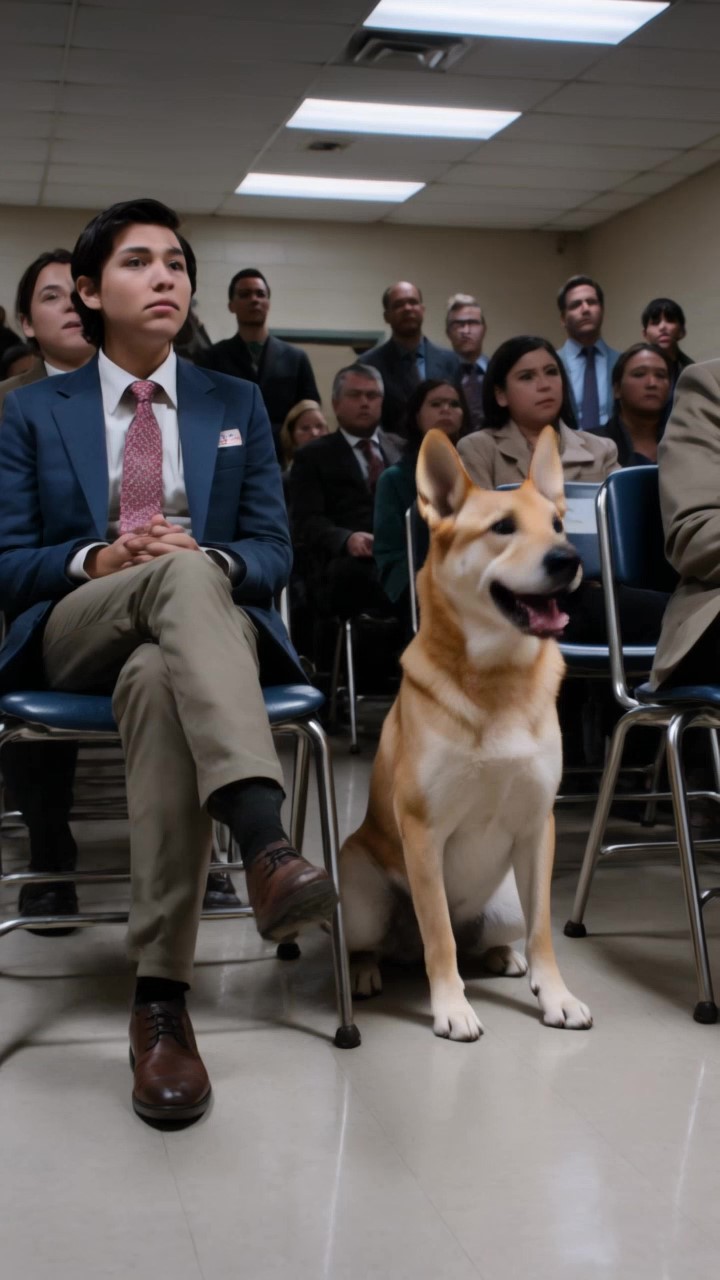
Noah Brooks had not “hidden” in the utility closet.
He had been guided there during a hallway crisis and left behind a door that could not open from the inside.
That distinction changed everything.
The school’s official report described a student with autism becoming overwhelmed before a donor assembly. It said he entered a nearby closet to avoid noise, remained there briefly, and was found by custodial staff. The report concluded supervision procedures should improve but no staff misconduct occurred.
Maria Alvarez knew the report was wrong.
She cleaned the east hallway during after-school programs. On assembly day, she heard scratching and a low whine. Atlas, Noah’s service dog, stood outside the utility closet door, pawing at the lower panel. Maria opened the door with her staff key and found Noah sitting on the floor, hands over ears, breathing fast.
The inside knob was broken. The latch could be opened from the hallway but not from inside. A cracked yellow mop handle lay near the wall where Noah had tried to reach the push plate.
Maria reported it immediately.
Principal Preston Hale thanked her, then told her not to discuss the incident because student privacy was involved. Student privacy was a real concern. It did not justify filing a false account.
Noah’s mother, Rachel, requested camera footage. Preston said the camera in that hallway had been blocked by assembly decorations. That was partly true. The main camera view was blocked. But a first-grade teacher, Leah Brooks, had filmed a short clip accidentally while recording students lining up for the assembly.
The clip showed Noah covering his ears as donors entered. Preston guided him toward the utility closet. Another staff member began to object. Preston said, “Two minutes. Let him calm down where the donors cannot see.” He closed the door. The staff member was pulled away by the assembly start. Atlas remained outside because service animals were not allowed into the storage closet under school policy.
Two minutes became eleven.
Leah did not realize the door had failed until Maria found Noah. When Leah saw the official report, she contacted Rachel privately and agreed to speak at the board meeting.
Preston learned of it. Before the meeting, his assistant told Leah the board needed to verify her phone video in a side room. Leah entered the board-room utility closet because the assistant said it was a quiet storage office. The door was closed. It locked from outside. Her phone still had signal, but the assistant took the hallway outside and did not return. Leah texted Maria, but Maria was already at the podium.
That was why Maria brought the cracked mop handle. It was physical proof the inside door hardware failed. Preston shut off her microphone before she explained it.
The service dog changed the room because Atlas responded to the same door behavior. His action did not prove Preston’s guilt by itself. It forced the board to open the closet.
Leah’s video provided the evidence.
The board suspended Preston immediately pending investigation. The assistant admitted she had been told to keep Leah away from the microphone until the meeting ended. She claimed she did not know the closet would lock from outside. Investigators found she had tested the handle earlier that day. She resigned.
Preston’s defense was that he never intended harm. He said he believed a quiet closet would reduce Noah’s sensory overload and prevent public distress during a donor event. Even if that were true, it failed at every level. A utility closet with broken hardware was not a calming room. Separating a child from a trained service dog was not support. Closing the door so donors would not see distress treated disability as an image problem rather than a student need.
Maria’s role also received scrutiny. Some administrators said she violated privacy by speaking publicly. The board’s independent counsel found she first reported internally and was ignored. Noah’s mother had authorized discussion of the safety failure. Maria had not shared medical details beyond what was necessary to correct the false report.
The school changed policy. Utility closets and storage rooms could not be used for student calming or isolation under any circumstance. Sensory-support rooms required outward-opening doors, interior release hardware, staff visibility, and documented supervision. Service-dog access rules were rewritten with disability experts so emergency separation did not occur casually. Any door that could not open from inside was removed from student-accessible areas until repaired.
Board meetings changed too. No employee scheduled to speak could be moved into a closed room by administrative staff without a board member present. Microphones could not be cut off by the person accused in the complaint. Evidence from service workers, aides, teachers, and students had to be preserved before official reports were finalized.
Noah’s recovery was slow. For weeks, he refused to pass the hallway. Atlas also hesitated near closed utility doors. The district paid for counseling and additional service-dog training support. Rachel transferred Noah to a different school after the semester. Staying would have required passing too many adults who had accepted the first report.
Maria lost her janitorial contract at that school when the contractor reassigned staff after the controversy. Public pressure forced the district to require she be offered an equivalent position with no loss of pay. She accepted a different campus.
Leah, the teacher, returned after a leave of absence. She struggled with guilt because she had filmed but not understood the danger quickly enough. Rachel told her, “You came back to speak. That mattered.”
At the next board meeting, Noah did not attend. Rachel did. She placed the cracked mop handle and Atlas’s old leash on the table.
She said, “One adult found my son. One adult filmed the truth. One dog refused to stop scratching at a door. The system listened only when all three became impossible to ignore.”
The board voted to publish the corrected report.
Maria did not become famous. She remained a cleaner, then later trained as a school facilities safety aide. Her first lesson to new staff was simple:
“If a door closes on a child, somebody must know how it opens from both sides.”
The villain had tried to silence a witness by turning off one microphone.
The truth had more than one way to make noise.


Leave a Reply