
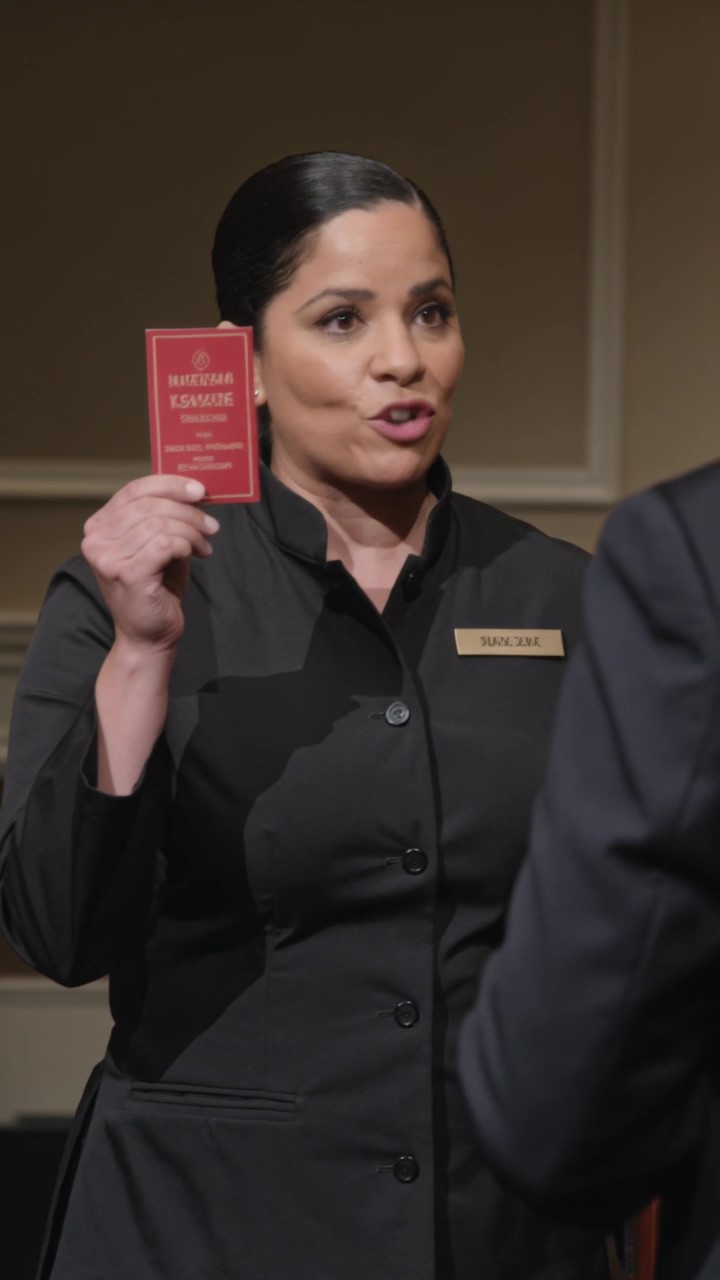
The forty-one red cards did not prove every allegation by themselves.
They did something more important at the award ceremony.
They made it impossible for Charles Whitmore to continue claiming the practice had never existed.
The Harbor Crown Hotel employed more than two hundred people across housekeeping, food service, laundry, maintenance, front desk, security, and events.
Charles did not build the hotel from nothing.
His family purchased it twenty years earlier and expanded the ballroom business aggressively.
The hotel became known for weddings, medical conferences, political dinners, and charity galas.
The ballroom where Charles received the award generated much of the property’s profit.
It also created unpredictable labor.
A wedding scheduled to end at ten could continue until midnight.
Guests left slowly.
Tables had to be cleared.
Glassware counted.
Floors cleaned.
Rental chairs stacked.
Kitchen equipment sanitized.
Managers struggled to predict exactly how many paid hours every event required.
The company’s official policy was clear.
Employees must remain clocked in for all work.
The unofficial practice was different.
Banquet managers were measured against labor-cost targets set before each event.
If the event ran late, managers faced questions about overtime.
Several began ordering workers to clock out at the scheduled end time, then finish “closing responsibilities” before leaving.
The instruction was rarely written in a sentence that said:
Work without pay.
Instead, workers heard phrases like:
We need everyone to show commitment.
The clock is closed, but the room is not.
Help the team finish.
You can go after manager check.
To organize the remaining work, supervisors used red cleanup cards.
The cards were originally designed for paid task distribution during large events.
Each listed a zone and closing duties.
Managers handed them out after employees clocked out because the electronic scheduling system no longer showed those workers as active.
The red cards became a shadow roster.
Nina Alvarez worked evening dishwashing and banquet cleanup.
She was fifty-one and had spent twelve years at the hotel.
Her job was physically demanding but familiar.
She knew how many racks of glassware fit each machine cycle.
Which serving trays warped under excessive heat.
Which ballroom events produced broken glass under dark tablecloths.
Nina did not consider herself an activist.
She wanted accurate hours.
The unpaid work began gradually.
Ten minutes after clock-out.
Then twenty.
During holiday events, more than an hour.
Nina wrote her actual departure times on grocery receipts.
A younger dishwasher told her to stop complaining because managers could reduce shifts.
Nina understood the fear.
Hotel schedules changed weekly.
A worker who challenged one manager could disappear from the best events without being formally disciplined.
The incident that ended Nina’s job occurred after a pharmaceutical banquet.
Employees clocked out at 11:00 p.m.
The room remained full of glassware and wet kitchen mats.
A supervisor handed Nina a red card with four tasks.
Nina asked to clock back in.
The supervisor said payroll had closed and told her to finish “as part of tonight’s team commitment.”
Nina placed the red card on the manager’s desk and left.
The next week, she received only one short shift.
She filed an internal wage complaint.
Human resources asked managers whether anyone required off-clock work.
They denied it.
The hotel’s time records showed workers had clocked out.
Camera footage showed some remaining inside, but management claimed they stayed voluntarily for meals, transportation, or socializing.
The red cleanup cards would have connected their presence to assigned tasks.
The company said the cards were informal reminders destroyed after each event.
Nina had kept hers.
Human resources accused her of removing internal materials.
Then a cash discrepancy appeared in the employee meal register.
Nina had used a supervisor meal code when the machine failed to accept her card.
The supervisor had verbally approved it.
There was no written note.
The hotel terminated Nina for policy violations involving timekeeping, unauthorized materials, and meal access.
The termination letter did not say she was fired for reporting unpaid work.
It built a different story around smaller issues.
Nina contacted a worker center.
The center interviewed other employees.
Many had saved red cards accidentally in apron pockets or lockers.
Some photographed them because managers frequently changed tasks.
Forty-one cards were eventually preserved.
The worker center helped file wage claims with the state labor department.
Investigators requested payroll records, security access logs, cleaning schedules, manager messages, and cards.
The hotel produced most records but stated the red-card practice did not continue after clock-out and suggested workers coordinated false claims.
Charles received the hospitality award while the investigation remained open.
The award came from a private industry association.
Its judges reviewed company submissions, employee benefits, community donations, and turnover data.
The hotel’s application described a “family culture where staff voluntarily support one another beyond assigned roles.”
That phrase appeared in training materials.
It sounded positive.
Inside the wage investigation, it carried another meaning.
Nina learned the award ceremony would be held in the Harbor Crown ballroom.
She did not plan to rush the stage alone.
The labor investigator, Leah Brooks, had been invited by the association to observe after the worker center raised concerns. Current and former employees purchased guest tickets through supporters and organized the card display.
The purpose was not to surprise investigators.
They already had the evidence.
The purpose was to confront the public story in the exact room where unpaid work had been normalized.
Charles’s reaction damaged his position.
When he tore Nina’s card and called it an internal task note, he confirmed his familiarity with the system.
The investigator had asked the workers to retain originals, so the card onstage was a certified copy. The real original remained secured.
Charles claimed he tore it because he believed Nina was using hotel property for a publicity stunt.
The explanation did not remove what cameras captured:
Recognition.
Denial.
Destruction.
And forty-one matching cards rising around him.
The industry association paused the award.
It did not declare the hotel guilty onstage.
The labor department completed its review over the following months.
Time records, security exits, kitchen equipment logs, event schedules, manager texts, and red cards showed a consistent pattern.
Workers remained after clock-out for assigned closing work.
The average unpaid period varied.
Some nights involved twelve minutes.
Others exceeded an hour.
The department calculated back wages, overtime adjustments, and penalties across multiple years within the legal recovery period.
The total was substantial.
Not every employee received the same amount.
Some worked only a few affected events.
Others had hundreds of unpaid hours.
The hotel entered a settlement without admitting every alleged violation.
It agreed to pay verified wages and penalties, correct records, and accept independent monitoring.
Several managers were disciplined.
Two had explicitly instructed employees to clock out and continue.
They were terminated.
Others remained after retraining where evidence showed they followed inherited practice without personally threatening workers.
Charles faced the board.
He had not handed every red card to employees.
He had approved the labor targets and received internal warnings that cleanup continued after clock-out.
Emails showed him responding:
Managers must solve overtime without compromising guest standards.
That sentence did not directly order wage theft.
It demanded two outcomes that could not always coexist without more staffing or higher labor cost.
Managers solved the contradiction downward.
Charles also signed the award application describing voluntary extra support.
The board removed him from day-to-day hotel operations for one year and appointed an external general manager.
Some workers wanted permanent removal.
Others cared more about wages and enforceable procedures.
Nina said:
“Do not make his punishment the whole repair. If the next manager has the same targets, we will get a different face and the same cards.”
The hotel changed its systems.
Employees could not clock out while active tasks remained assigned.
If an event exceeded schedule, managers opened an authorized overtime code.
Red cards were replaced by digital and paper task sheets linked to paid time.
Workers confirmed completion before clock-out, not after.
Security exit times were reviewed against payroll for unexplained gaps.
Meal access could not be used as discipline or evidence of theft without full context.
And managers’ bonuses included wage-compliance measures, not only labor-cost reduction.
The hospitality association withdrew the Employer of the Year award.
It reviewed how companies submitted evidence.
Future applicants needed anonymous employee surveys conducted outside management control, wage-complaint disclosures, and verification from payroll auditors.
The association invited Nina to speak at its next conference.
She refused the keynote.
“I am not becoming free labor at an event about unpaid labor.”
They offered an honorarium.
She accepted a short worker panel instead.
The panel included a housekeeper, banquet captain, dishwasher, payroll specialist, and labor attorney.
No single worker represented everyone.
Nina received back wages and compensation through the settlement.
The amount helped her pay debt and replace an unreliable car.
It did not transform her into a wealthy person.
She found work in a hospital kitchen where closing tasks were documented more clearly.
For months, she still photographed every schedule and clock screen.
Trust did not return with one settlement check.
Current Harbor Crown employees faced mixed feelings.
The payments mattered.
The monitoring mattered.
Some lost shifts while the hotel changed staffing models.
The new general manager initially cut event bookings to control compliance.
Workers demanded that reform not become reduced income.
The hotel negotiated guaranteed minimum hours for core banquet staff and created a voluntary on-call list with clear overtime rules.
Justice inside the villain’s arena was satisfying for cameras.
Justice after the cameras required boring details:
Payroll codes.
Staffing ratios.
Appeal procedures.
Independent audits.
And workers receiving the money they had already earned.
Charles returned to the hotel after the year away, but not as sole operating authority.
At his first staff meeting, he stood in the same ballroom.
No award banner.
No gold lights.
He apologized.
His first draft said the company had “failed to communicate expectations.”
Workers rejected it.
The final version said:
The hotel benefited from work performed after employees clocked out. Management pressure and denial allowed the practice to continue. Workers who reported it were punished or discredited.
Nina attended through video from the worker center.
She did not clap.
An apology accurately describing harm was a requirement, not a performance she owed gratitude for.
The torn red card stayed in the labor department case archive.
A photograph of it appeared in hotel training beside the phrase:
NO TASK EXISTS OUTSIDE PAID TIME.
Years later, a banquet ran ninety minutes late.
A new manager told staff:
“We are over labor.”
A server held up the active task sheet.
“Then authorize the time or close the room differently.”
The manager opened the overtime code.
The ballroom cost more to clean that night.
That was not inefficiency.
That was the actual price of the event.
Nina had returned to the room where Charles sold himself as a family employer.
The workers did not defeat him by proving they were more loyal.
They won by refusing to let loyalty remain a word management used when it wanted labor without a wage.







Leave a Reply