
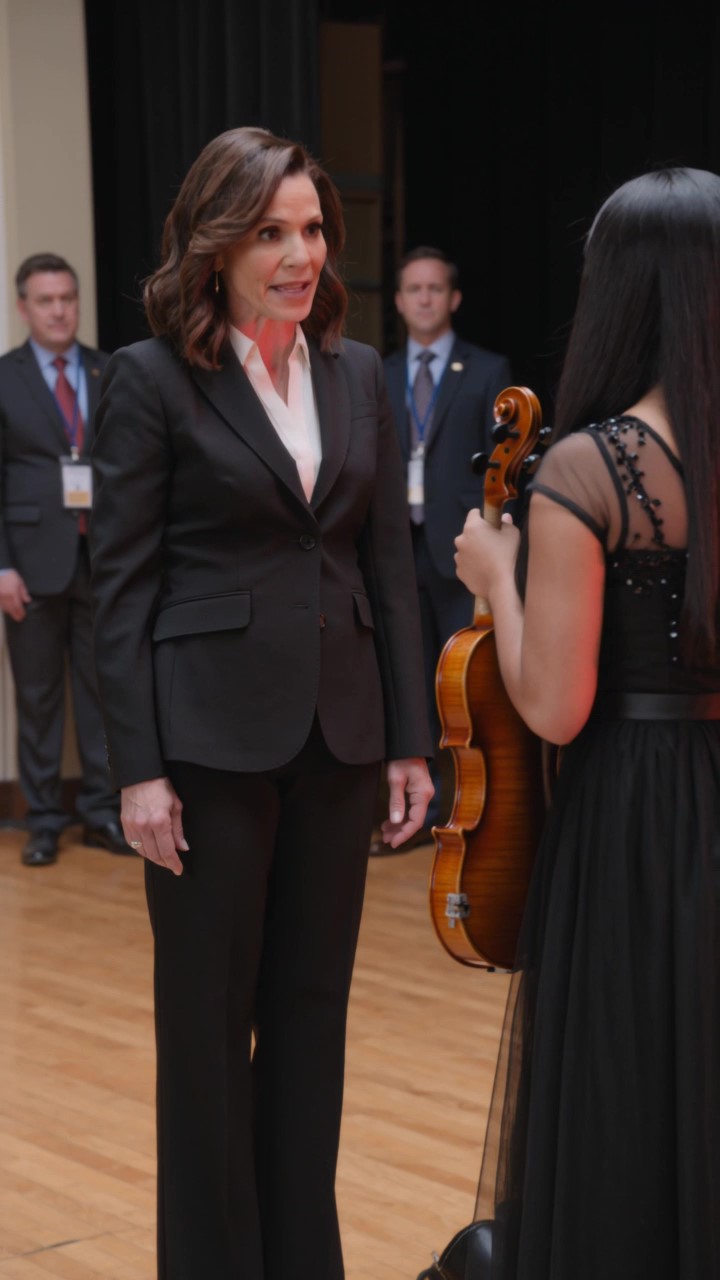
Maya Brooks did not receive the original scholarship that evening.
The final could not simply resume ten minutes later.
The venue had to be assessed.
The tracking device had to be preserved.
The family needed a safe exit plan.
Other finalists had already performed under the published schedule.
The interruption changed the competition for everyone.
Rachel Cole’s decision protected Maya.
It also cost the teenager a moment she had practiced for nearly a year.
Both truths remained.
Maya had played violin since age seven.
Her mother Leah worked as a respiratory therapist and paid for lessons by taking weekend shifts.
Maya’s father, Daniel Brooks, once attended every recital.
The family’s situation changed gradually.
Daniel became controlling after the separation.
He demanded access to Leah’s work schedule, Maya’s messages, and every rehearsal location.
When Leah set boundaries, he appeared unexpectedly at school events and followed them after appointments.
The court case was complicated.
Daniel denied threatening anyone and said he was a father being excluded from his child’s life.
Some interactions looked ordinary from the outside.
The pattern across months did not.
A family court issued a temporary protection order while custody and safety assessments continued.
The order prohibited Daniel from approaching Leah or Maya and from using third parties or electronic means to monitor their location.
Maya knew there was a court order.
She did not know every allegation or every protective step.
Leah and the advocate believed a fifteen-year-old should understand enough to follow safety plans without carrying the full burden of adult conflict.
That decision later became part of Maya’s anger.
She felt protected and managed at the same time.
The scholarship competition was organized by the Westbridge Youth Arts Foundation.
Finalists performed live before judges and online donors.
The broadcast usually displayed student names, schools, and performance order.
Because of the protection order, Maya’s profile used only her first name and school region.
The venue address was sent privately to registered families.
The foundation agreed not to publish arrival footage.
Rachel was the school orchestra teacher and designated safety contact.
She knew the family had confidentiality restrictions.
She did not know the detailed court file.
On competition morning, Maya’s violin case remained in a monitored rehearsal room.
Students, parents, staff, photographers, and instrument technicians moved through the area.
During sound check, Maya left the case open while tuning onstage.
Rachel heard a small chirp beneath the velvet lining.
At first, she thought it was a digital tuner.
The device was not part of Maya’s equipment list.
It had been attached under a removable shoulder-rest compartment.
Rachel did not pull it free immediately.
She photographed its position for the venue safety liaison, then closed the case and moved it into her direct view.
The advocate was called.
The police liaison was already traveling to the venue when Maya’s performance time arrived.
Rachel asked Preston to delay the solo.
He refused without an explanation.
“The broadcast schedule cannot stop for an unidentified electronic accessory.”
Rachel could not announce the family’s court order in a control room full of volunteers and sponsors.
She said only:
“There is a student safety concern. Hold the feed.”
Preston asked whether there was an immediate threat.
Rachel answered:
“I cannot rule one out.”
He believed she was overreacting to a lost-item tag commonly used in instrument cases.
Many musicians use trackers legitimately because instruments are valuable.
That fact made the device ambiguous.
The question was who had registered it and how it entered the case.
Preston told the broadcast team to proceed.
Maya walked onstage.
The red camera light turned on.
Rachel heard the tracker chirp again.
The advocate had not yet reached the wings.
Rachel made the choice.
She stopped the performance and cut the feed.
She did not tell Maya why in front of the audience because the device might still be transmitting and because public explanation would reveal the exact safety concern.
Maya experienced only betrayal.
Her teacher took the violin.
The audience watched.
The scholarship opportunity disappeared.
Rachel accepted being hated for those minutes.
The police liaison later confirmed the device account was connected to Daniel.
Investigators found he had purchased it after the protection order. He claimed he intended to track the expensive violin, not Maya, and said the device had been placed in the case before the order took effect.
Transaction records contradicted part of that account.
Venue footage showed a family acquaintance entering the rehearsal room and standing near Maya’s case during sound check.
The acquaintance admitted Daniel had asked him to “make sure the violin didn’t get lost.”
He said he did not know about the order’s electronic-monitoring restriction.
The court handled the violation.
The story did not require detailing how tracking technology worked or how to evade it.
What mattered was that a prohibited person used an object associated with the child to learn her movements.
The competition foundation faced a separate question.
What should happen to Maya’s scholarship chance?
Preston initially argued that allowing a private re-performance would violate equal conditions.
Other finalists had performed live, under pressure, before the same audience.
Maya’s family argued she had not withdrawn and had been removed for a verified safety threat.
The judges reviewed policy.
There was no rule for that situation.
They decided not to award her the original first-place scholarship based on a private performance alone.
Instead, all finalists’ recorded semifinal scores remained valid, and Maya received a rescheduled adjudicated performance before the same judges without public broadcast.
The winner from the live final kept the main scholarship.
The foundation created an additional safety-interruption scholarship funded from its emergency reserve and sponsor contribution.
Maya earned it based on her rescheduled score.
That solution was imperfect.
It prevented another student from losing an award already earned.
It prevented Maya’s interruption from ending her opportunity completely.
It also meant her scholarship carried a story she did not choose.
For weeks, people referred to her as “the tracked violinist.”
Maya hated the label.
She stopped playing for two months.
The violin itself felt contaminated by adult decisions.
Leah considered replacing the case.
Maya refused at first.
Then asked for a plain case with no sentimental presentation.
The original case remained evidence until released, then was discarded with Maya’s consent.
Rachel’s job came under review.
Parents accused her of humiliating a child and disrupting a major event without explaining herself.
Video clips showed her lowering Maya’s bow and taking the case.
The tracker confirmation was not public initially because the family’s legal matter remained private.
Rachel could defend herself fully only by exposing the reason she had promised to protect.
She declined interviews.
The school placed her on paid administrative leave during review.
Maya remained angry and did not immediately speak for her.
That silence hurt Rachel.
It also belonged to the child.
Protecting someone does not purchase their public defense.
The independent school review examined Rachel’s actions using confidential evidence.
It found she followed the designated safety-contact role, requested a delay, escalated to the venue, and stopped the broadcast only after the request was denied.
She was reinstated.
The public statement said a verified student-safety concern justified the interruption.
It did not identify the tracker, court order, or family history until Leah and Maya later chose to disclose a limited version.
When they did, Maya wrote her own statement:
My teacher did not remove me because I was unprepared. She removed me because adults had information about my safety that I did not fully understand. I am grateful she acted. I am also angry that I learned the danger while standing onstage. Both are true.
Rachel read the statement twice.
She did not ask Maya to remove the anger.
The family and school reviewed what Maya should have known earlier.
The advocate explained that protective secrecy can become another loss of control if the young person affected is excluded from every decision.
Maya was old enough to receive a clearer safety plan.
She did not need every court detail.
She did need to know why public locations, instrument access, and livestreams were restricted.
Leah apologized for withholding too much.
“I wanted you to feel normal,” she said.
Maya answered:
“Normal without information was not safer.”
That sentence changed the plan.
Maya participated in future decisions.
She chose which events to enter.
Which name appeared publicly.
Who handled her instrument.
And what staff could say if an event had to stop.
The foundation changed its procedures.
Any designated student-safety contact could pause a livestream immediately.
The pause did not require public explanation.
Staff verified the concern privately.
Public schedules for protected students remained limited.
Instrument and equipment areas used controlled access.
Unfamiliar tracking devices or recording equipment triggered trained review—not amateur dismantling.
And scholarship rules included safety interruptions, allowing equitable rescheduling without taking an already-earned award from another student.
Preston apologized to Rachel and Maya.
His first explanation emphasized the complexity of running a live event.
Maya interrupted him.
“You thought the schedule was more real than the risk because the schedule was visible.”
He accepted that.
The foundation removed him from sole authority over safety pauses.
He remained competition director under a shared protocol.
Daniel’s contact with Maya remained restricted while the family court case continued.
The story did not resolve into permanent hatred or immediate reconciliation.
Maya had memories of a father who once tuned her violin and waited outside lessons.
She also had to understand that affection did not make monitoring acceptable.
Counseling helped her hold both.
Rachel returned to orchestra teaching.
Maya did not return to her class immediately.
She studied with another instructor for one semester because being in the same room made the stopped solo replay too strongly.
Rachel accepted that distance.
At the end of the year, Maya invited her to a small school recital.
No livestream.
No scholarship cameras.
Before performing, Maya placed her new violin case beside Rachel’s chair.
“Can you watch it?”
Rachel nodded.
“Only the case?”
Maya almost smiled.
“Only the case.”
She played the solo she had lost.
Not perfectly.
One high note sounded thin.
She continued.
Afterward, the audience applauded.
Rachel remained seated until Maya came offstage.
The teacher had once accepted being called a saboteur because explaining too soon would have exposed the person she was protecting.
The later repair required something harder than secrecy.
It required giving that young person enough truth to become part of her own protection.




Leave a Reply