
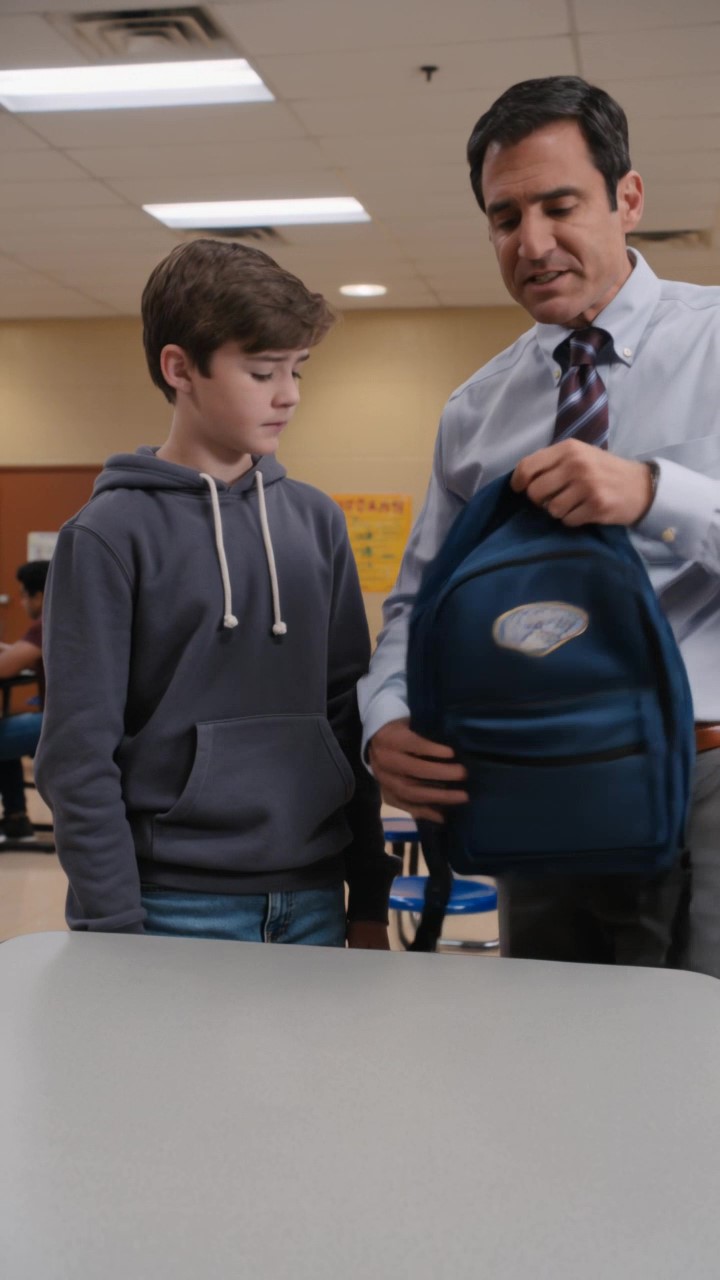
Eli Brooks had broken a school rule.
That fact did not justify the public humiliation.
The district’s share-table policy allowed students to place unopened, approved food items on a designated table during meal service. Other students could take those items for immediate consumption.
The policy did not clearly authorize taking multiple items off campus.
The restriction existed for reasons.
Food safety.
Program accounting.
Allergy concerns.
And federal meal rules that differed depending on funding and product type.
Eli did not know those details.
He knew sealed food remained on the table after lunch and was sometimes discarded.
He knew Nina had once told a student:
“If you are hungry, take one before you go.”
He also knew his sister checked the kitchen shelf every night.
Their mother, Rachel Brooks, worked cleaning shifts at a medical office and weekend laundry at a rehabilitation center. She usually managed food carefully.
The family received nutrition assistance and school meals.
Then a recertification notice went to an old apartment address.
Benefits paused.
Rachel submitted the correction immediately.
The agency required additional proof.
A community pantry had limited appointment slots.
The next available distribution was Friday.
It was Monday.
Rachel had enough rice, canned beans, oatmeal, and two frozen chicken portions.
The children would not starve before Friday.
But breakfast became uncertain.
Mia was seven and had recently begun worrying whenever pantry shelves looked empty.
Months earlier, the family’s refrigerator failed.
Food spoiled overnight.
For several days, meals came from neighbors and convenience stores.
Mia began asking before bed:
“Is there breakfast tomorrow?”
Rachel reassured her.
Eli noticed the question returned whenever supplies ran low.
He started marking food with days.
Monday oatmeal.
Tuesday apple.
Wednesday cereal.
The labels gave Mia something visible.
Not abundance.
Predictability.
Eli did not tell Rachel he was taking school food.
He knew she would feel ashamed that he believed it necessary.
He also feared she would stop him before the pantry appointment.
At lunch, he ate the main meal.
Then waited until students left unopened items on the share table.
Nina saw him take two items on the first day.
She asked whether he was hungry.
He said:
“For later.”
Nina should have clarified the policy and connected the family to the school social worker.
Instead, she made an informal decision.
She allowed him to take sealed fruit and shelf-stable items that would otherwise be discarded at the end of service.
Her motive was compassionate.
Her process was unsafe for both of them.
No record existed.
No allergy plan was checked.
No one contacted Rachel.
By Thursday, another student saw Eli placing food in his backpack and told a teacher he was stealing cafeteria supplies.
Assistant Principal Charles Whitmore received the report during lunch.
Charles had recently been criticized after snack inventory disappeared from an after-school program. He wanted a visible response.
He called Eli to the table in front of other students.
He asked whether food was inside the backpack.
Eli said yes.
Charles then emptied it publicly.
He believed embarrassment would deter other students.
He did not first ask Nina.
He did not move the conversation to an office.
He did not contact the counselor.
He saw multiple items and decided the behavior represented taking more than one’s share.
His sentence—“There are children who actually need this”—revealed the assumption beneath the discipline.
Need had to look different.
More obvious.
More officially approved.
Eli’s clean school clothes and working mother did not match the image Charles expected.
Mia’s arrival was not arranged as a dramatic reveal.
The elementary program ended earlier on Thursdays.
An aide brought her to Eli’s campus because Rachel’s shift ended at 5:30.
Mia knew the marked apple because Eli had shown her the shelf that morning.
When she asked whether Tuesday had fallen, the cafeteria understood the food’s purpose before any adult report was read.
That small detail hurt because it showed what Eli had been managing alone.
Not total starvation.
A younger child’s fear.
A few uncertain mornings.
A mother already doing paperwork.
And a brother trying to create a calendar out of apples.
Charles ended the public search.
He returned the food.
Then made a second mistake.
He told Eli:
“You should have asked for help.”
Eli answered:
“My mother did.”
Nina turned away because the sentence struck harder than the accusation.
The family had asked.
The systems were simply moving slower than hunger and anxiety.
Rachel arrived after work expecting a discipline meeting.
She saw the food on the table and Mia holding Tuesday’s apple.
Rachel did not praise Eli immediately.
She hugged both children.
Then told Eli:
“You cannot hide this from me.”
He began crying.
“I did not want Mia to know.”
“She already knew something was wrong.”
That was the family lesson.
Children often notice scarcity before adults name it.
Silence can protect them from details.
It can also leave them inventing explanations and responsibilities.
Rachel told Mia the truth in age-appropriate language:
The benefit card had a paperwork problem.
Food was available.
Adults were fixing it.
Breakfast might be simple for a few days.
Mia asked whether the apple was still hers.
Rachel said yes.
The school social worker arranged an emergency grocery card that afternoon and moved the pantry pickup forward through a cancellation slot.
The assistance mattered.
It should have happened before a backpack search.
The district investigated the incident.
Charles said he followed theft-report procedure.
The procedure required private questioning and confirmation of inventory ownership.
He had done neither.
The food came from the share table, not locked stock.
The district removed the theft notation from Eli’s record.
Charles received formal discipline for the public search and humiliating language.
He remained assistant principal after retraining and oversight.
Some parents wanted him fired.
Rachel asked for reforms more than a symbolic punishment.
“Another child should not have to produce a hungry little sister before adults believe the need is real,” she said.
The district changed share-table policy.
Approved sealed items could be taken after meal service under clear food-safety rules.
Students requesting multiple take-home items were referred discreetly—not punished—to family support.
No student had to explain financial details in the cafeteria.
Staff could issue same-day emergency food packs while benefits or pantry services were pending.
Parents received multilingual information.
And benefit-processing problems reported to the district triggered temporary meal support without waiting for the child to ask repeatedly.
Nina also faced review.
She had permitted take-home food informally.
The district did not punish her for feeding a child.
It required the cafeteria to create a documented process so kindness did not depend on which manager happened to notice.
Nina helped design it.
Each emergency pack contained ordinary items.
No labels saying needy.
No separate brown bag carried through the hallway.
Students collected them through the same office used for sports forms and bus passes.
The school also changed backpack-search rules.
Immediate safety concerns remained exceptions.
Suspected food or property violations required privacy, a second adult, and an opportunity for the student to explain before belongings were displayed.
Charles apologized to Eli and Mia in Rachel’s presence.
He did not bring a gift.
He said:
“I turned a question about food into a performance in front of your classmates.”
Eli looked at him.
“You wanted them to see what happens.”
“Yes.”
“They saw.”
Charles nodded.
That was true.
Students had seen more than he intended.
The video did not go viral because the school prohibited filming in the cafeteria and asked families not to circulate the one short clip recorded.
Eli was grateful.
He did not want the apple becoming internet content.
The district used a recreated, anonymous scenario for training instead.
No faces.
No names.
Just a backpack, sealed food, and a question:
What information do you need before deciding what this means?
Rachel’s benefits resumed the following week.
The family pantry filled gradually.
Not with a dramatic donation mountain.
With normal groceries.
Oatmeal.
Eggs.
Fruit.
Rice.
Chicken.
Mia stopped checking the shelf every night after several months.
Sometimes anxiety remains after the shortage ends.
Rachel began using a small weekly breakfast chart.
Mia helped choose the pictures.
Eli no longer wrote days directly on apples.
One afternoon, Nina gave him a marker and asked him to label cafeteria storage bins as part of a paid student summer job.
He laughed when he wrote TUESDAY on the fruit crate.
The detail that had exposed his family’s need became ordinary again.
Eli did not become a child hero responsible for feeding Mia.
Adults made sure he understood that.
His care for her was loving.
The burden should never have been his.
At the end of the year, Charles passed the share table during lunch.
One sealed apple remained.
A student asked whether she could take it for the bus ride home.
Charles checked the new sign.
Then answered:
“Yes.”
No interrogation.
No audience.
No child required to prove who would eat it.
The small heartbreaking detail was not that a brother loved his sister.
That part was beautiful.
It was that he believed love required him to quietly build tomorrow’s breakfast from food other children left behind.







Leave a Reply