
Nina Alvarez was not Margaret Whitmore’s secret daughter.
She was not a hidden heir.
She did not receive money, property, or legal authority through the cassette.
That was what made the recording harder for Charles to dismiss.
It did not threaten the estate.
It threatened the family’s preferred version of care.
Margaret spent her final year at Harbor House Hospice after a long period of heart failure and cognitive decline. Her memory changed unevenly. She forgot dates, misplaced words, and sometimes believed she was living in an earlier apartment. She also had clear periods, especially in the mornings and during familiar music.
Her children loved her.
That remained true.
Charles managed finances and insurance.
His sister Vivian coordinated doctors.
Granddaughter Lily visited after school when she could.
The family was not absent in the simple way people sometimes imagine.
They were busy, uncomfortable, and often frightened by the version of Margaret that illness created.
When visits became difficult, they shortened.
They told themselves she would not remember.
Sometimes she did not.
Sometimes she did.
Nina began at Harbor House as a Wednesday evening volunteer after retiring from a school cafeteria job. Her official role was companionship: reading, music, sitting quietly, helping patients write simple notes, and calling staff if medical needs arose. She was not a nurse. She did not administer medication. She did not replace professional care.
Margaret liked Nina because Nina never corrected her harshly.
If Margaret said the bus fare was ten cents, Nina asked where they were going.
If Margaret asked whether peach cups were on sale, Nina read the grocery circular aloud.
If Margaret forgot a name, Nina wrote it on a yellow pad and placed it beside the bed.
Charles initially appreciated Nina.
Then he grew uneasy.
Margaret began asking for “Wednesday Nina” when family visits felt rushed. She once told Vivian, “Nina remembers the names better than you do.” Vivian cried in the parking lot after that. Charles reacted differently. He began describing Nina as a stranger becoming too involved.
The tension increased after Margaret asked Nina to help record a cassette.
Harbor House had a drawer of donated music players for patients who preferred tapes or CDs. Margaret found an old blank cassette inside a box of jazz recordings. She said she wanted to leave a message for Lily.
Nina refused at first.
“I can ask your nurse to call your family.”
Margaret said:
“No. If I ask Charles, he will turn it into a document.”
That sentence made Nina cautious.
Volunteers could not create legal recordings or take instructions related to property. Nina called the volunteer coordinator. The coordinator and a hospice social worker met with Margaret during a clear period.
They established boundaries.
The tape could contain personal messages, names, memories, and thanks.
It could not change medical directives, finances, or legal decisions.
Margaret agreed.
The social worker documented the session.
Nina operated the cassette player because Margaret’s hands shook.
The recording took four sessions.
Margaret became tired often.
Sometimes she repeated herself.
Sometimes she asked to erase a line because it sounded cruel.
Nina did not edit the tape alone. The social worker held the cassette between sessions in the music drawer.
In the final session, Margaret asked Nina to bring the tape to the memorial if her family did not mention the staff and volunteers who had stayed with her.
Nina again hesitated.
“That could hurt them.”
Margaret answered:
“They will be hurt because they know it is true.”
The social worker documented that request too.
When Margaret died, the family planned a polished memorial. Charles wrote the program. It thanked doctors, the attending hospice physician, and “the Harbor House team.” That phrase was not wrong. It was vague enough to make no individual visible.
The nurse who changed Margaret’s oxygen tubing at three in the morning remained unnamed.
The janitor who kept the hallway light low because bright light scared her remained unnamed.
The kitchen aide who saved peach cups when Margaret stopped eating most foods remained unnamed.
Nina remained unnamed.
Lily remembered her grandmother mentioning a tape. Charles said dementia had produced many imaginary requests. He did not look in the music drawer.
Nina did.
The social worker released the cassette to her with a copy of the documentation. Nina brought it to the memorial and planned to give it quietly to Lily.
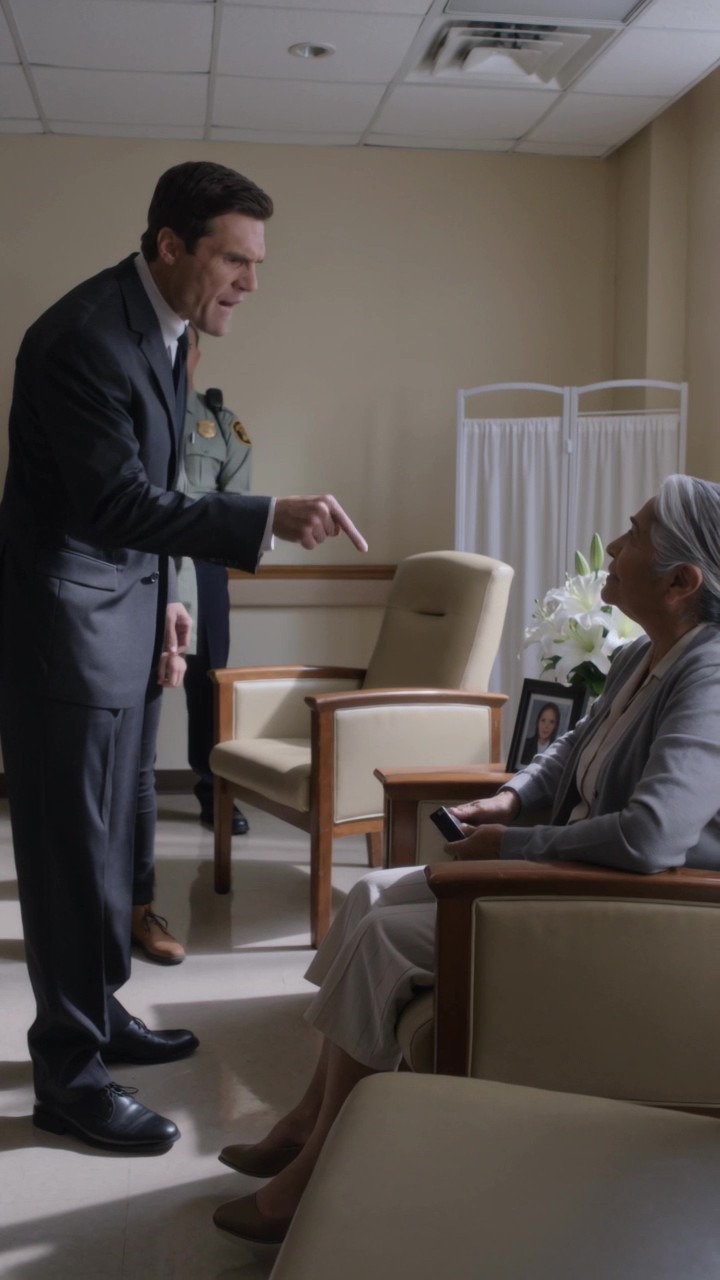
Charles saw her first.
His anger came from grief, embarrassment, and control.
He did not want a volunteer appearing with a mysterious object in front of donors, relatives, and family friends. He feared accusations that the family had abandoned Margaret. He also feared something more private: that Margaret had noticed the shrinking visits and named the people who filled the space.
Security escorted Nina because Charles asked.
Lily stopped it by playing the tape.
Margaret’s voice was weak, but clear enough.
She thanked Vivian for arguing with insurance until the right bed arrived.
She thanked Charles for selling the winter house before repairs swallowed its value.
She thanked Lily for painting her nails blue even after she forgot the reason.
Then she named the people Charles had folded into “team.”
Leah, the night nurse who sang low so I would not fight the mask.
Samuel, who fixed the squeak on the linen cart because it sounded like the hospital.
Rosa from the kitchen, peach cups.
Mr. Bell at the desk, who always said my son called even when I could not talk.
And Wednesday Nina, who wrote the names when my own hand shook.
The room changed because the tape did not accuse without balance.
Margaret thanked her family.
Then corrected their omission.
When the tape said she had heard Charles call volunteers “not family,” he looked physically smaller.
He had said it two months earlier outside Margaret’s door, believing she slept.
She had not.
After the memorial, Charles wanted to keep the cassette private. Lily refused to surrender it. Vivian mediated. They agreed to make a copy for the family and donate the original to Harbor House only if Nina and the staff agreed.
Nina did not want the tape displayed as proof she mattered.
She wanted Margaret’s named thanks to reach the people on it.
Harbor House held a small private listening for staff and volunteers.
No cameras.
The janitor Samuel cried when his name played.
Rosa laughed through tears at “peach cups.”
Leah, the nurse, stood in the back with folded arms and said she was just doing her job.
Nina answered:
“Then she wanted your job named.”
That became the larger repair.
Harbor House reviewed how families were guided through memorial planning. Staff could not demand recognition. Volunteers could not insert themselves into ceremonies. But hospice leadership began offering families an optional “care circle” page listing people who had direct roles, if the patient or family wished.
The page included categories:
Clinical staff.
Volunteers.
Food service.
Housekeeping.
Front desk.
Spiritual care.
Maintenance.
Not every name appeared in every memorial. Consent mattered. Privacy mattered. Some staff did not want public listing. Some families preferred private thanks.
The change simply prevented “team” from becoming a word that erased labor.
Charles apologized to Nina three weeks later.
His first attempt failed.
“I was protecting the family from confusion.”
Nina looked at him.
“Your mother was clear enough to thank you. Was she only confused when she thanked me?”
Charles sat with that.
The second apology was better.
“I was ashamed that she needed people when I was not there. I made that shame about your place in the room.”
Nina accepted the apology.
She did not become part of the Whitmore family.
She continued volunteering on Wednesdays.
She refused all gifts beyond a handwritten card from Lily.
The card said:
Thank you for writing the names.
Nina kept it inside a cookbook.
Lily visited Harbor House months later as part of a school service project. She asked Nina whether dementia meant every late memory was untrustworthy.
Nina answered carefully.
“Memory can change. That is why we do not use one tape to change a will. But feelings can remain. Habits can remain. Recognition can remain. Your grandmother knew who sat with her on Wednesdays.”
Lily nodded.
“She knew I painted her nails.”
“Yes.”
“She said blue.”
“She did.”
Lily smiled.
That was the gift the tape returned to her.
Not a scandal.
A real memory she was afraid the illness had swallowed.
Charles later rewrote Margaret’s memorial page for the family archive. It still named doctors and family. It also named the care circle.
Nina read it once.
Then handed it back.
“What do you think?” Charles asked.
“I think next time, do it before someone has to bring a tape.”
Harsh.
Accurate.
The small gray cassette player remained at Harbor House in the music drawer. It was not displayed. Patients used it for old songs and occasional messages, with social-worker guidance and clear boundaries.
On the drawer, someone taped a label:
ASK WHO STAYED.
That was Margaret’s real reversal.
Not that volunteers are the same as relatives.
Not that paid staff replace children.
But that the hours of care a family cannot or will not fill are not empty.
Someone fills them.
And sometimes the person dying remembers exactly who did.





Leave a Reply