
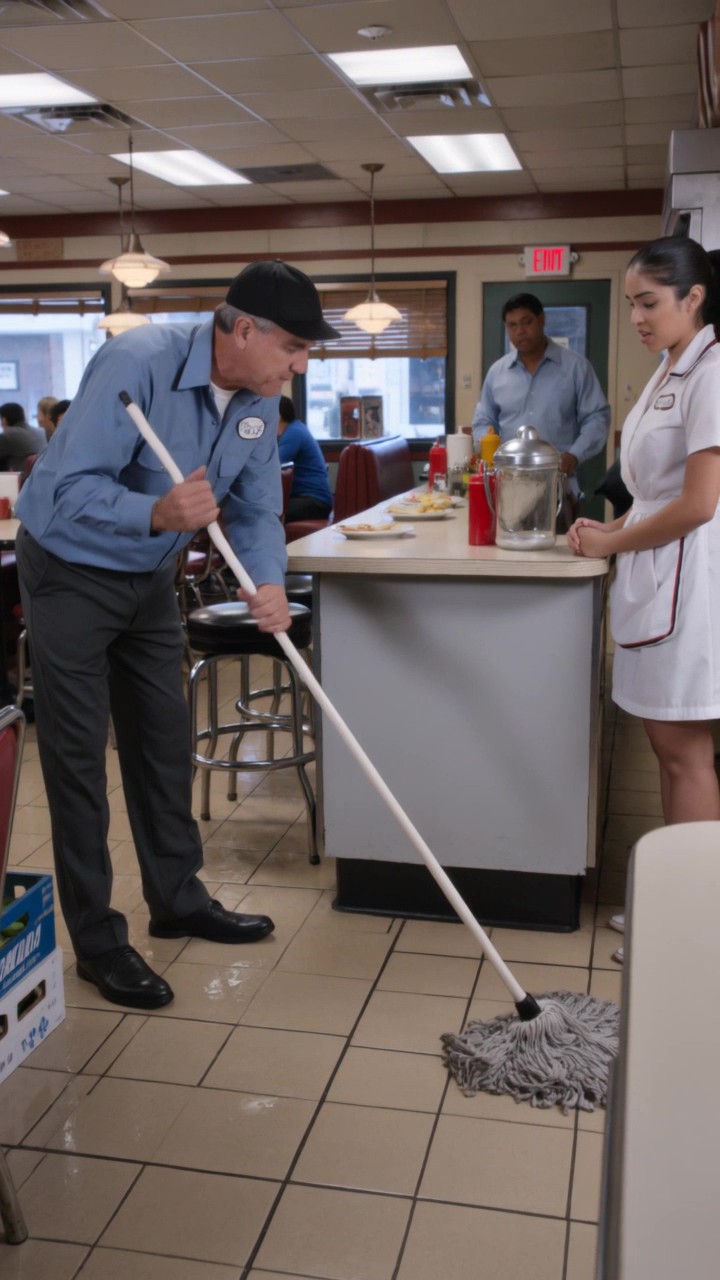
Samuel Bell was not a billionaire.
He was not secretly wandering the country for fun, waiting to humiliate rude managers.
He was a retired restaurant founder who still owned the original building and a minority stake in the diner chain carrying his family name.
That made the confrontation powerful.
It also made it more complicated than a simple disguise story.
Bell Family Diner began as one room in Westbridge in 1987.
Samuel and his wife, Elena, opened it after years of working in cafeterias and roadside diners. The first menu had soup, meatloaf, eggs, coffee, pie, and a handwritten promise near the register:
Feed people like you expect them to come back.
Elena drew the bell logo on a napkin during the first week.
It became the sign.
The diner survived because regular people returned.
Nurses after night shifts.
Bus drivers between routes.
Factory workers.
Families after church.
Samuel cooked, repaired booths, did payroll, and knew which customers needed extra time to pay.
He was not perfect.
The early diner relied on long family hours and informal systems that would not meet modern standards.
As the business grew, his children professionalized it.
Bell Family Diner became a regional chain through franchises. Corporate offices handled branding, supply contracts, payroll systems, and compliance.
Samuel retired after Elena died.
He kept ownership of the original Westbridge building and a small share of the parent company. He no longer managed daily operations.
The Westbridge location was franchised to Charles Whitmore three years before the incident.
Charles presented himself as an energetic operator who could “modernize a sentimental old unit.” He updated lighting, added delivery tablets, expanded hours, and improved sales at first.
Then complaints began.
Workers said tips were disappearing from pooled distributions.
Servers claimed they were penalized for customer complaints by losing access to tip-outs.
Kitchen staff reported off-clock prep.
Delivery vendors complained the back door was often chained during receiving hours because Charles did not want “street traffic” near the kitchen entrance.
Corporate received anonymous messages.
Charles denied wrongdoing.
He said older employees resisted change and used the Bell family name to avoid accountability.
Corporate sent warnings and requested records.
The records looked clean enough.
Tip pools were documented.
Payroll totals matched sales reports.
Employee turnover was high but not unusual for restaurants.
Samuel learned about the complaints from a former cook who still called him every Christmas. The cook said:
“They are using your sign to scare people into silence.”
Samuel contacted Leah Brooks, the chain’s compliance director.
Leah did not want him walking into the store emotionally.
She opened an internal review.
The challenge was evidence.
Workers feared retaliation.
Some were undocumented relatives of citizens and feared any official complaint.
Some needed schedules and could not risk losing shifts.
Tip theft is often hidden inside formulas, deductions, service charges, and vague penalties.
Leah asked Samuel not to interfere until investigators had enough records.
Samuel agreed.
Then Nina called the corporate hotline after Charles removed the tip jar and told servers they would “earn it back” when customer review scores improved.
Leah decided to conduct an on-site visit.
Samuel asked to come.
“Not as founder,” she said.
“As the landlord delivering produce.”
The original diner still purchased tomatoes and greens from a local farm cooperative Samuel supported. He sometimes helped with deliveries when short-staffed. Charles did not know his face because the founder’s portraits had been removed during renovation and replaced with modern brand images.
Samuel wore the rain jacket he used for errands.
He did not dress poorly as an act.
He looked like an old delivery driver because, that morning, he was one.
The back door was chained.
That was the first violation.
Food deliveries must use the proper receiving entrance for safety and sanitation, but chaining it closed during receiving hours forced vendors through the dining room or made them wait in weather.
When Samuel entered the front, Charles treated him as an inconvenience.
The mop was not the legal issue.
The tip jar was.
Nina’s reaction told Samuel more than Charles’s insult did. She looked afraid before she looked angry.
Charles had created a discipline system where tips could be withheld for vague failures: not smiling enough, customers complaining about wait time, failing to upsell dessert, refusing last-minute schedule changes. He called it “service accountability.”
Tips legally belonged to employees under applicable wage rules once customers left them for staff, subject to lawful tip-pooling arrangements. Management could not confiscate them as punishment.
Charles also used the tip jar symbolically. When he was unhappy with workers, he removed it from the counter and told customers staff were “training today.” Some customers still left cash on tables. Managers collected it and placed it in a locked office drawer for “redistribution.” Redistribution often never happened.
Leah’s folder contained more than employee statements.
It included point-of-sale records, cash-drawer notes, manager texts, and photos of tip jars removed during shifts. A former assistant manager provided copies of spreadsheets showing “tip penalties” by employee name.
The investigation did not rely on Samuel being insulted.
His presence exposed culture.
The documents proved wage violations.
When Samuel revealed the lease, Charles tried to shift tone immediately.
He called it a misunderstanding.
He said he respected the Bell legacy.
Samuel asked why the back door was chained.
Charles blamed security.
Leah asked why the tip jar was empty.
Charles blamed employee performance.
Nina finally spoke.
“He said tips are a privilege.”
Several workers nodded.
Charles said they were coordinating against him.
Leah paused service, contacted corporate counsel, and instructed a temporary manager waiting nearby to take control of the shift. Customers were offered meals at no charge if delays affected them. Workers remained paid.
Charles was not arrested in the dining room.
Employment and wage investigations rarely resolve with instant handcuffs.
He was removed from active management pending review.
Corporate terminated the franchise agreement after confirming repeated violations and retaliation.
The parent company assumed temporary operation of the Westbridge diner because the building lease allowed Samuel to reject a franchisee who breached labor and safety obligations.
Charles fought the termination.
He argued corporate used minor documentation errors to seize a profitable location.
The arbitration record showed more than minor errors.
Tip withholding.
Off-clock prep messages.
Back-door safety violations.
Retaliatory schedule reductions after hotline complaints.
And false records submitted to corporate.
Workers received back wages, tip restitution, and penalties through a settlement and state labor review.
The amounts varied.
Nina received enough to pay overdue rent and fix her car.
Not enough to erase years of instability.
Several employees left anyway.
A workplace can be corrected too late for the people it hurt.
Samuel faced criticism too.
Some workers asked why corporate had waited so long.
Nina said:
“You needed the founder to be insulted before you believed us?”
Samuel answered honestly:
“No. I believed too late because the records looked cleaner than your fear sounded.”
That was not enough, but it was better than pretending the system worked quickly.
Leah changed the hotline and audit process.
Tip complaints triggered immediate preservation of point-of-sale data, cash-drawer notes, and schedule changes.
Anonymous worker interviews were conducted away from the restaurant.
Franchisees could not control which staff spoke to auditors.
Tip-jar removal was banned unless replaced by an approved digital distribution method visible to staff.
Managers could not use customer review scores to reduce tips already given.
Back doors could not be chained during receiving hours.
And compliance visits included one low-status entry point: delivery, dish area, host stand, or closing shift—not only meetings with managers.
Samuel reopened the diner under corporate operation for six months.
He did not return as daily owner.
He was too old for that and knew nostalgia was not a management plan.
A new franchisee was selected only after employee interviews and compliance review.
Nina joined the worker committee that met monthly with management.
She did not become general manager overnight.
She did not want that job.
She wanted tips distributed correctly, schedules posted on time, and no one mocked for asking.
The founder’s wall was restored, but Samuel refused a large portrait.
Instead, the diner hung Elena’s original napkin drawing beside a new statement:
THE BELL MEANS NOTHING IF THE PEOPLE SERVING UNDER IT ARE NOT PAID WHAT CUSTOMERS GAVE THEM.
Some customers complained that politics had entered breakfast.
Samuel answered one of them personally.
“Wages were always in the kitchen. You only noticed when they reached the wall.”
The customer did not return for a month.
Then came back for pie.
Charles opened a different restaurant across town and claimed he had been pushed out by corporate politics. Former employees watched the announcement with mixed feelings. Some were angry. Some ignored it. Nina said:
“Let the next workers know how to check their tips.”
That became the practical lesson.
The Westbridge diner kept paper and digital tip summaries posted where employees could review them. Staff signed off after distribution but could dispute amounts without losing shifts. New hires received training on wage rights from an outside nonprofit, not from the manager alone.
Samuel still delivered produce occasionally.
When he did, he used the back door.
It was no longer chained.
One rainy afternoon, a young vendor tracked mud through the dining room by mistake. A new shift lead grabbed a mop and said:
“I’ll get it.”
The vendor apologized.
The shift lead shrugged.
“You brought the tomatoes. We clean the floor we charge people to eat on.”
Nina heard it from the coffee station and smiled.
The old confrontation became a story employees told new staff, but Samuel corrected one detail whenever he heard it.
“They say I went undercover,” he told them. “I went through the wrong door and saw how people were treated when nobody important was expected.”
That was the point of the disguise.
Not that powerful people should pretend to be poor for one afternoon.
That systems reveal themselves in the way they treat the person they believe cannot hurt them.







Leave a Reply