
Juniper did not expose a criminal conspiracy.
She exposed a care failure hidden under ceremony language.
The horse had worked at Meadow Bridge Therapy Center for eleven years. Children with mobility challenges, anxiety, grief, and developmental needs rode her under trained supervision. Juniper was calm, slow, and patient. She tolerated uneven balance, sudden tears, and small hands gripping too tightly.
That did not mean she was equipment.
By twenty-two, Juniper needed fewer sessions, a careful diet, joint support, and medication for recurring stomach irritation. The veterinarian recommended retirement from regular riding. The center began seeking a long-term placement.
Charles Whitmore offered his private farm. He had donated to Meadow Bridge for years and funded part of the indoor arena roof. His farm had space and staff. On paper, it was not a bad option.
The problem was timing and image.
The center had lost two grants that year. Preston Hale, the barn director, needed donors reassured that the program remained successful. A public retirement ceremony with Charles promised photographs, press, and future funding. Juniper had recently become restless and stopped finishing grain. Elena reported the change repeatedly.
Elena’s job title was stable cleaner.
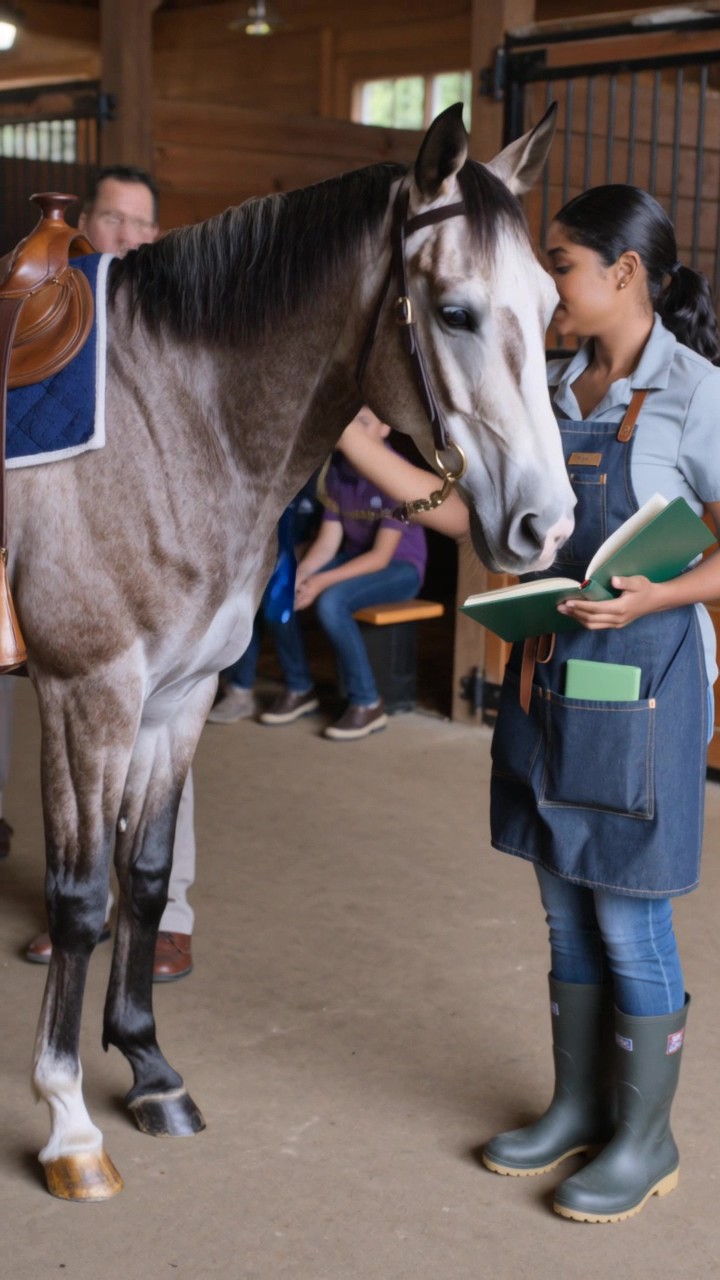
Her tasks included mucking stalls, sweeping aisles, filling water buckets, washing saddle pads, and cleaning the therapy helmets children used. Because she worked evenings, she also saw what many administrators did not: who finished feed, who paced after lights-out, who drank less water, which horses lay down normally, and which ones avoided grain.
Elena had no veterinary license.
She did not diagnose.
She recorded.
Her green notebook began as a personal memory aid after a feed chart was misplaced. She wrote what she saw and alerted supervisors when patterns changed. For Juniper, the notebook mattered because the horse’s discomfort often appeared first as small changes: half a bucket of hay left, less interest in grain, teeth grinding, pinned ears when girth pressure was applied.
The veterinarian had prescribed an evening medication schedule. Elena administered it under written instructions after staff training. Two weeks before the retirement ceremony, Preston told her to stop giving the medicine unless he was present because “donor transfer paperwork needs clean medication logs.” He wanted the horse to appear stable and uncomplicated for the transfer.
Elena objected.
Preston said the medication was not being stopped permanently; it was being “reviewed.” He told the veterinarian Juniper’s appetite had improved. He told Elena to keep concerns internal and avoid upsetting donors.
Juniper’s appetite worsened.
On the ceremony morning, Elena found most of the grain untouched and called Preston again. He told her to sweep the aisle, not attend the event.
When Juniper refused the gold lead rope, people first treated it as funny. Horses sometimes stop for ordinary reasons. But Juniper did not simply refuse movement. She walked to Elena, pressed the apron pocket where the notebook always sat, and dropped the ribbon near her boots.
The animal’s behavior did not serve as medical proof.
It created a pause.
The veterinarian, Dr. Leah Brooks, read the notebook and compared it to the official feed and medication charts. The official charts had gaps. The notebook listed repeated refusals and held medication. Dr. Brooks examined Juniper immediately and postponed any transfer. The horse needed treatment, rest, and reassessment.
Preston tried to frame Elena as emotional.
“She bonded with the horse and resisted retirement,” he said.
Elena did love Juniper. That was not the problem. The problem was that her observations matched the horse’s condition and the missing medical entries.
The center’s board opened a review. It found that Preston had not intended to harm Juniper, but he had prioritized ceremony, donor comfort, and clean paperwork over timely veterinary communication. He did not falsify all records, but he omitted important changes and discouraged a lower-status worker from reporting what she saw.
That was enough.
Preston lost animal-care authority and later resigned. Meadow Bridge created a rule that care observations from cleaners, feeders, volunteers, and riders had to enter the official health log if repeated twice. A supervisor could add context, but not erase the report. Medication changes required veterinarian approval, not donor-timing convenience.
Charles’s role was more complex.
He had not known medication was held. He had accepted a ceremony built around his generosity. At first, he felt humiliated and suggested Elena had staged the notebook reveal. Dr. Brooks corrected him.
“A horse cannot read your press schedule,” she said.
Charles withdrew his immediate transfer offer and funded a neutral retirement assessment instead. The final recommendation placed Juniper not at his private farm but at a smaller sanctuary where her diet, medication, and quiet routine could be maintained by a team experienced with older therapy horses.
Elena did not receive Juniper as a personal pet. She could not afford full care, and her apartment did not allow large animals. She became part of the visiting care circle, with paid hours to assist Juniper’s transition during the first month. The sanctuary later hired her part-time for evening feeding because her records were careful.
The children who attended the ceremony were confused. One boy asked if Juniper hated Mr. Whitmore. Elena answered:
“No. She was uncomfortable, and she went to the person who noticed.”
That explanation became the center’s new teaching story. Animals do not owe humans polite behavior that supports a ceremony. A refusal can be information.
Meadow Bridge also revised donor events. No animal transfer, retirement, or adoption ceremony could proceed without same-week veterinary clearance, current feed records, and direct input from the people performing daily care. Donor speeches no longer happened in the barn aisle while the animal stood under lights.
Juniper recovered over several weeks. She never returned to therapy riding. Children visited her at the sanctuary in small groups. She accepted carrots, leaned into brushing, and occasionally ignored everyone with the dignity of an old horse who had earned the right.
Elena kept using the green notebook, but the sanctuary gave her official charts too.
One evening, Charles visited quietly. No cameras. He brought no ribbon.
“I thought writing checks meant I was helping,” he told Elena.
“You were,” she said. “But checks do not notice unfinished hay.”
He nodded.
Juniper, uninterested in moral lessons, pushed his jacket pocket for peppermints.
The story people first wanted was simple: generous donor retires beloved therapy horse.
The true story was better.
A beloved animal was protected because the person cleaning stalls wrote down small facts even when the people with microphones did not want to hear them.






Leave a Reply