
Marcus Reed did not feed six hundred households by himself.
That was the sentence he repeated every time someone tried to turn the correction into a new hero story.
The flood response succeeded because drivers drove, volunteers loaded, churches opened parking lots, county road crews updated closures, clients answered phones, and food-bank staff kept working after sleeping on office floors.
But the crate-routing method came from Marcus.
The county food bank served families across three towns and several rural routes. Every Thursday, it delivered boxes to older adults, disabled clients, families without cars, and community pickup points. The route software normally handled addresses, driver assignments, dietary notes, and delivery order.
During the spring flood, water rose faster than forecasts predicted.
At midnight, the warehouse still had power but the dispatch system stopped syncing with county road updates. The software showed routes as if both river bridges remained open. In reality, one was already underwater and another was about to close.
Marcus worked overnight moving pallets, checking cooler temperatures, and staging morning delivery lanes. His official title was forklift driver. He was not a route manager.
He knew the routes anyway.
For six years, he had watched drivers load by town, church lot, senior building, and back-road cluster. He knew which boxes went to the dialysis apartment building, which senior tower needed low-salt packs, which rural road washed out first, and which volunteer always took the long hill road because her van handled it better.
At 1:30 a.m., the warehouse floor drain backed up.
Water entered near Dock 3.
Marcus moved dry goods away from the low side and stacked milk crates on folding tables. The milk crates were usually used for produce overflow. They had handles, open sides, and could be carried quickly if pallets became too heavy to move through water.
At 1:47, the software map went blank.
The screen still held client lists, but no live routing.
Marcus called the on-call operations line.
No answer.
He called the assistant supervisor.
Voicemail.
He called county road information and wrote closures on a paper wall map.
Then he began tagging crates.
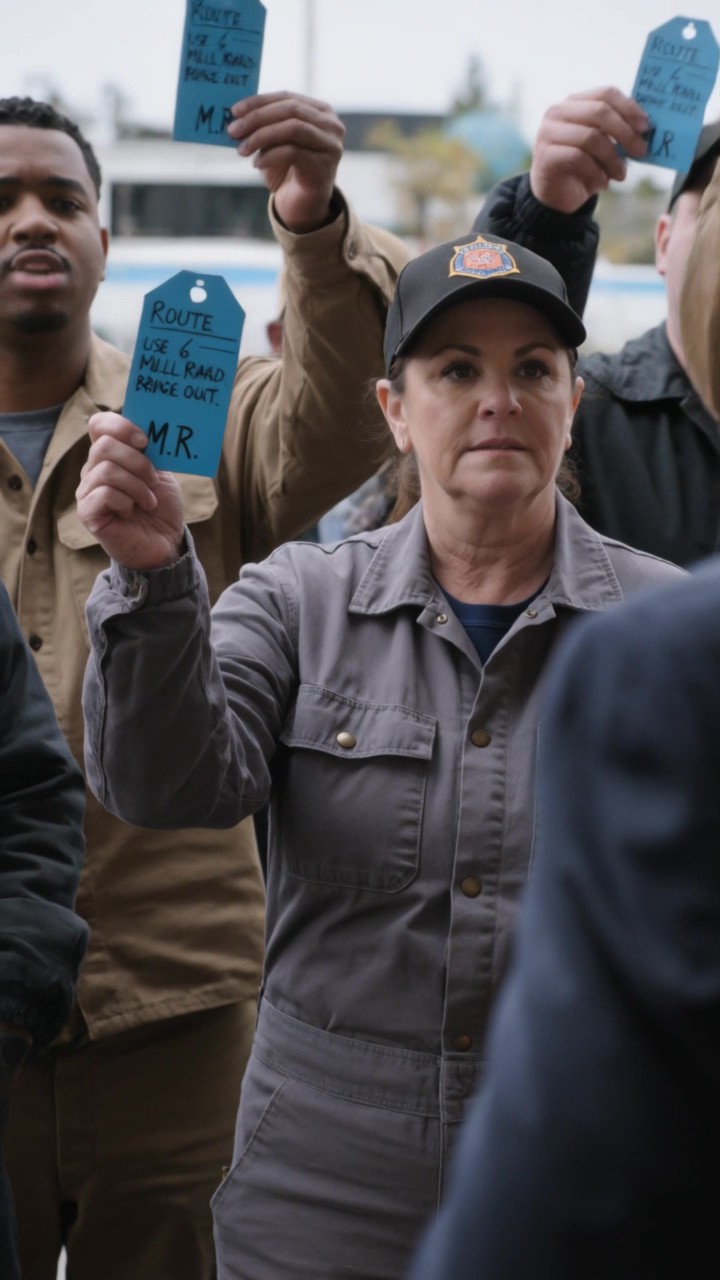
ROUTE 6 — USE MILL ROAD. BRIDGE OUT.
SENIOR TOWER FIRST — ELEVATOR OUT BY 10.
CHURCH LOT B — MOVE TO HIGH SCHOOL GYM.
LOW-SALT BOXES — VAN 3.
He used blue marker because it was thick enough to read in bad light.
He signed M.R. at the bottom of each tag because the food bank required initials for any manual route change.
That policy existed to prevent confusion.
It later became evidence.
Marcus did not invent emergency logistics. He improvised within what he knew. Some tags were revised when new road closures came in. Two crates were staged wrong and corrected before loading. The method was messy but functional.
At 3:20 a.m., Marcus reached three drivers directly. He told them not to use River Bridge. One driver had planned that crossing because the software still showed it open. Twenty minutes later, the bridge closed.
At 4:15, volunteers began arriving early because they had seen flooding near their homes. Marcus handed them crate groups and told them to wait for driver confirmation. He did not let eager volunteers load random vehicles.
At 5:38, he reached Charles Whitmore, the food-bank director.
Charles arrived at 6:25 with the communications manager and county liaison. By then, the crates were grouped, the first revised driver list existed, and the wall map was covered in tape. Charles authorized fuel cards, called partner churches, and secured the high school gym as a substitute pickup point. Those actions mattered.
Then the public story changed.
The morning deliveries succeeded. Some boxes arrived late. A few households required next-day follow-up because driveways remained flooded. But the food bank avoided a total route collapse.
Local news praised the organization. Charles gave interviews from the loading dock. He said “we redesigned the delivery system overnight.” At first, Marcus did not object. “We” included everyone.
But internal emails began saying:
Under Charles Whitmore’s direction, leadership created a crate-routing model now used countywide.
A grant application described “executive-led rapid redesign.” A conference invited Charles to discuss his “manual crate-routing innovation.” Marcus’s name appeared only in a staff list.
The workers noticed.
Drivers knew who had called them before dawn.
Volunteers remembered Marcus standing in water with blue marker on his hands.
A church coordinator had received a photo of a milk-crate tag from Marcus’s phone before Charles arrived.
When the county announced a flood-response award, several employees asked that the dock team be named. The food bank’s communications office said the award recognized organizational leadership and that naming every contributor was impossible.
Nobody asked to name every contributor.
They asked not to erase the person who created the method being praised.
At the ceremony, Charles used the same sentence again:
“When the roads disappeared, our leadership redesigned delivery in one night.”
The milk crates onstage were intended as props.
They became witnesses.
The tags had not been recreated. They were originals gathered from returned crates. One still showed mud on the corner. The reporter’s question about M.R. forced Charles to choose between truth and spin.
He chose spin first.
“Manual routing.”
That answer collapsed as soon as drivers lifted their tags.
The warehouse supervisor, Leah Brooks, brought the night security log because she had already warned Charles the program language was inaccurate. The log showed times, calls, and Marcus’s handwritten manual-route board before Charles’s building access entry.
The food bank board paused the ceremony.
An independent review followed.
It found that Charles had not stolen credit for every action. He had authorized external partnerships, communicated with county officials, and coordinated public resources after arrival. But he had repeatedly described the crate-routing system as executive-created despite knowing Marcus began it before command staff arrived.
The board required a public correction.
The county award was reissued to the Flood Route Team, naming Marcus Reed, the overnight warehouse staff, volunteer drivers, partner churches, county road liaison, and Charles for executive coordination.
Marcus accepted only after the plaque included roles, not hierarchy.
It read:
FOR KEEPING FOOD MOVING WHEN DIGITAL ROUTES FAILED.
Manual crate-routing initiated overnight by warehouse staff and completed by drivers, volunteers, partners, and leadership.
Charles remained director but lost sole approval over emergency communications. Future public statements required timeline review from frontline leads before awards, grant applications, or media interviews. Staff who originated emergency procedures had to be named in internal records, even if a broader team received public recognition.
The food bank also improved the method itself.
Milk crates were not ideal for every delivery.
Some boxes needed cooler control.
Some clients required privacy.
Some route tags exposed too much address information.
A formal backup system was developed:
Numbered route crates.
Weatherproof tags.
Limited client identifiers.
Paper maps updated hourly.
A two-person verification table.
Driver call logs.
And a rule that no manual route moved unless both warehouse and driver confirmed the change.
Marcus helped build the system, but he was not left as the only person who knew it. He trained three warehouse workers and two dispatch volunteers. The food bank paid him for training hours and changed his title to warehouse routing coordinator, with a raise.
He kept forklift shifts too.
“I still like moving pallets,” he said.
The drivers joked that Marcus trusted a pallet more than a microphone.
He did.
The correction did not make all staff happy. Some believed Charles should resign. Others feared donor confidence would drop if leadership conflict became public. Clients cared less about title disputes than whether food arrived.
That became Marcus’s line in the board meeting:
“If truth about how the boxes moved makes donors stop giving, then we were raising money on a story too weak to carry groceries.”
Donors did not stop.
One major donor asked for clearer emergency planning. Another funded backup radios.
Charles apologized to Marcus privately first. Marcus asked for a public version because the credit had been taken publicly.
The public apology said:
“I allowed language that made an overnight warehouse solution sound like an executive invention. That was wrong. Marcus Reed initiated the manual crate-routing method before I arrived, and the team completed it.”
Marcus did not hug him.
He nodded once.
That was enough for the meeting.
Months later, another storm hit. The software worked, but the food bank practiced the paper system anyway. Marcus was off that night. A younger warehouse worker named Denise led the route board. She corrected a mislabeled senior route before dispatch loaded it.
The system worked without Marcus present.
That was the proof he wanted.
At the next annual report, the flood story appeared with a photograph of the original blue tag:
ROUTE 6 — USE MILL ROAD. BRIDGE OUT. M.R.
Under it, the caption read:
The first tag was written by night warehouse worker Marcus Reed. The deliveries were completed by many hands.
Marcus approved that sentence.
It finally held both truths.
He was not the only rescuer.
He was the one whose name had almost been washed off the crate.







Leave a Reply