
Maria Alvarez did not win Daniel’s custody hearing by walking dramatically into a courtroom.
The hearing did not end in one gasp.
Family court rarely works that way.
But the blue cooler changed what everyone in the room had been prepared to believe.
Daniel Brooks loved his daughter Mia. That was not the question. The question was whether he could provide stable care after the death of Mia’s mother, Rachel, and after several months of missed appointments, late school pickups, and incomplete paperwork.
Daniel worked nights loading medical supplies at a warehouse. The job paid more than day shifts and kept health insurance active, but it created a childcare problem. When Rachel was alive, she handled mornings. After she died, Daniel tried to move to days, but the warehouse had no open positions.
Maria, his mother’s younger sister, stepped in.
She lived in a rented room behind a laundromat and cleaned offices in the afternoons. Every weekday morning, she reached Daniel’s apartment at 5:20 a.m., made oatmeal or eggs, checked Mia’s backpack, walked her to school, and documented medications when Mia’s asthma flared.
Maria did not call it documentation.
She called it “not forgetting.”
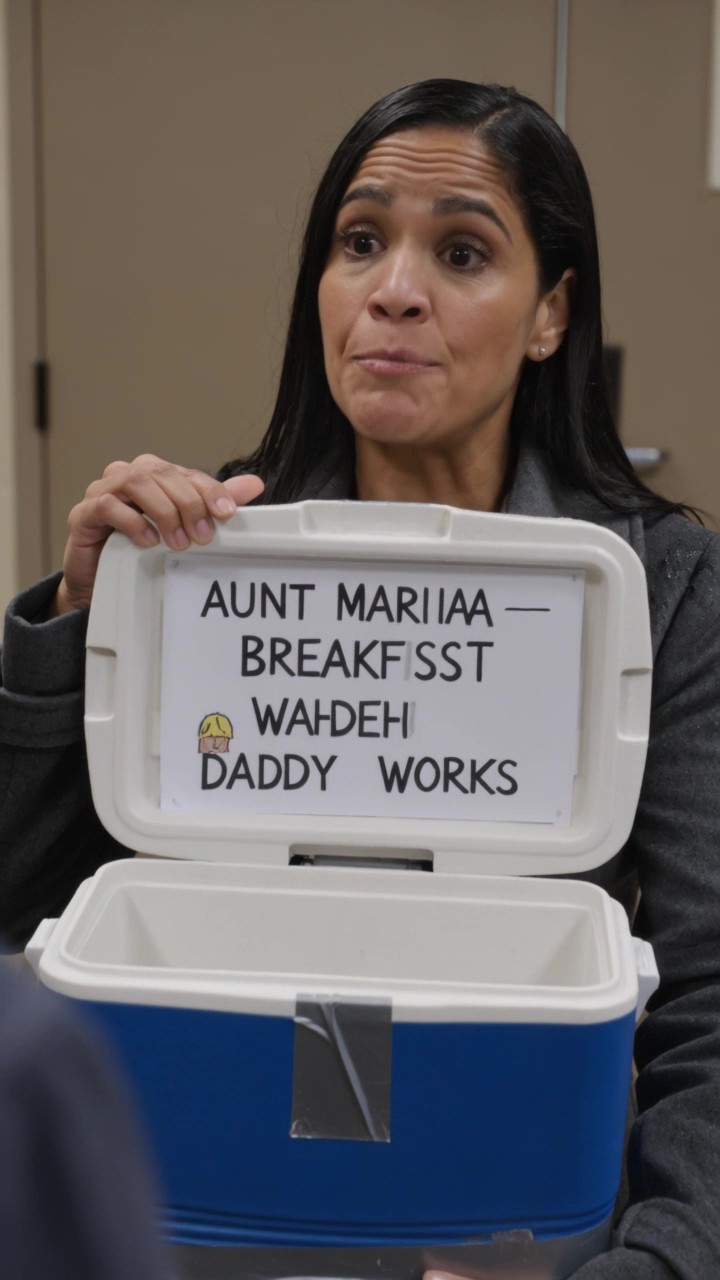
She kept everything in the blue cooler because Daniel’s apartment had suffered a pipe leak months earlier and paper stored under the sink was ruined. The cooler sealed tightly enough to protect drawings, pharmacy instructions, school notes, and emergency contact copies. It looked ridiculous in a courtroom. It had also protected the only complete record of who cared for Mia when Daniel worked.
Celeste entered Daniel’s life six months after Rachel died. She was organized, well-dressed, and sincerely wanted stability for him. She also believed Daniel’s family looked like the reason the court doubted him.
Maria’s old coat.
The taped cooler.
The way she carried grocery bags from discount stores.
The way she spoke plainly instead of using family-court phrases.
Celeste told Daniel that hearings were about presentation. She was not entirely wrong. Courts are supposed to judge facts, but appearances still shape first impressions.
The problem began when presentation became erasure.
Celeste prepared calendars showing a proposed future schedule: daycare, her own flexible work, Daniel’s night shift, and weekend parenting classes. The plan looked clean. It did not show how Mia had survived the last year.
Maria’s cooler did.
The charter bus was arranged by a church volunteer because several relatives and supporters were attending the hearing. At boarding, the driver said luggage needed to fit beneath the bus. Maria’s cooler did not fit easily because the handle was taped and the lid caught on the compartment edge. Celeste became embarrassed as other passengers waited in the rain.
She said:
“If we walk into court with that, the judge will think we live out of containers.”
Maria answered:
“I am not opening it for looks.”
Daniel stood between them, tired and ashamed. He wanted Celeste’s plan. He wanted Maria’s help. He did not want the court to see how messy the year had been.
When the driver warned that they would miss the highway window, Celeste told him to close the compartment.
Daniel hesitated.
That hesitation became the choice.
The bus left Maria at the terminal.
At court, Daniel realized the problem only when the caseworker asked for evidence of caregiving support. Celeste’s future calendars were not enough. The court needed to know whether the person covering mornings was reliable, whether Mia had medication oversight, and whether school attendance had improved when Maria became involved.
Daniel could describe it.
The caseworker could not verify it quickly.
The judge asked where Maria was because her name appeared in school contact notes.
Daniel said she missed the bus.
He did not say they left her.
Maria’s arrival happened because Samuel Ortiz, the terminal janitor, knew the county shuttle schedule. He heard Maria calling relatives who did not answer. He was not allowed to abandon his job and drive her personally. He did something more realistic. He called the courthouse clerk, confirmed the hearing floor, helped Maria reach a public shuttle, and asked his supervisor to let him use his meal break to carry the cooler through security because the handle had broken completely.
That help did not make Samuel the savior of the custody case. It kept the evidence from sitting under a bus terminal bench.
Inside the cooler, the court found:
School sign-in sheets showing Maria dropped Mia off consistently.
Pharmacy instruction copies with dated check marks.
Breakfast notes Mia had drawn on napkins.
A log of asthma symptoms Maria shared with Daniel’s clinic.
Text messages printed from Daniel confirming Maria’s morning schedule.
A signed letter from Mia’s teacher describing improved attendance after Maria began helping.
And the drawing that made everyone stop looking at the cooler as clutter.
AUNT MARIA — BREAKFAST WHEN DADDY WORKS.
The judge did not award permanent custody on the spot. Daniel already had legal custody as Mia’s surviving parent. The hearing concerned supervision, support plans, and whether temporary court monitoring should continue.
The cooler showed Daniel was not alone and that Mia’s daily care had been steadier than the incomplete paperwork suggested.
It also showed Daniel had nearly hidden the person making that steadiness possible.
The judge ordered a revised support plan naming Maria as an approved caregiver, not an informal relative who appeared only when convenient. The court required Daniel to complete parenting classes, update school and medical records, and attend follow-up review. Celeste could remain involved, but she could not replace Maria’s documented caregiving with a prettier calendar.
After the hearing, Daniel apologized in the courthouse hallway.
“I froze,” he said.
Maria answered:
“No. You chose silence because it cost you less than choosing me in front of her.”
That sentence hurt because it was exact.
Celeste apologized too, but her first version failed.
“I only wanted us to look stable.”
Maria looked at the blue cooler.
“Stable is a child knowing who brings breakfast.”
Celeste eventually learned to work with Maria rather than around her. She helped Daniel organize copies into a binder, but the original drawing remained in the cooler because Mia liked knowing it was there.
The court review three months later went better. Daniel had moved to a split shift. Maria still handled two mornings a week. Celeste handled paperwork. Mia’s attendance remained steady. No one pretended grief was finished or that the family was suddenly perfect.
Samuel received a thank-you card from Mia with a bus drawn on the front. The terminal supervisor allowed it on the employee bulletin board after removing the child’s last name.
Maria kept the blue cooler for emergencies.
At family events, Celeste once suggested replacing it with a leather document case.
Maria refused.
“The case would look better,” she said. “The cooler already proved itself.”
The person left behind at the bus station was not extra baggage.
She was the missing record of care.





Leave a Reply